
Preparing Youth to Thrive in the Age of Artificial Intelligence
The rapidly changing global landscape, shaped by artificial intelligence (AI), digital transformation, climate challenges, and evolving labour markets, demands a renewed understanding of youth skills development. This article explores the competencies young people need to thrive in the twenty-first century, emphasizing the importance of AI literacy, digital competence, critical thinking, creativity, communication, adaptability, entrepreneurship, sustainability awareness, and ethical responsibility. World Youth Skills Day highlights the urgent need to bridge the gap between education and employment by promoting lifelong learning and inclusive skill development. The article argues that future-ready youth require not only technical abilities but also human-centred capabilities that enable them to innovate, collaborate, and contribute responsibly to a rapidly transforming world.
Introduction
Every generation enters adulthood in a world different from the one its parents inherited. For today’s youth, however, the scale and speed of change are exceptional. Artificial intelligence (AI), automation, climate change, geopolitical uncertainty, digital communication, and rapidly evolving labour markets are transforming how people learn, work, communicate, and participate in society. In this environment, education can no longer be understood merely as the acquisition of a degree or a fixed body of knowledge. Young people need a broad and continuously evolving portfolio of skills that enables them to adapt, create, collaborate, and act responsibly.
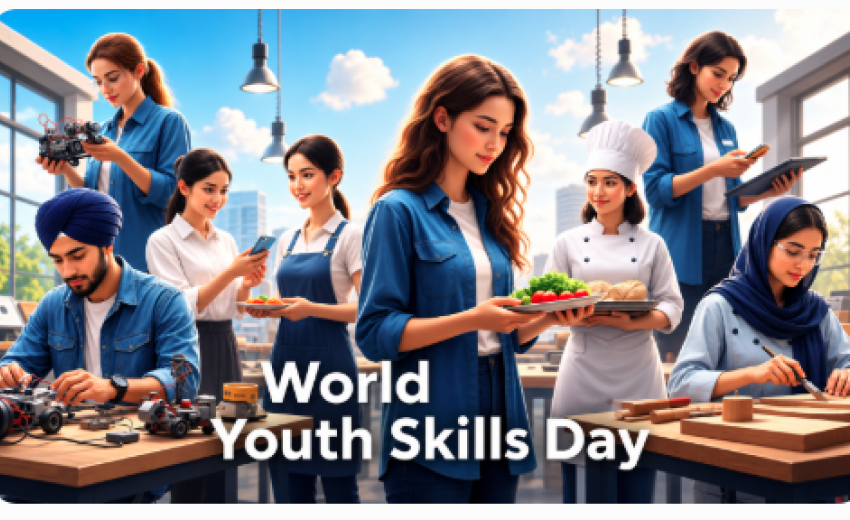
World Youth Skills Day, observed annually on 15 July, draws global attention to the importance of equipping young people with skills for employment, decent work, entrepreneurship, and active citizenship. The observance is particularly significant in the age of artificial intelligence. AI can increase productivity and expand access to knowledge, but it can also automate tasks, transform occupations, spread misinformation, and deepen inequalities. The central challenge, therefore, is not simply to prepare young people to compete with machines. It is to help them develop distinctly human capabilities while learning to use powerful technologies wisely. The future will belong not merely to those who possess information, but to those who can interpret it, question it, apply it, and use it for the common good.
From Qualifications to Capabilities
For much of the twentieth century, education followed a relatively predictable model: acquire a qualification, enter a profession, and apply the knowledge gained during formal education throughout one's working life. That model is increasingly inadequate. Technologies, occupations, and professional requirements now change so rapidly that skills can become outdated within a few years.
This does not mean that degrees and professional qualifications have lost their value. Rather, qualifications must be accompanied by capabilities. A certificate indicates what a person has studied; capability demonstrates what a person can actually do. Young people, therefore, need to become lifelong learners. They must develop the ability to acquire new knowledge independently, update existing skills, and move across disciplinary boundaries. The capacity to learn, unlearn, and relearn may become one of the defining competencies of the twenty-first century.
Educational institutions must respond accordingly. Memorization remains useful, but it cannot be the principal measure of learning in an age when information is instantly accessible. Greater emphasis is needed on inquiry, experimentation, problem-solving, interdisciplinary learning, and the practical application of knowledge. The fundamental question facing education is changing from “What does the student know?” to “What can the student understand, create, solve, and contribute?”
AI Literacy: Learning to Work with Intelligent Machines
Artificial intelligence is rapidly becoming a general-purpose technology. Young people will encounter AI not only in technology-related careers but also in medicine, education, agriculture, engineering, journalism, business, law, science, and the creative industries. AI literacy must therefore become a basic educational competency. This does not mean that every young person must become a programmer or machine-learning engineer. It means understanding what AI can and cannot do, how to use it effectively, and how to evaluate its outputs critically.
Young people should know that AI systems can generate convincing but inaccurate information. They should understand the importance of checking sources, protecting personal information, recognizing bias, and maintaining human responsibility for important decisions. Effective use of AI requires judgment rather than passive dependence. The most productive relationship between humans and AI is likely to be collaborative. AI can assist with research, analysis, translation, brainstorming, and routine tasks. Human beings remain essential for defining meaningful goals, understanding context, exercising ethical judgment, and taking responsibility. The educational objective should therefore be neither fear of AI nor unquestioning enthusiasm for it. Young people need the confidence to use AI and the wisdom to question it.
Digital and Information Literacy
Digital literacy extends far beyond knowing how to operate a smartphone or use social media. A digitally skilled person must be able to locate reliable information, evaluate sources, manage data, communicate appropriately, protect privacy, and understand the risks of digital environments. This is increasingly important in an era of misinformation, manipulated media, algorithmic influence, and information overload. Access to more information does not automatically produce greater knowledge. Without critical judgment, an abundance of information can create confusion rather than understanding. Young people must learn to ask basic but powerful questions: Who created this information? What evidence supports it? What interests may be involved? Can the claim be independently verified?
Cybersecurity awareness is equally important. Safe password practices, protection from scams, responsible data sharing, and understanding digital footprints are now basic life skills. Digital citizenship also involves ethical conduct. The apparent distance created by screens should not eliminate responsibility for one's words and actions. Respectful communication, awareness of online harm, and responsible participation in digital communities are essential components of contemporary citizenship.
Critical Thinking and Problem-Solving
As machines become better at generating answers, the human ability to ask good questions becomes increasingly valuable. Critical thinking enables young people to distinguish evidence from assertion, identify assumptions, recognize manipulation, and consider alternative perspectives. These abilities are essential not only in employment but also in democratic life and personal decision-making.
Problem-solving requires more than applying a memorized formula. Many contemporary challenges, such as climate change, social inequality, public health, technological disruption, and sustainable development, are complex and interconnected. They rarely have simple solutions. Young people must therefore learn to approach problems systematically: understand the issue, gather evidence, identify constraints, generate alternatives, test solutions, learn from failure, and revise their approach. Schools and universities can cultivate these abilities through project-based learning, research, debate, case studies, experimentation, and engagement with real-world problems. Assessment systems should reward reasoning and originality rather than merely reproducing expected answers.
Creativity and Innovation
In an age of automation, creativity becomes more, not less, important. Machines can generate content and identify patterns, but meaningful innovation often begins with human curiosity, imagination, and the ability to connect ideas from different fields. Creativity should not be restricted to the arts. Scientists, engineers, entrepreneurs, teachers, and community leaders all require creative thinking. It allows people to imagine alternatives, redesign systems, and develop new responses to emerging problems.
Young people should therefore be encouraged to experiment and to view failure as part of learning. Educational cultures that punish every mistake may produce cautious students rather than innovative thinkers. Innovation also requires ethical direction. The ability to create something does not necessarily mean that it should be created or deployed without reflection. Young innovators must ask not only “Can this be done?” but also “Who benefits, who may be harmed, and what consequences could follow?”
Communication, Collaboration, and Human Skills
The future of work will remain deeply human. Even in technologically advanced workplaces, people must explain ideas, negotiate differences, build trust, lead teams, and cooperate across cultures and disciplines. Communication involves more than speaking confidently. It includes listening carefully, writing clearly, presenting complex ideas understandably, and adapting communication to different audiences.
Collaboration is equally important. Many major problems cannot be solved by individuals working alone. Young people need experience in teamwork, shared responsibility, constructive disagreement, and conflict resolution. Empathy is also a practical competency. Understanding others' perspectives and needs improves leadership, education, healthcare, design, public service, and community life. As artificial intelligence becomes increasingly capable of producing technically competent outputs, qualities such as trustworthiness, compassion, judgment, and the ability to build meaningful relationships may become even more valuable.
Adaptability, Resilience, and Lifelong Learning
Young people entering the workforce today may change jobs, industries, and even careers several times. Some occupations will disappear, others will be transformed, and entirely new professions will emerge. Adaptability is therefore essential. It involves responding constructively to change without abandoning one's principles or sense of purpose.
Resilience is equally important, but it should not be mistaken for simply enduring every difficulty in silence. Healthy resilience includes learning from setbacks, seeking support when needed, adjusting strategies, and continuing with greater understanding.
Lifelong learning must become a normal part of adult life. Short courses, vocational training, professional development, online learning, apprenticeships, and self-directed study will increasingly complement traditional education. The future-ready individual is not someone who has finished learning. It is someone who knows how to continue learning.
Green Skills for a Sustainable Future
Climate change and environmental degradation are transforming economies and creating new skill requirements. Renewable energy, sustainable agriculture, green construction, circular economies, environmental monitoring, and climate-resilient infrastructure will require millions of skilled workers. Yet green skills are not limited to environmental professions. Every sector will increasingly need people who understand sustainability and can consider the environmental consequences of decisions.
Young people should develop ecological literacy: the ability to understand the interconnectedness of human society, economic activity, and natural systems. Sustainability should become a dimension of engineering, business, technology, public policy, and everyday decision-making. The green transition should also be viewed as an opportunity. With appropriate education and investment, young people can become innovators and entrepreneurs who create solutions to environmental challenges while generating meaningful employment.
Entrepreneurship and Financial Literacy
Not every young person will find an opportunity through traditional employment. Many will create their own opportunities through entrepreneurship, freelancing, social enterprise, and digital platforms. Entrepreneurial skill is fundamentally the ability to recognize a need and organize resources to address it. It involves initiative, creativity, planning, communication, risk assessment, and persistence.
Financial literacy is equally essential. Young people should understand budgeting, saving, credit, debt, investment, taxation, and the basic principles of financial decision-making. These are practical life skills that affect personal independence and long-term security. Entrepreneurship education should also emphasize responsibility. A successful enterprise should not be measured solely by profit but by the value it creates for customers, workers, communities, and society.
Ethical and Civic Competence
Perhaps the most overlooked future skill is ethical judgment. Technology gives individuals and institutions extraordinary power. AI, biotechnology, surveillance systems, social media, and data analytics can improve lives, but they can also be misused. Technical competence without ethical responsibility can produce efficient systems that are nevertheless harmful or unjust. Young people need opportunities to discuss difficult questions about fairness, privacy, human dignity, responsibility, sustainability, and the social consequences of innovation.
Civic competence is equally important. Education should prepare young people not merely to become employees but also to become informed and responsible citizens. They should understand their rights and responsibilities, participate constructively in society, and engage respectfully with people who hold different views. A society that produces highly skilled workers but neglects ethical and civic development may become technologically advanced without becoming genuinely wise.
A Shared Responsibility
Preparing young people for the future cannot be the responsibility of schools alone. Governments must create inclusive education and training systems. Universities and vocational institutions must update curricula more rapidly. Employers should invest in apprenticeships, mentoring, and continuous training. Technology companies must contribute to responsible digital and AI literacy. Families and communities also play an essential role in cultivating curiosity, responsibility, and confidence.
Young people themselves must be active participants rather than passive recipients of education. They should be involved in designing programmes intended for them and encouraged to identify the challenges they wish to solve. Access must remain central. The benefits of technological transformation cannot be limited to young people who already possess economic and educational advantages. Rural youth, marginalized communities, young women, persons with disabilities, migrants, and economically disadvantaged learners must have meaningful access to skills development. A shared future requires shared opportunity.
Conclusion
World Youth Skills Day reminds us that the future is not simply something that happens to young people. Young people will help create it. The skills required in the age of AI extend far beyond technical proficiency. Youth need AI and digital literacy, critical thinking, creativity, communication, collaboration, adaptability, green skills, entrepreneurship, financial literacy, and ethical judgment. Above all, they need the capacity to continue learning throughout life.
The purpose of education should not be merely to prepare young people for the jobs that exist today. It should enable them to navigate jobs that have not yet been created, technologies that have not yet been invented, and challenges that cannot yet be fully predicted. The defining skill of the future may therefore be neither coding nor any single technical competency. It may be the ability to combine knowledge with wisdom, technology with humanity, adaptability with purpose, and individual success with responsibility for the common good. That is the deeper meaning of skills for a shared future: preparing young people not merely to survive change, but to shape change in ways that contribute to a more inclusive, sustainable, and humane world.