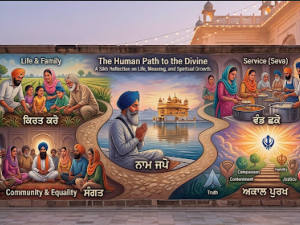

The twenty-first century presents Sikhi with an extraordinary paradox. Sikhi possesses a universal spiritual message and a rich intellectual tradition. It has a living scripture that continues to guide Sikh thought and practice. It also has a history of courage and sacrifice. Today, Sikhi has a global community spread across continents. Yet it faces several serious challenges. Institutional fragmentation remains a significant concern. Engagement among younger generations is also declining in many Sikh communities. Cultural assimilation and superficial religiosity present additional challenges. Political uncertainty and demographic pressures further complicate the situation. Another major concern is the inadequate transmission of Sikh philosophy in contemporary intellectual language. The central question, therefore, is not simply how Sikhi can survive in the twenty-first century. It is also how Sikhi can remain spiritually authentic, intellectually vibrant, socially relevant, and globally influential.
The future of Sikhi cannot be secured simply by preserving buildings, rituals, historical memories, or external symbols. These are important dimensions of Sikh identity. However, the deeper survival of Sikhi depends on preserving and transmitting its spiritual worldview. It also requires the continued transmission of its ethical values, intellectual freedom, and transformative way of life. The challenge before the Sikh Panth is to move from defensive preservation to confident renewal.
From Preservation to Regeneration
For much of modern Sikh history, considerable energy has been devoted to protecting Sikh identity. This remains necessary, particularly in an age of globalization. However, identity cannot survive through preservation alone. Every living tradition must continuously reinterpret its foundational principles in response to changing circumstances.
The Sikh concept of Chardi Kala provides an important philosophical framework for such regeneration. Chardi Kala is not merely a form of passive optimism. It represents an active orientation toward hope and courage. It also encourages creativity and constructive engagement with life. Hukam teaches human beings to accept reality without abandoning their responsibility. Seva transforms spirituality into meaningful social action.
The Sikh future should not be understood as a simple return to the past. The past provides the foundation for Sikh identity and thought. However, the future requires creative engagement with new realities. Sikhs must therefore carry forward the essential vision of the Gurus while responding thoughtfully to the challenges of the twenty-first century. This raises an important question: What would Guru Nanak's intellectual courage look like in the twenty-first century? What would his social compassion look like? How would his spiritual radicalism respond to the needs of contemporary humanity?
Re-centring Sikhi on Shabad
The most important foundation of Sikh survival is the restoration of Shabad to the centre of Sikh life. Sri Guru Granth Sahib is not merely a scripture to be respectfully placed in a gurdwara. It is the principal source of Sikh spiritual wisdom. It is also a source of ethical guidance. It provides a profound framework for understanding human existence. It addresses the relationship between the individual and the Divine. It also explores the nature of the self, society, suffering, truth, and liberation. Sri Guru Granth Sahib should therefore be approached as a living source of wisdom.
Yet many Sikhs encounter Gurbani primarily through ritual recitation. They may listen to Gurbani during daily prayers and religious ceremonies. However, they may not always engage deeply with its philosophical meaning. They may also have limited opportunities to study its historical and intellectual context. This can create a gap between reciting Gurbani and understanding Gurbani. Bridging this gap should be a priority for Sikh education.
The twenty-first-century Sikh should be encouraged to read Gurbani. Sikhs should also be encouraged to understand its meaning. They should be given opportunities to ask questions about its teachings. They should be encouraged to contemplate its deeper implications. Most importantly, Gurbani should become part of everyday life. Its teachings should influence personal conduct, relationships, social responsibilities, and ethical choices.
Sikh institutions have an important role in this transformation. They should provide accessible translations of Gurbani. They should also develop reliable commentaries and explanatory resources. Digital learning platforms can make Sikh teachings available to a global audience. Podcasts and documentaries can introduce Gurbani to younger generations. Online courses can provide systematic opportunities for learning. Educational resources should be developed for children and youth. They should also address the needs of professionals, academics, and non-Punjabi-speaking Sikhs.
The future of Sikhi will depend substantially on how the next generation experiences Gurbani. Young Sikhs should experience it as a living source of wisdom. They should not encounter it merely as an inherited religious text. Gurbani should help them understand themselves and the world around them. It should also help them develop ethical discernment and spiritual awareness. When Gurbani becomes a lived source of wisdom, the transmission of Sikhi becomes meaningful and sustainable.
Educating the Sikh Mind
Education must become the central instrument of Sikh regeneration. Sikh education should extend beyond memorization of historical events and religious vocabulary. It should develop Bibek - the capacity for discernment, critical reflection, ethical reasoning, and independent thought.
A comprehensive Sikh educational framework should integrate Sikh philosophy with science and technology. It should also engage with ethics, psychology, environmental studies, economics, and political thought. The framework should address emerging fields such as artificial intelligence and gender studies. It should further respond to contemporary social issues.
Sikh youth should be encouraged to ask difficult questions about God, consciousness, suffering, morality, technology, identity, death, ecology, and human freedom. Sikhi should not fear questions; rather, it should cultivate a spirit of inquiry, reflection, and critical thinking. The Sikh intellectual tradition is strengthened, rather than weakened, when Sikhs engage openly with competing ideas. A confident tradition does not need intellectual isolation for protection.
Youth as Partners, Not Merely Followers
The survival of Sikhi ultimately depends upon its relationship with young people. However, youth cannot be treated merely as recipients of instructions. They must become co-creators of the Sikh future.
Young Sikhs live in multicultural, multilingual, technologically sophisticated societies. Their identities are often multiple and overlapping. They may simultaneously identify as Sikh, Canadian, American, British, Australian, Indian, Punjabi, and global. These identities may also be shaped by their professional, scientific, artistic, and digital affiliations. Sikh institutions must recognize this complexity rather than demanding a single cultural model of Sikh identity.
Youth should therefore have meaningful representation in gurdwara governance. They should also be represented in Sikh educational institutions, research organizations, charitable foundations, and community decision-making bodies. Leadership development programs can equip young Sikhs with the skills and confidence needed to assume greater responsibilities. Sikh entrepreneurship networks, research fellowships, and innovation centres can further encourage their intellectual and professional growth. International youth forums can provide opportunities for young Sikhs to engage with global challenges and exchange ideas. These initiatives can help transform young Sikhs from passive community members into intellectual, professional, and institutional leaders.
Reforming Sikh Institutions
Institutional renewal is equally urgent. Many Sikh institutions continue to function through structures designed for earlier social and political circumstances. The twenty-first century requires institutions that are transparent, accountable, professional, participatory, and service-oriented.
Gurdwaras should respond effectively to the changing needs of the Sikh community. They should become centres of learning, dialogue, and community service. They should also promote mental and social well-being. Environmental action and cultural creativity should be integral to their activities. Gurdwaras should not function merely as places of worship. Their governance should prioritize competence, integrity, gender inclusion, and youth participation. Financial transparency and collective decision-making should also be essential components of effective Gurdwara management.
The principle of Sarbat da Bhala can provide the ethical foundation for institutional life. Sikh institutions should measure their success not simply by the buildings they construct or the funds they collect, but by the positive transformation they produce in individuals and communities.
Sikhi and the Global Human Future
Sikhi has the potential to make an important contribution to global civilization. Its principles of Ik Oankar and equality possess universal relevance. The principles of dignity and seva are equally significant. Sikh thought emphasizes justice, compassion, and truthful living. It also promotes ecological responsibility and rejects all forms of discrimination. These principles have particular relevance in the contemporary world.
Climate change, artificial intelligence, inequality, religious polarization, loneliness, forced migration, and technological disruption are creating unprecedented ethical challenges. These challenges require new ways of thinking about humanity and its relationship with the world. Sikh thought can contribute meaningfully to these important conversations. It offers a worldview that emphasizes the interconnectedness of all humanity. It also recognizes the sacred significance of nature and emphasizes the ethical accountability of power. Furthermore, Sikh philosophy regards spirituality as inseparable from social responsibility.
The Sikh response to globalization should not be one of cultural isolation. Instead, it should emphasize active and ethical engagement with the wider world. Sikhs should participate confidently in universities and scientific institutions. They should also contribute to public policy, business, the arts, and the media. Their engagement should extend to environmental movements and humanitarian organizations. Interfaith dialogue should likewise remain an important avenue for Sikh participation.
Technology as an Opportunity
Digital technology offers perhaps the greatest opportunity for the transmission of Sikh knowledge since the invention of the printing press. Gurbani databases, artificial intelligence, digital archives, and historical repositories can make Sikh knowledge accessible to people worldwide. Virtual classrooms, multilingual translation systems, online universities, and interactive educational platforms can further expand access to Sikh learning and education.
However, technology must serve Gurmat, rather than replace authentic scholarship. AI-generated interpretations of Gurbani, for example, require careful scholarly oversight. The Sikh community should establish research centres dedicated to the digitization and textual explication of Sikh scriptures and historical materials. These centres should also focus on computational linguistics, Sikh history, and the ethical applications of artificial intelligence. The goal should be to create a global Sikh knowledge ecosystem in which authentic Sikh scholarship is accessible to anyone, anywhere.
Gender Equality and Social Justice
The Sikh commitment to human equality must be reflected consistently in Sikh institutions and social practices. Women should not merely participate in Sikh institutions. They should also occupy positions of leadership, scholarship, governance, and religious authority. Their roles should be determined by their competence and commitment.
Similarly, Sikh communities must confront caste discrimination and economic inequality. They must also address domestic violence and racism. Addiction and loneliness remain other serious social challenges that require attention. A Sikh community that speaks of equality but tolerates discrimination undermines its own theological foundation.
A New Sikh Leadership
The future requires a new model of Sikh leadership. Leadership should move from personality-centred authority toward principle-centred service. Sikh leaders must possess spiritual literacy and intellectual competence. They should also demonstrate administrative ability and ethical integrity. In addition, they need technological awareness and a global perspective.
An ideal Sikh leader should embody the Sikh synthesis of Sant and Sipahi. Such a leader should be spiritually grounded while remaining socially courageous. The leader should be compassionate yet willing to confront injustice. At the same time, the leader should remain humble while demonstrating intellectual confidence.
Conclusion
The survival and growth of Sikhi in the twenty-first century will not be determined primarily by population numbers. It will depend upon whether Sikhi continues to generate meaningful human beings; people who embody Naam, seva, equality, courage, compassion, justice, humility, and Chardi Kala.
The Sikh future must therefore be built upon five interconnected commitments: deeper engagement with Shabad, transformative education, empowered youth, institutional renewal, and global ethical engagement. Sikh identity must remain rooted in its foundational principles while becoming capable of speaking intelligently to the realities of a rapidly changing world.
The ultimate vision should not be a larger Sikh community merely in numerical terms, but a wiser, more compassionate, intellectually vibrant, socially responsible, and spiritually awakened Sikh community.
Sikhi will survive not simply because Sikhs preserve what they inherited, but because they understand it deeply enough to renew it courageously. The task of the twenty-first century is therefore neither preservation without reflection nor change without roots. It is rooted renewal: remaining faithful to the Guru while fearlessly responding to the needs of humanity.
In this sense, the future of Sikhi can be expressed through a simple principle: preserve the Shabad, renew the institutions, educate the mind, empower the youth, serve humanity, and engage the world. That would transform the survival of Sikhi from a defensive concern into a confident vision of its contribution to humankind's future.