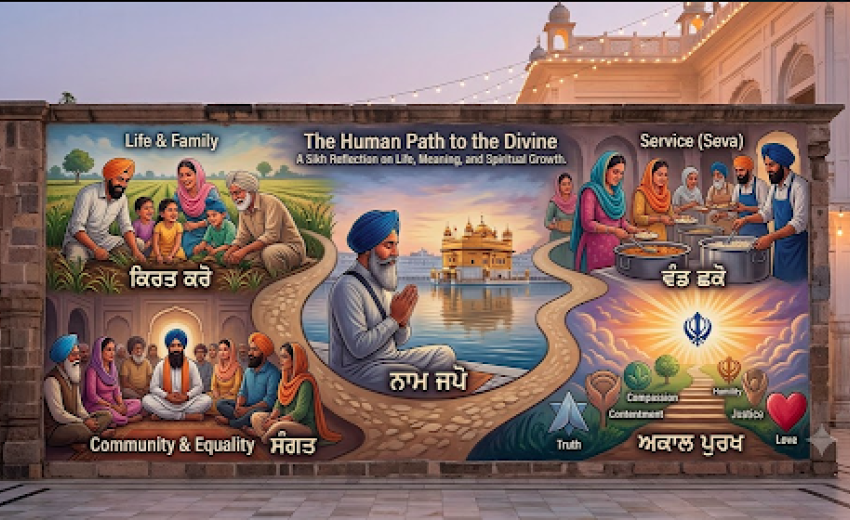

The Human Path to the Divine: A Sikh Reflection on Life, Meaning, and Spiritual Growth
For much of my life, I understood spirituality primarily through the lens of belief. I associated it with religious teachings, sacred texts, prayers, rituals, and the acceptance of certain truths about God. These aspects certainly have their place, but my understanding has gradually evolved. I have come to realize that spirituality is not merely about what I believe; it is about how I learn to live, how I relate to others, and how I gradually become more fully human.
From a Sikh perspective, spirituality begins with the recognition of Ik Onkar, the One Reality that permeates all existence. This understanding transforms the way I see myself and the world around me. If the same Divine presence exists within all beings, then spirituality cannot be separated from everyday human relationships. It must be expressed through compassion, humility, justice, and love. The question is not only "What do I believe about God?" but also "How does my awareness of the Divine transform the way I treat life and other people?"
My journey has taught me that ordinary human experiences are among the greatest spiritual teachers. Love, loss, uncertainty, wonder, meaning, and mortality are not distractions from spirituality; they are the very circumstances through which spirituality unfolds.
Love has taught me the meaning of connection and self-transcendence. In Sikh teachings, love is not merely an emotion but a spiritual orientation toward the Divine and creation. The path of the Sikh is a path of love: love for Waheguru, love for humanity, and respect for all creation. Every act of kindness, forgiveness, and service becomes an expression of this love. Through relationships, I have learned that I cannot grow spiritually by turning inward alone; I must learn to see myself reflected in others.
Loss has been one of my deepest spiritual teachers. Experiences of separation, disappointment, and grief have challenged my assumptions about control and permanence. Sikh wisdom reminds me that everything exists within Hukam, the Divine Order. Accepting Hukam does not mean becoming passive or indifferent toward suffering. Rather, it means learning to respond to life's changes with acceptance, courage, and trust. Loss has taught me humility and has deepened my appreciation for the preciousness of every moment.
Uncertainty has also shaped my spiritual growth. Human beings naturally seek security and definite answers, but life often presents questions that cannot be easily resolved. Sikh spirituality does not encourage blind certainty; instead, it cultivates awareness, reflection, and trust in the Divine. Through Naam Simran, I learn to quiet the restless mind and discover inner stability even when external circumstances remain uncertain. Spiritual maturity, I have realized, is not the absence of questions but the ability to live meaningfully despite unanswered questions.
Wonder has become one of the most profound ways through which I experience the presence of the Divine. Whether contemplating the vastness of the universe, observing the beauty of nature, listening to sacred music, or witnessing acts of extraordinary compassion, I encounter moments that awaken a sense of awe. Gurbani repeatedly invites human beings to recognize the wonder of creation. This sense of Vismad (wonder-filled awe) reminds me that existence is not merely a collection of ordinary events but a sacred expression of Divine creativity.
My search for meaning has led me to understand spirituality as a commitment to purposeful living. Sikh teachings provide a practical framework through the principles of Naam Japna (remembering the Divine), Kirat Karni (honest living), and Vand Chhakna (sharing with others). These principles demonstrate that spirituality is not confined to meditation or personal devotion; it must influence how I work, how I contribute to society, and how I respond to human suffering. Meaning emerges when my actions become aligned with compassion and service.
Seva has particularly transformed my understanding of spirituality. Service reminds me that spiritual growth is not measured by personal achievement or religious knowledge but by my willingness to contribute to the well-being of others. When I serve without expecting recognition, I experience a deeper connection with humanity. Seva dissolves the illusion of separation and reveals the shared dignity of all life.
Mortality has perhaps been my most powerful reminder of what truly matters. The awareness that life is temporary encourages me to live with greater gratitude and responsibility. Sikh teachings remind me that the purpose of human existence is not merely the accumulation of wealth, status, or recognition but the realization of the Divine and compassionate engagement with the world. Remembering mortality helps me focus on what endures: love, kindness, wisdom, and the positive impact I leave on others.
Over time, I have come to see spirituality not as a separate dimension of life but as the way life itself is approached. It is reflected in how I speak, how I listen, how I respond to suffering, and how I recognize the sacredness of every person. The ideal Sikh is not one who withdraws from the world but one who lives within it as a Gurmukh: a person whose consciousness is oriented toward the Divine while actively participating in society.
This understanding also reshapes the meaning of religious practice. Prayer, meditation, and remembrance are not ends in themselves; they are pathways toward transformation. Their purpose is to cultivate humility, compassion, courage, and wisdom. Spirituality becomes authentic when inner realization leads to ethical action.
I continue to see myself as a student on this journey. Spiritual growth is not a destination that I achieve once and for all. It is a lifelong process of learning, unlearning, and becoming. Each experience - joy and sorrow, success and failure, certainty and doubt - offers an opportunity for deeper awareness.
Today, I understand spirituality as the lifelong cultivation of my capacity to inhabit life more fully. It is learning to recognize the Divine presence in all beings, to accept life within Hukam, to respond with compassion, and to live in Chardi Kala, a state of resilient optimism and spiritual strength.
Ultimately, spirituality is not only about knowing God; it is about becoming the kind of human being who reflects Divine qualities in the world. The journey toward the Divine and the journey toward becoming fully human are not separate paths. They are one continuous journey of awakening.