
Preserving the Past, Teaching the Present:
Prof. Dr. Kanwal Khalid's Journey in Art, Archives, and Heritage
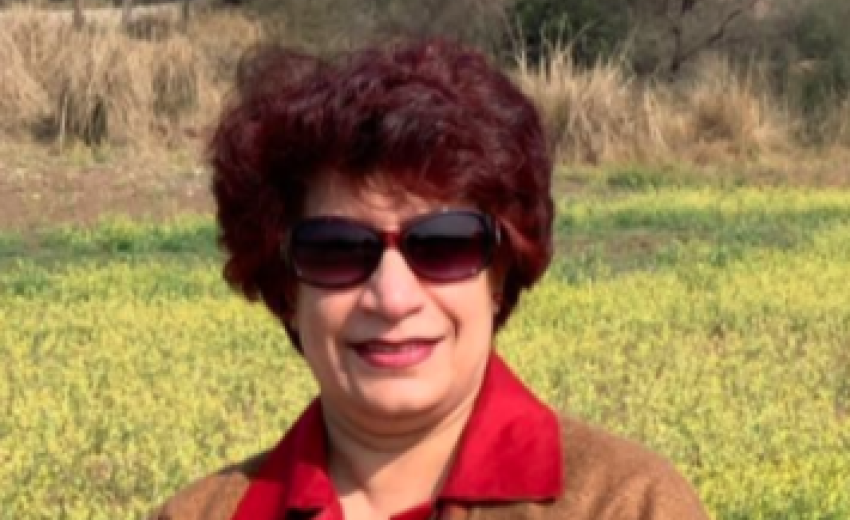
Prof. Dr. Kanwal Khalid is among Pakistan's most distinguished scholars of art history, culture, and heritage. She has built a career spanning more than three decades at the intersection of academia, museum stewardship, archival preservation, and public education. As a specialist in the art and history of South Asia, with a particular focus on the nineteenth-century Sikh and colonial eras, she has shaped the way Lahore's visual and cultural heritage is studied, taught, and presented to the public.
Dr. Khalid's academic journey began at the College of Art & Design, University of the Punjab, Lahore, where she earned her Bachelor of Fine Arts in Graphic Design in 1990, followed by a Master of Fine Arts in the same discipline in 1993. She completed her PhD at the university's Research Centre in 2011, specializing in the history of art, culture, and heritage of South Asia. Her doctoral research concentrated on the arts produced during the reigns of Maharaja Ranjit Singh and Maharaja Sher Singh. This domain became the defining thread of her scholarly identity.
Dr. Khalid entered government service in 1995, beginning at the Civil Secretariat's Education Department. She also served as Protocol Officer for foreign delegations. Her career quickly expanded into education and heritage administration. She has held teaching posts as Assistant Professor at Punjab University's College of Art & Design and at Lahore College for Women University, and as Associate Professor at Gulberg College for Women, Lahore. She also served as Keeper of Paintings at the Lahore Museum, overseeing and digitizing its painting collections.
Her most significant administrative role came as Director of the Punjab Archives & Libraries Wing, S&GAD, where she led a landmark digitization, preservation, and modernization project, the first initiative of its kind undertaken in Pakistan. She currently serves as Professor of Art History at Punjab University's College of Art & Design, supervising doctoral and postgraduate research, and continues as History and Culture Advisor to both the Walled City of Lahore Authority (WCLA) and the Aga Khan Cultural Service (AKCS), Lahore.
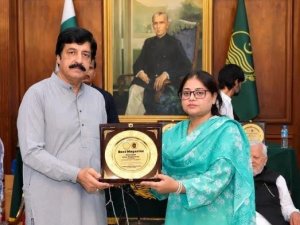
Beyond her home institution, she has held adjunct or visiting faculty positions at institutions including Forman Christian College, Beaconhouse National University, the National College of Arts, the University of Home Economics, the Institute for Art & Culture, and Sardar Bahadur Khan Women's University, Quetta. Recognizing her contributions to teaching, the Govt. of Punjab bestowed upon her the Best Teacher Award in 2026.
Dr. Khalid has authored more than 30 national and international research publications, many of which appear in HEC-recognized journals in both English and Urdu. Her book output reflects the depth of her archival and museological work: she co-authored Punjab Archives: From Mughal to Colonial Era and authored Picture Wall of Lahore Fort, a project documenting the world's longest mosaic kashi-kari wall, sponsored by WCLA, the Aga Khan Trust, and the World Bank.
Her most recent book, Between Light and Memory, 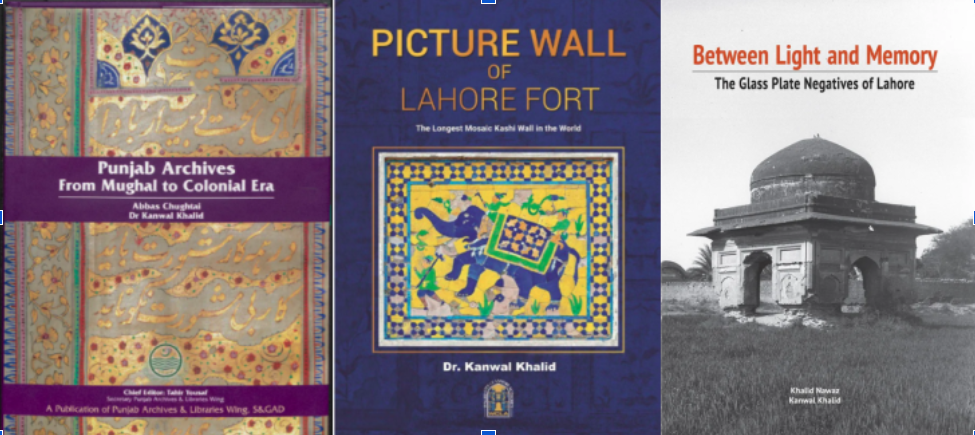 examines Lahore’s glass-plate photographic negatives. Several further volumes on Sikh-era miniature painting, the Zanana Masjid and Sehdara of Lahore Fort, and the administrative history of Punjab under British rule, remain in progress.
Her conference record is similarly extensive, with papers delivered at forums including the College Art Association (CAA) conferences in Chicago, New York, and California, the Victoria and Albert Museum in London, and numerous THAAP International Conferences in Lahore, on subjects ranging from Harappan archaeology to nineteenth-century Lahori painters and the socio-political history of Lahore Fort.
Dr. Khalid's expertise has been recognized through prestigious international fellowships, including a French government-sponsored training in museum and heritage policy and a CAA–Getty Foundation research grant. She serves on the Executive Board of the Archaeology Department of Punjab, the Academic Council of the University of Home Economics, and the Board of Studies at Punjab Tianjin University of Technology. She also contributed to UNESCO's working group on the protection and promotion of cultural diversity.
Committed to bringing art history beyond the classroom, Dr. Khalid has been a familiar voice on Pakistani television and radio, appearing on PTV's Art Café, Express TV, FM 95 Radio, and SUNO TV, where she discusses Sikh-era art and heritage in Punjabi. She also runs what is regarded as Pakistan's first Art History teaching vlog on YouTube. Her creative contributions extend to philately: she designed commemorative postage stamps issued by the Government of Pakistan in 2015 and 2018, and assisted with the stamp marking the opening of the Kartarpur Corridor in 2019, designed by her husband, Khalid Nawaz.
Through her archival modernization work, museum scholarship, and decades of teaching, Dr. Kanwal Khalid has helped preserve and reinterpret Lahore's layered cultural history for new generations. Her media and digital outreach have carried the discipline of art history to audiences far beyond the university lecture hall. During a recent meeting with her, I learnt more about her contributions and insights into 19th-century Sikh and colonial-era art in Punjab, as well as the history of art, culture, and heritage of South Asia. I'm sharing a brief write-up of the interview for readers' benefit.
Section 1: Early Life, Academic Formation & Sikh Art Specialization
Dr. Singh: What first drew you to art and design, and what led you from a BFA/MFA in Graphic Design toward a PhD in art history?
Dr. Khalid: I think it was a natural inclination because in my family there was no artist. My father was a professor of Urdu and Persian Literature and a poet also, so the atmosphere of literary discourses was part of my growing up, but no fine arts. My initial passion was Graphic Design that led to the completion of BFA and MFA. I wanted to study further, so the only option available in Pakistan was an MPhil in Art History, in which I studied South Asian Arts. After studying Eurocentric subjects, this was my first formal encounter with regional arts. I simply fell in love with the philosophies and arts of our land. During my MFA, art history was already one of my favorites. That is why the transition from design to history was smooth. In fact, I studied arts with the eye of a designer that is quite rare in the world of art history.
Dr. Singh: Your doctoral research centered on the arts of Maharaja Ranjit Singh and Maharaja Sher Singh's periods. What first sparked your fascination with the Sikh era specifically?
Dr. Khalid: Art books of the world did not say much about the arts of Punjab, especially Lahore. It looked as if no art was produced here. The situation further deteriorated whenever there was a mention of the Sikh Era. Most of the writers rejected the arts created under the Sikh Rule by declaring them inferior in nature. This triggered me, and I took it as a challenge to find the evidence and specimens of a city and Era that were completely disregarded. People around me were also not very happy about it. Things have changed in the past two decades, but twenty-five years ago Sikh Art was not considered a worthy expression to discuss in art books.
Dr. Singh: What makes 19th-century Sikh and colonial-era art in the Punjab so distinct, both visually and historically, from other periods you've studied?
Dr. Khalid: The Arts produced in these two Eras were very distinct from each other. Sikh Art was the last spark of an artistic tradition of thousands of years that was to be crushed by the British in the second half of the 19th c. The creative expressions were never going to be the same because under the heavy tutelage of European styles, indigenous expressions were simply dying away.
Dr. Singh: You've written about miniature painters as "historiographers.” How do these paintings function as historical documents in their own right?
Dr. Khalid: Painters used to sit in royal courts and record the important events and meetings held there that would become part of official chronicles. Within that context, I call painters historiographers because some fascinating socio-political undercurrents have been portrayed in those paintings.
Dr. Singh: Your research touches on figures like Hukma Singh and Sikh-era manuscripts; what do these lesser-known sources reveal that mainstream histories often miss?
Dr. Khalid: Most of the researchers focus on the available sources to collect the data and narrate the obvious, but in much of my quest for research, I try to bring forth those elements of history that have never been explored. They can be documents, facts, artifacts, analytical perspectives, etc. The discovery of a completely unknown artist like Hukma Singh and the finding of very critical archival documents reveal such interesting dimensions of Sikh Darbar that have never been explored before.
Section 2: Museums, Archives & Major Works
Dr. Singh: How did the Sikh school of painting in Lahore evolve, and what happened to it after the transition to colonial rule?
Dr. Khalid: Lahore was an important art center for centuries. The city even redefined Mughal miniature painting by adding local elements to otherwise heavily Persianized art. All this happened when Akbar’s court and atelier shifted to Lahore. This is one dimension apart from many that were being introduced by the Lahori artists. Anarchy and disruption inflicted upon Punjab due to the decline of the Mughals brought misfortune to the artists of Lahore. They fled to peaceful states that were mostly situated in the hills. This was also one of the reasons for the development of the Pahari School of painting. But all the arts returned to the city when Maharaja Ranjit Singh brought peace and prosperity to Lahore, which led to the Sikh School of painting in Lahore. The great patronage of both the rulers and the public was a great boost for the arts. But the situation did not last long, and the British takeover of the city not only ended the political rule of locals, but it also discouraged all the arts and crafts that had an indigenous flavor to them.
Dr. Singh: You're currently working on a book on Sikh Era Miniature Paintings. What new perspective will it offer readers?
Dr. Khalid: The book that I am working on is entirely based on research, and during my tedious years of studies, I discovered facts and lots of visual evidence that have never been brought to light before. The book is not about assumptions, but whatever argument is put forth in the publication has been strengthened by authentic visual evidence that I am sure the readers will find both interesting and an addition to the knowledge, which is quite meagre when it comes to Sikh Arts.
Dr. Singh: As Director of the Punjab Archives, you led the first digitization and modernization project of its kind in Pakistan: what were the biggest challenges in that undertaking?
Dr. Khalid: One of the biggest challenges that I faced was to make senior technocrats realize how important Digitization is for the future of research and the safety of the documents. The other challenge was to develop an effective retrieval system because the documents and files were in the millions. Last but not least were the financial issues, but fortunately I was able to convince the Government of Punjab that has been very generous in extensions and funding of the Project, even during the hard times of COVID-19.
Dr. Singh: During your time as Keeper of Paintings at Lahore Museum, what was the most significant discovery or restoration you were involved in?
Dr. Khalid: As the Keeper of the Painting collection, the first assignment I took upon myself was to create a computerized catalogue of the whole collection; that was the first ever in Pakistan at that time. I completed the task during my stay there. For the restoration, I was involved in the restoration of the Sadequain Mural, which is still in process.
Dr. Singh: Your book Between Light and Memory is based on glass-plate negatives of Lahore; what stories did these fragile images help you uncover?
Dr. Khalid: Every image in my latest publication, Between Light and Memory, has a story to tell. This is the largest number of prints that have been produced from the glass plate negatives, portraying an era long gone. Most of the monuments depicted are either lost or changed beyond recognition. The book is a huge repository for researchers with photographs of more than 160 monuments.
Section 3: Scholarship, Teaching & Mentorship
Dr. Singh: What is lost when heritage material isn't properly archived, and what can other institutions in Pakistan learn from the Punjab Archives project?
Dr. Khalid: The knowledge is lost. Lack of care and facilities may lead to the loss of past data that can be instrumental in understanding that past. In Punjab Archives, I set a prototype for future digitization projects in Pakistan. Archival repositories of the world can take advantage of all the lessons that were learned in that process.
Dr. Singh: Picture Wall of Lahore Fort documents the longest mosaic kashi wall in the world; what was it like researching a monument of that scale?
Dr. Khalid: Picture Wall was one of the most difficult research projects of my life due to its scale. The number involved was huge. The categorization of the subjects was another uphill task that I faced. On the other hand, it was the second monograph ever written after 1920. Overall, the book was a great challenge for me that took more than five years of my life.
Dr. Singh: Co-authoring Punjab Archives: From Mughal to Colonial Era must have required navigating vast and varied source material; how did you approach organizing that history?
Dr. Khalid: Patience and persistence are the key. History is a vast field and, for a researcher, a very tricky one indeed. Most of the time, the events happened long before you were even born. Coming up with new conclusions from centuries-old happenings is very tough. And for a person like me who does not believe in just hashing the previously stated narratives, it is never research. I have to have my own findings, and this is exactly what I did in this book. It’s a compilation of many lesser-known facts along with some new angles searched for the first time.
Dr. Singh: Having taught for over thirty years across multiple institutions, how has your approach to teaching art history evolved over the decades?
Dr. Khalid: My teaching of art history is entirely different from the way we were taught. My method is more inclusive. I try to make my students feel connected to the larger frame of action. Instead of focusing on one region, the approach is to connect the dots universally because this is how humanity has always been.
Dr. Singh: What do you hope your MPhil and PhD students carry forward from your mentorship, beyond academic knowledge?
Dr. Khalid: An analytical perspective of their own. I encourage them to think boldly and independently, to critically appreciate, but as a historian, I try to inculcate the trait of being unbiased and free from prejudice. I encourage them to treat every historical figure as human beings, neither purely as heroes nor as villains.
Section 4: Public Engagement, Creative Work & Legacy
Dr. Singh: Among your thirty-plus research publications, is there one paper or finding you consider most personally significant, and why?
Dr. Khalid: One paper that took lots of my time and effort is titled “Gems and Jewels of India”. Being a South Asian woman, I love gems and jewels, but studying them purely from a political perspective was an experience of its kind. The findings during the research are mind-blowing. It touched history from a very different angle. Who would have thought of exploring history through the ornaments worn by the people?
Dr. Singh: You run what's considered Pakistan's first Art History YouTube vlog; what motivated you to bring academic art history to a digital, public audience?
Dr. Khalid: The YouTube vlog is another of my experiments, but unfortunately, I never had the patience to develop a method and wait for the subscribers, etc. The channel is still there, but now much of my time is spent providing expertise for many national and international platforms because very soon I realized that this social media is the future tool for knowledge. So, I adopted it real quick.
Dr. Singh: Speaking on Sikh-era heritage on platforms like SUNO TV in Punjabi, how important is language in making this history accessible to local communities?
Dr. Khalid: For me, language is not only a means of communication, but it connects different ethnic groups all over the world. Podcasts presented on SUNO TV in Punjabi gave the local communities access to knowledge and information. And that is exactly what I have been doing.
Dr. Singh: You designed commemorative postage stamps for the Government of Pakistan, and your husband designed the Kartarpur Corridor stamp; what was that experience like, working on national symbols tied to shared heritage?
Dr. Khalid: As is said internationally, stamps are ambassadors of any nation, so this is how we look at them. But the designing of the Kartarpur Corridor stamp was another kind of experience because this was much more than designing just another stamp. It was building a huge stepping stone for better relations between two communities of the Subcontinent. I am sure the future generations will be able to appreciate the magnitude of the event much better then us.
Dr. Singh: Looking back at your career: from Protocol Officer to Professor to Heritage Advisor, how would you like your contribution to Lahore's cultural memory to be remembered?
Dr. Khalid: I think I would like to be remembered as a person who looked at the art, history, and culture of the region in a passionate but logical manner, defining and highlighting the atrocities committed by the foreign agents against a land that we all so lovingly call Punjab and Lahore.
Dr. Singh: Thank you, Dr. Khalid, for taking the time to participate in this interaction. It was wonderful meeting you and hearing your views on various aspects of 19th-century Sikh and colonial-era art in Punjab, the history of art, culture, and heritage of South Asia.
Dr. Khalid: Thank you very much, Dr. Singh, for your intelligent and thought-provoking inquiry. I appreciate your input and efforts very much.