
The true measure of a society’s progress cannot be determined merely by the height of its buildings, the quality of its roads, or the expansion of its industries. These are visible indicators of material development, but the deeper measure of civilisation lies in the intellectual and moral vitality of its people—their capacity to acquire knowledge, think critically, exercise informed judgement, cultivate creativity, and sustain a lifelong passion for learning. At the centre of this intellectual culture stands the library, while the librarian serves as its custodian, guide, and human interface with the world of knowledge.
In India, 12 August is observed as National Librarians’ Day in commemoration of the birth anniversary of Dr S. R. Ranganathan (1892–1972), widely regarded as the father of Indian library science. His pioneering contribution transformed the understanding of librarianship from the mere preservation and circulation of books into a dynamic philosophy of knowledge service. His celebrated Five Laws of Library Science placed the reader at the centre of the library system and established principles that remain remarkably relevant in the digital age.
The first of these laws—“Books are for use”—contains a profound social philosophy. A book locked away from its readers has little social value; knowledge acquires meaning when it is accessed, interpreted, questioned, and transmitted. Ranganathan's vision therefore transcended the physical library. It represented a democratic conception of knowledge in which libraries exist to facilitate intellectual development and ensure that the resources of learning are available to all.
The Age of Information and the Crisis of Knowledge
We are living in an unprecedented age of information. A smartphone can provide access within seconds to books, journals, archives, lectures, databases, newspapers, encyclopaedias, and innumerable other sources of information. Digital technology has undoubtedly democratised access to knowledge in ways that earlier generations could scarcely have imagined.
Yet an abundance of information does not necessarily produce an abundance of knowledge.
The internet contains authoritative scholarship alongside misinformation, fabricated narratives, manipulated images, commercially motivated content, ideological propaganda, and incomplete or decontextualised claims. The central challenge of the contemporary information society is therefore no longer simply access to information, but the ability to determine what is reliable, relevant, authentic, and intellectually defensible.
This is precisely where the modern library and librarian acquire renewed significance. The librarian is no longer merely the custodian of printed volumes. He or she increasingly functions as an information mediator, research guide, digital curator, bibliographic specialist, and facilitator of information literacy. The librarian helps readers navigate the enormous landscape of available information and distinguish evidence-based knowledge from material that merely appears convincing.
In this sense, the library remains an institution of intellectual discipline in an age characterised by information excess.
Books, Libraries, and the Making of Great Minds
The biographies and autobiographies of eminent scholars, writers, scientists, administrators, reformers, and political leaders repeatedly demonstrate the formative influence of books and libraries. Great minds have rarely developed in intellectual isolation. Their habits of reading, reflection, annotation, discussion, and research have often been nurtured by access to books and institutions devoted to learning.
The library provides something that the smartphone, despite its extraordinary capabilities, cannot entirely reproduce: an environment deliberately structured for sustained intellectual engagement.
The digital screen encourages speed, immediacy, and continuous switching between sources. A serious library encourages concentration, patience, contemplation, and sustained reading. These qualities are indispensable to scholarship. Deep reading requires time; critical thought requires concentration; and intellectual maturity requires exposure to ideas that may challenge one's existing assumptions.
The distinction is therefore not between books and technology as mutually exclusive alternatives. The real challenge is to establish a healthy intellectual relationship between print culture and digital culture.
The Decline of Public Libraries
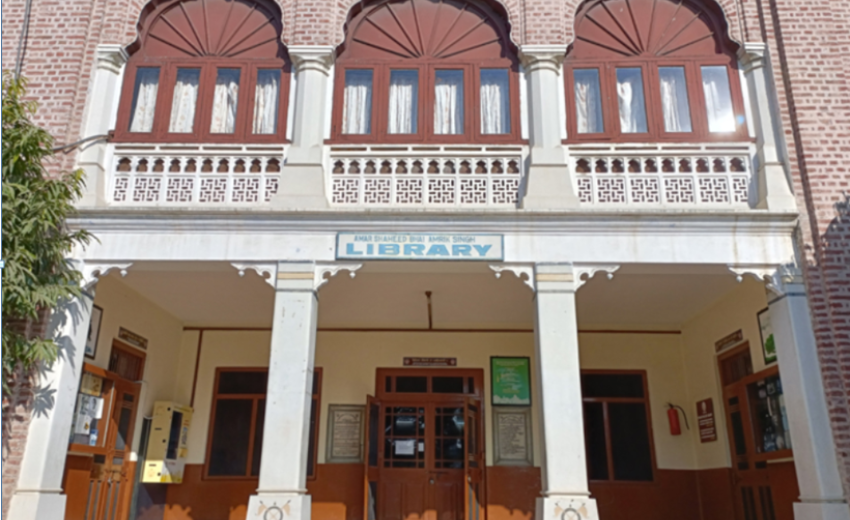
Despite the growing importance of knowledge in modern society, the condition of many public libraries in India remains a matter of serious concern. The problem is particularly visible in several parts of Punjab, where the tradition of literary and intellectual activity has historically been strong. In many places, public libraries are absent, inadequately funded, poorly maintained, or deprived of qualified professional staff.
A library building without books, a collection without readers, and a reading room without a competent librarian cannot fulfil the social purpose of librarianship.
In some communities, libraries continue to exist largely as formal institutions rather than living centres of learning. Inadequate infrastructure, outdated collections, insufficient digital facilities, limited opening hours, lack of trained personnel, and weak community participation can gradually transform a potentially vibrant institution into a neglected public facility.
This decline deserves much greater public attention. Roads, bridges, hospitals, schools, and other physical infrastructure are rightly regarded as essential to social development. Libraries should be understood in the same framework—not as decorative cultural institutions but as intellectual infrastructure.
A road enables physical movement; a library enables the movement of ideas.
Punjab and the Need for a Library Renaissance
Punjab possesses a remarkable literary heritage. Its contribution to Punjabi literature, Sikh scholarship, poetry, folklore, historiography, journalism, and religious studies is immense. The region has produced generations of writers, scholars, poets, educators, and public intellectuals.
Yet literary heritage cannot survive merely through commemorative events.
The organisation of literary conferences, poetry recitations, book releases, seminars, and award ceremonies is valuable, but these activities must be connected with a permanent institutional culture of reading. A society cannot become intellectually vibrant merely by honouring writers once a year; it must create conditions in which young people can read those writers throughout the year.
There is consequently a strong case for a Library Renaissance in Punjab—a systematic programme for establishing, restoring, digitising, and professionally managing public and community libraries at district, town, and village levels.
Every village need not possess an elaborate library building, but every community should have meaningful access to a properly managed library, whether independently or through a network of shared facilities.
Libraries and Social Equality
One of the greatest virtues of the public library is its democratic character. A person who cannot afford to purchase expensive books, journals, or digital subscriptions can nevertheless enter a library and gain access to knowledge.
The library thus performs an important function of social equalisation.
A child from an economically disadvantaged family can sit beside a child from a prosperous household and read the same book. A student preparing for a competitive examination can access reference material that may otherwise be beyond his or her financial means. A farmer can consult agricultural literature; a senior citizen can pursue a lifelong interest; a researcher can consult specialised material; and a young writer can discover the literary traditions that preceded him.
In this respect, the public library is not simply a cultural institution. It is an instrument of educational justice and social inclusion.
The Library in the Digital and Artificial-Intelligence Era
The rise of digital technology and artificial intelligence should not be interpreted as a reason for abandoning libraries. On the contrary, it provides an opportunity to redefine and strengthen them.
Modern libraries should incorporate e-books, e-journals, online catalogues, institutional repositories, digitised manuscripts, digital archives, open-access resources, research databases, and appropriate artificial-intelligence tools. Librarians should be trained to assist users in discovering, evaluating, and ethically using these resources.
Artificial intelligence may assist with classification, metadata generation, translation, information retrieval, discovery, and research support. But technology cannot replace human judgement in determining credibility, context, intellectual responsibility, and ethical use.
The library of the future should therefore be neither exclusively physical nor exclusively digital. It should be a hybrid knowledge institution, combining the permanence and contemplative character of books with the accessibility and reach of digital technology.
Libraries and the National Education Policy
The objectives of contemporary educational reform cannot be achieved through classrooms alone. If students are expected to develop creativity, critical thinking, research aptitude, independent learning, and interdisciplinary understanding, libraries must become integral to the educational process.
Schools, colleges, and universities require modern libraries with qualified professionals, current collections, digital resources, accessible reading spaces, research databases, and programmes designed to cultivate reading habits.
The library should not be treated as an ancillary department of an educational institution. It should be regarded as one of its intellectual foundations.
Teachers teach students how to engage with a particular field; libraries enable them to explore beyond the prescribed curriculum.
The Librarian: The Human Heart of the Library
No discussion of libraries is complete without recognising the librarian.
The librarian is often among the least publicly acknowledged professionals in the educational and intellectual ecosystem. Yet librarians assist generations of students and researchers, preserve collections, organise information, guide readers, maintain catalogues, support scholarship, and increasingly provide access to complex digital resources.
The modern librarian requires professional knowledge of cataloguing and classification, information technology, digital preservation, research databases, copyright, metadata, information literacy, archival methods, and emerging technologies.
Professional development must therefore become a continuing process. A library cannot be modern merely because it contains computers. It becomes modern when its human resources possess the knowledge and professional competence required to use those technologies meaningfully.
Preserving Cultural and Documentary Heritage
Libraries also have a responsibility extending beyond contemporary information services. Rare books, manuscripts, newspapers, photographs, personal papers, oral histories, local records, genealogical materials, and other documentary resources constitute the collective memory of a society.
For regions such as Kashmir and Punjab, where history has passed through periods of political transformation, migration, conflict, and cultural change, the preservation of documentary heritage assumes particular importance.
Digitisation can provide an additional layer of protection and accessibility, but digital copies should complement rather than replace the preservation of original materials. A scanned manuscript is valuable; the original manuscript is also an irreplaceable historical artefact.
Libraries should consequently collaborate with archives, museums, universities, scholars, and local communities to identify and preserve endangered documentary heritage.
From Government Responsibility to Community Participation
The revival of libraries cannot be left entirely to governments. Government support is indispensable, particularly in funding, infrastructure, staffing, digitisation, and policy development. However, libraries ultimately become successful when communities develop a sense of ownership towards them.
Local bodies, educational institutions, philanthropic organisations, writers, publishers, scholars, alumni associations, and civil society organisations can all contribute.
Instead of merely donating books without considering their relevance, communities should support curated collections, professional management, reading programmes, children's sections, digital facilities, and long-term maintenance.
A library should become a place where people return—not because they are compelled to do so, but because they discover intellectual companionship there.
Parents and the Culture of Reading
The revival of libraries must also begin within the home.
Parents have an important role in shaping children's relationship with books. If children grow up seeing reading as a meaningful and pleasurable activity, they are more likely to develop intellectual curiosity. Digital devices should not necessarily be treated as enemies; rather, children should be taught to use technology purposefully while retaining the habit of sustained reading.
A child who spends time with books develops not only vocabulary and knowledge but also imagination, empathy, concentration, and the capacity to understand perspectives different from his or her own.
The objective should therefore not be to eliminate screens but to prevent screens from eliminating reading.
A Call for Social Reform
If society genuinely seeks reform, it must look beyond ceremonial declarations and symbolic gestures. Social reform requires institutions capable of producing informed and responsible citizens.
Political leaders, administrators, educators, intellectuals, writers, parents, religious and community organisations, and ordinary citizens must recognise the library as a fundamental component of social development.
Governments should establish measurable programmes for the revival of public libraries. Every district should have a properly funded central library, while towns and villages should have accessible reading and knowledge centres according to local requirements. Existing libraries should be assessed, renovated, digitised, and professionally staffed.
Public expenditure on libraries should be viewed not as a cultural luxury but as an investment in human capital, democratic citizenship, educational opportunity, and social cohesion.
The distribution of digital devices may provide access to information, but access without guidance can also magnify misinformation. A library provides the institutional environment in which information can be evaluated, contextualised, and transformed into knowledge.
Conclusion
The crisis confronting libraries is ultimately not a crisis of buildings or books alone. It is a crisis concerning the place we assign to knowledge in our conception of society.
A society that neglects its libraries risks weakening the intellectual foundations upon which democratic and humane civilisation depends. Conversely, a society that protects its libraries, respects its librarians, encourages reading, supports research, and preserves its documentary heritage invests in generations yet unborn.
The library must therefore be reclaimed from the margins of public policy and restored to the centre of educational and social planning. It should be a living institution—open to every citizen, responsive to new technologies, rooted in cultural memory, and committed to intellectual freedom.
On National Librarians’ Day, the most meaningful tribute to Dr S. R. Ranganathan would not be another ceremonial speech. It would be a renewed national commitment to the institutions he envisioned: libraries that serve readers, librarians who guide seekers of knowledge, and communities that regard learning as a lifelong social responsibility.
A nation may build magnificent infrastructure and achieve impressive economic growth, but its enduring civilisation will ultimately be judged by the quality of minds it produces.
Roads connect places; libraries connect minds.
Buildings provide shelter; libraries provide intellectual horizons.
Technology delivers information; libraries teach us how to understand it.