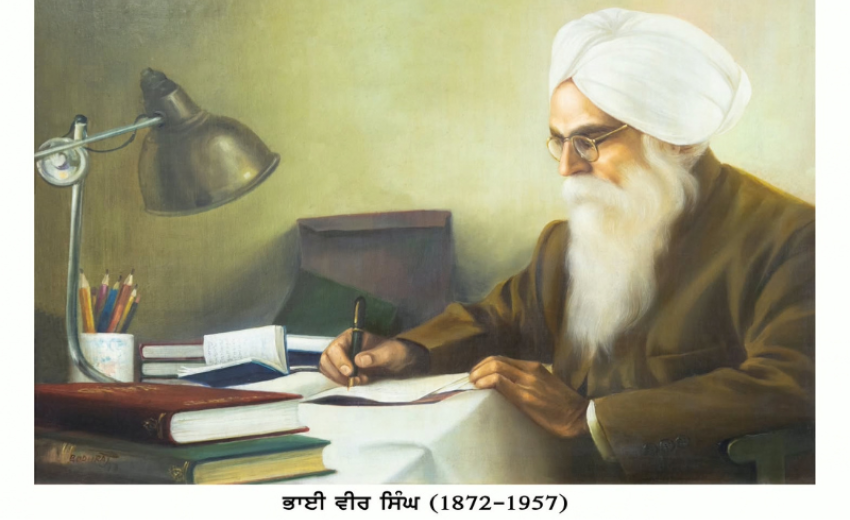

Bhai Vir Singh (1872–1957) occupies a position of profound reverence in Sikh and Punjabi literature. Widely regarded as the father of modern Punjabi literature and celebrated as a saint-poet, spiritual interpreter and architect of literary modernity, he is often placed in the distinguished tradition of great Indian literary figures such as Rabindranath Tagore.
Bhai Vir Singh inherited a rich intellectual and spiritual legacy. His family lineage was associated with Diwan Kaura Mall of the Lahore Darbar, while his father Dr Charan Singh and maternal grandfather Giani Hazara Singh were themselves distinguished scholars and personalities of the Sikh tradition. Their learning, spirituality and commitment to the Panth deeply influenced Bhai Vir Singh. Responding to the intellectual and spiritual needs of his age, he transformed this inherited legacy into an enduring literary mission.
His contribution encompasses poetry, novels, plays, prose, biography, epic literature, Gurmat scholarship, editing and textual preservation. Through his writings, he connected the Sikh heritage of the Gurus with the social and spiritual concerns of contemporary society. Though personally reserved and rarely inclined towards public oratory, his pen became a powerful medium for social reflection, moral guidance and spiritual awakening.
Among his most valuable literary legacies are his letters, which reveal his profound understanding of human life and his compassionate engagement with the concerns of ordinary people. Collections such as Veer Sunehade, Prasangaliya, Pyare Jiyo, Hamdardi Patra and Veer Patravali have preserved hundreds of these illuminating letters for successive generations.
The present collection is a humble effort to bring together some letters of Bhai Vir Singh Ji found in various sources relating to the Jammu and Kashmir Valley. By preserving and presenting these valuable literary and spiritual reflections, an attempt has been made to make this lesser-known material accessible to present and future generations and to contribute, however modestly, to the continuing study of Bhai Vir Singh's enduring legacy. I have made every effort to translate these original Punjabi letters into English with accuracy, while preserving, as far as possible, their original tone, meaning, spiritual depth, and literary character. Particular care has been taken to retain the distinctive voice and idiomatic expression of Bhai Vir Singh, without imposing unnecessary modernisation upon the language. The translation is intended to make these valuable letters accessible to a wider readership, particularly the younger generation, and to facilitate a deeper understanding of Bhai Vir Singh’s spiritual thought, literary sensibility, and correspondence with his well-wishers in Jammu and Kashmir.
A
60, Lawrence Road, Amritsar
20-8-1934
The Victory of the Lord God
Long live Kripalu!
I had tried to explain to myself the hope of the Guru which is understood from the Bani. The meaning of the Guru’s Bani has helped me in my sufferings and has made it easier for me to bear them. Therefore, the ‘side known by the mind’ and the ‘side experienced in the soul’ have
shown themselves to be equal. Our mind cannot understand the totality of things. Almost all the philosophers of the East and the West till now have been ignorant of this principle.
Beyond intellect lies the path of experience.
Blind faith is something below intelligence.
Experience is something beyond the intellect and is not an imaginary thing; it is something that comes through experience.
The first stage of experience is faith. The Guru’s words about faith are:
“Where did the Lord come to believe? Then He revealed His mind to the wise.”(G.G.S., 285)
Knowing is the religion of intellect. Intellect is bound by time, place, etc. It cannot go beyond time. So, with intellect, one can know the visible, temporal and material things, but one cannot know the timeless, eternal and infinite things with intellect. The mind can realise this through experience.
The intellect rejoices; in the realm of consciousness its answers are given by the gods. There are other questions about them; they are answered again. Then questions arise about them and answers arise, and the cycle continues.
After reading your entire letter, your question seems to be: Why are the good sad and the bad happy?
The suffering and happiness that living beings experience are the result of their own deeds. In answer to this question, good men and wise sages have said this:
Karma is of three types: Sanchit, Kriyaman and Prarabdha. The karmas that have been accumulated before birth and have become the cause of this birth and the giver of happiness and sorrow in it are the Prarabdha karmas. Everyone has to suffer them. The karmas that have been done before this birth and have not become Prarabdha karmas are still lying accumulated. At the end of this birth, they will be combined with the karmas of this birth and become the predestined karmas for the next birth according to our sanskars.
The karmas that we are doing now are called Kriyaman karmas. These, especially after death, will be combined with the accumulated karmas; some will become Prarabdha karmas for the next birth, while some will remain accumulated.
The sages give an example regarding predestined karmas—that of an arrow released from a bow. They are no longer under our control; they have gone.
So, those good people who are suffering are suffering from their Prarabdha karmas. They will remain so until their Prarabdha karmas have been fulfilled. Those who are experiencing happiness despite being bad are experiencing the fruit of their previous Prarabdha karmas, because birth is due to accumulated karmas. If all the karmas are good, one becomes a god; a human being does not then take a human body. If all are bad, one becomes an adept; a human being cannot enter a human body. Thus, a human being is born from both good and bad mixed karmas.
According to them, both good and bad people experience pain and pleasure. The idea that all sinners are happy, and always happy, is neither accepted nor observed by the sages. Happiness and sorrow come to everyone according to their past deeds, although there is a difference in the nature of sorrows.
Those people who are now becoming good and becoming devotees and wise will still suffer the karmas of their destiny. Yes, their accumulated and active karmas will be burnt.
So this is the explanation of our sufferings that good people have given.
I have heard ascetics who practise meditation say that they want to get rid of sufferings by worshipping God. They are doing business. They are not doing devotion. Enjoy the fruits of your deeds with gratitude, and do devotion in the future. Your future will be bright. Then you will not suffer.
In the books of Sufi ascetics and other spiritual seekers, there are common sayings written on this point: they are not lovers of God who seek happiness through worship and goodness. They are the baniyas who do business.
It is written in Sri Guru Granth Sahib:
“Narayan Nindsi Kai Bhuli Gwari
I will do good and evil.” (G.G.S., 695)
“I have done what I have done, and I will not be blamed.” (G.G.S., 433)
You have asked about the Mahatma of the highest state. You have seen Sant Atar Singh Ji; you have experienced him; you have met him in your dreams and have experienced him too.
I am no longer in the ranks of the saints, which is why I cannot give you any information about my personal acquaintances, either today or yesterday.
In Mardan, I saw Sant Karam Singh Ji in this state in 1908. Some persons who have attained such a state are known to me. Nowadays I hear that there is a Nand Singh Ji in the forests of Jagraon in the Ludhiana district; there is a Sant Bhagwan Singh Ji in some village near Gurdaspur; there is someone from Hoshiarpur, though I do not know his name; there is a Sant from Alibeg; and some Sant Prem Singh Ji is said to be from Marala.
In fact, it is right for a saint to test himself. Two saints of the same state should meet; it is not necessary that both of them should be agreeable to each other. Someone else works upon the structure of his mind and the state of the saint’s mind, which creates an opportunity for connection or benefit with the saint.
If your mind reflects that, then search for the state of the tongue. My writing may be your imagination, but I did not write about my imagination. I had explained the state of a happy person as told by Guru Sahib Ji.
You yourself can read Gurbani and find out whether Guru Ji has given personal experiences here or not. I have found comfort from the things told in Gurbani in my times of sorrow. So, when someone asks me something, I tell him from where I have become happy.
Vir Singh
For
S. Durlabh Singh Ji, Jammu
B.
Widdi Combe, Kasauli
1-8-1946
The Fateh of Lord Vaheguru Ji.
Long live the wanderer!
May the Name be remembered, and may the Name be sweet.
Your letter of 14-7-46 reached me while I was still in Amritsar. I have been here for four or five days. After staying another four or five days, I would have gone to Amritsar, if the Guru so willed.
The world is like a river in which waves of happiness and sorrow are continually rising. One cannot cross this river by merely walking.
The waves of happiness beat against the waves of pleasure, and the result is often sorrow. The waves of sorrow torment, dishearten and tear the heart. In this river, some are swept away by the waves of happiness, some by the waves of sorrow, and some by both—often by both.
Running away from pain does not leave the pain behind; sadness, heartache and despair arise. Likewise, running after happiness does not necessarily lead to happiness. Even when we find it, it does not remain with us. The impulse of happiness turns towards pleasures. Having found happiness, the mind commits excesses and indulges itself, thereby giving pain an opportunity to return to us as the fruit of our pleasures.
Renunciation has been tried as a medicine for sorrow: suppressing cravings, killing desires, leaving one’s home, going to live in forests, cultivating austere desires, practising stubborn austerities and performing penance. Many experiences have been made in this way. Yet the needs of the body, its maintenance and its protection do not allow one to become completely free from desire. Some may have succeeded, but it seems that sadness, heartache, despair and helplessness inevitably accompany such a life.
Guru Nanak Dev Ji saw that when the household is abandoned, society as a whole becomes weak. The good people are left behind. Moreover, if the whole world were to be abandoned, who would feed the monks, arahants, siddhas, sadhus and avdhutas? Physical needs themselves do not allow one to remain completely free from worldly attachments.
Therefore, you have said:
“The river is deep and difficult to cross;
my search is not in vain, for I am in love with You.
You are my refuge, O Lord.
Nanak has made You his boat.” (SGGS, p. 520)
The river is so deep that I cannot even put my feet into it. How, then, can I cross it?
The poet says: “In my heart, O Lord, Your love is dwelling.” Through that love, O my Master, my heart has been warmed by You. This journey with You, O Beloved, has become a vessel for me—indeed, a vessel of greater safety than any ordinary boat.
Therefore, if, seeing the suffering of the world, or suffering ourselves, we become dispassionate and practise vairāg, we cannot thereby become perfect. Nor can we ever completely leave behind the seed of suffering. Those who dwell in forests and move away from the things that create attachment and aversion ultimately come face to face with suffering. Then, by entering into renunciation, the heart may fall into sadness, heartache, despair and, many times, utter emptiness. If renunciation alone were the medicine, why would the whole world still be filled with suffering?
Now look at Nature. At its root is Creation, together with consciousness. Consciousness is working throughout the whole play of Nature. We ourselves are conscious beings. In our consciousness there is not merely intellect or understanding; there is also feeling.
Where has this feeling come from?
Just as our body is formed by combining various elements from the world of Nature, so too our consciousness has come from the same reservoir of consciousness. That reservoir is the Perfect Consciousness; we are its parts.
There is within us the feeling of love. That Perfect Consciousness is Love itself. That Form of Love knows love, appreciates love and itself is the embodiment of love. If we connect our mind through love with that Form of Love, then the mind will rise above happiness and sorrow.
By remaining in that family of love, we shall become detached from the world. This detachment will be the true vairāgī spirit. It will not take the form of sadness, heartache, despair and helplessness. Rather, the mind will rise above all other attachments and illusions through love of the One who is the Lover.
It will not run away from suffering; it will bear suffering in the strength of a higher love and fulfil its destiny. In times of sorrow, it will cherish happiness and perform more good deeds. It will share its happiness with others. In this way, it will live a life of true asceticism.
It will be inwardly free. Its desires and thirsts will become its servants. Thus, the householder, even while living in the world, may become a true renunciant—balanced, disciplined and moderate.
Now this question remains: “How can I love You?”
The answer is the Name.
The Name makes our mind like a needle and thread. Through remembrance of the Name, the mind is sewn to the Lord. Thus, the Name is love; the Name is that which joins the mind with the Lord.
In this way, the river itself becomes a stream that can be crossed.
Therefore, remain attached to the Name. For yourself, remain a householder, even while becoming a true renunciant. Remain attached to the Name. (SGGS, p. 64)
Yours sincerely,
Veer Singh
To
Sant Karam Chand Sahjawan Wale,
Mohapura, Baramulla, Kashmir.
C.
Baramulla, Kashmir
22-9-1927
Barkhurdar Ji!
I hope you are happy and in good health.
The pleasures of the world attract the heart, and all our energy and time are spent in their pursuit. We know very little of the Lord. The world remains absorbed in forgetfulness of Him, while those who remember Him give little or no place to the remembrance of the Lord.
The happiness of the heart, the true joy of the heart that rests in the refuge of the Lord, is not to be found in the world. Yet, because our nature and our inclinations remain attached to worldly things, the path to the Lord appears to us like climbing a mountain. Therefore, remain steadfast.
All other forms of happiness follow the happiness of the Lord. The happiness of the Lord is a higher happiness. One should not be deterred by its difficult and demanding aspects, nor should one allow oneself to be distracted by those things that make the mind sluggish and indolent.
Education, material possessions, honour and wealth are all found in the world. But sometimes, by the grace of Providence, one receives an opportunity to find the path to the Lord. Such opportunities should be received with courage and steadfastness.
May the Guru’s grace grant you success in foreign lands, but may He also grant you a great share in this land of spiritual illumination. Remember the Guru’s sweet words:
“My feet are sweet, O Guru.” (SGGS, p. 717)
And remember also those golden words:
“God has given you a thousand fruits, O Guru.” (SGGS, p. 717)
May the Guru’s grace bring you back into His lap, nourishing you with the joys of His bliss. There is no greater happiness than this.
I am staying in Kashmir for a couple of months. Tomorrow I am going to Gulmarg. When do you plan to return?
Yours affectionately,
Vir Singh
To
Dr Harbhajan Singh Ji,
London.
D. Sri Nagar, Kashmir
7-10-1928
The Fateh of Lord Vaheguru Ji.
Long live, Barkhurdar!
Your two letters have been lying unanswered for quite some time. I have not been able to reply. I have been thinking that, if something worthwhile comes to mind, I shall write to you.
1. You have asked about your conduct. Consult yourself and, together with your well-wishers, decide upon the kind of life and the place in which you wish to pursue it. Having decided, you should follow that path sincerely and beautifully. Whatever course of life you choose, live it with truth and devotion. In themselves, all places are beautiful in some way.
The real matter is Satsang and Kusang. They are to be found everywhere—in every company and in every place. The proper thing is that wherever God has placed you, seek Satsang and avoid Kusang. Be drawn towards Satsang and rise above Kusang. These two feelings must remain firm within you; do not allow them to become weak or loose.
Wherever you may go, remember this: if carrot seeds and bitter-gourd seeds are planted in the same soil, the carrot draws sweetness from that very soil, while the bitter gourd draws bitterness from it. The soil is the same, but each plant draws from it according to its own nature.
Therefore, this understanding and thought, this devotion and inner attraction towards the good, must become firm and steadfast within you.
2. I am coming to Abbottabad because of your affection and loving greetings, although I do not know why my mind does not feel inclined to go. I do not enjoy going to a place towards which my mind has neither desire nor enthusiasm. Therefore, I have little hope of coming, but please do not be disappointed.
3. Everything else is well. At present I am troubled about writing the tract. When it was being written, I had money, but two or four days were lost on the journey. Here, two or four days’ work would be sufficient.
4. May all the lovers of God be blessed.
Yours affectionately,
Vir Singh
To
Saman Mohan Singh Ji,
Ahluwalia.
E.
Victory to the Lord God
Gulmarg
2-9-1928
Holy Spirit, live.
Bani and Naam give pleasure in solitude, and through them the living being rises from the animal nature and attains the divine nature. Our body is only an animal, and the instinct within it is animal nature. But the happiness within is the gift of the human state and the lamp of light for this human birth. Through Bhajan and worship, inner perfection arises. Perfection is divine happiness. Through this, one becomes godlike.
“There is a time for the mind, the heart, the intellect and the soul; there is a time for the sound of the mind, the heart and the intellect.” (Japji, Pauri 36, p. 8)
Therefore, one should make the best use of human birth and rise as high as possible in this life.
Hitakari
Vir Singh
(Sources:
1.Bhai Vir Singh Ji: Aprakashit Pattar, edited by Dr Paramvir Singh and Dr Kulwinder Singh, 2023, Punjabi University,Dr Balbir Singh Kender, Dehradun,
2.Veer Suneharre, Edited by Jagjit Singh Guleria, 2017,Bhai Vir Singh Sahit Sadan,New Delhi.)