
The Folds of the Conqueror's Shadow
Some conquests are written not on maps, but in memory, fear, and cloth
But in the year 1804, on an ordinary hunting afternoon outside Gujranwala, the mountains received their first whisper that something had changed.
******
Hari Singh Uppal was seven years old when his father, Gurdial Singh, died, leaving him with a mother, a household sustained by grief, and the long shadow of a grandfather; Hardas Singh Uppal, who had fallen fighting Ahmad Shah Durrani in 1762. Dharam Kaur moved her son to her brother's home, and the boy grew up in the company of that ancestral ghost. He learned to ride before he learned arithmetic, learned to pray before he learned either. His mother would press his small face between her palms on certain evenings and search his eyes for something she feared she recognized.
"You have your grandfather's face," she would say; not as a compliment, not as a warning. Simply as a fact, the way one states that the river runs south.
By the time he was thirteen, Hari Singh had grown into the kind of stillness that makes other men nervous. It was a stillness that contained something coiled within it, patient and ready. It was on a hunt in 1804 that the coil finally announced itself.
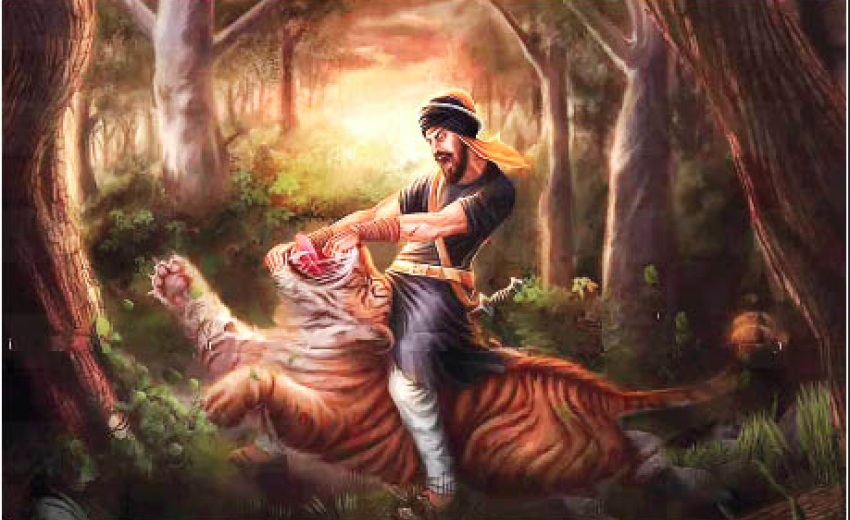
The party rode through forest thick with wet earth and old wood when the tiger came; not gradually, not as a warning, but all at once, the way catastrophe always arrives. It took his horse with a single, devastating swipe. The other hunters wheeled around, weapons drawn, shouting. 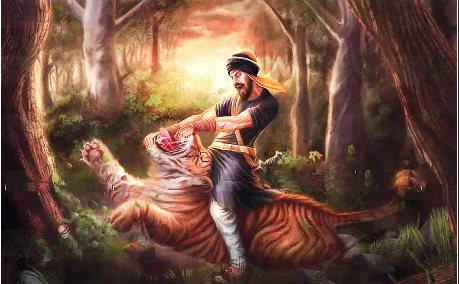
"Stay back," Hari Singh said.
His voice was steady. This detail would become legend; the sheer, impossible steadiness of it.
What followed was witnessed by several men, all of whom would recount it slightly differently for the rest of their lives, as is the nature of extraordinary things. What they agreed upon: the young man, unhorsed, armed only with a dagger and a shield, faced the tiger alone. The animal lunged. He moved. The dagger found its mark.
When it was over, he stood over the fallen beast in silence, breathing hard, blood on his hands that was not entirely his own. For this feat, he earned the name Baghmar – “Tiger-killer”. Later, when Maharaja Ranjit Singh himself witnessed him slay a lion (a nal) in combat, the Maharaja gave him the name that would ring across mountains and centuries alike: Nalwa. The Lion-killer.
No one understood yet that they had named a legend twice.
******
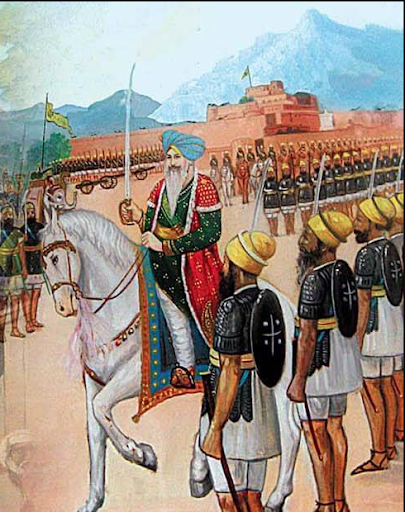 The Sikh Empire expanded the way a great river expands in monsoon season: not violently, but with an inexorable certainty that renders violence largely unnecessary. Kasur fell in 1807, when Nalwa was sixteen, commanding men twice his age with a composure that silenced every doubter. Sialkot fell next, his first independent command; two days of brutal engagement that ended with the Sikh flag flying above the fort and a seventeen-year-old general standing below it, watching the wind take the cloth. Multan. Attock. Kashmir. Peshawar. Each fortress, each valley, each mountain pass fell before the Khalsa cavalry, and at the vanguard, always, rode Hari Singh Nalwa.
He was not a cruel man. This demands to be stated plainly, because cruelty would have made him merely frightening, and Nalwa was something rarer; he was incomprehensible. The Sikh code he embodied was iron in its clarity: women, children and the elderly were not to be harmed, and surrender was to be honoured. These were not courtesies. They were the laws of the Khalsa, and Nalwa enforced them as rigorously as he enforced every other discipline of war.
On the battlefield, however, he was the storm that does not negotiate with trees.
By 1818, when Peshawar fell, the Pashtun tribes had already developed a peculiar, involuntary intimacy with his name. Fear has its own grammar, its own idioms, and across the mountain villages beyond the Khyber Pass, Nalwa's name had entered the most private vocabulary of domestic life. When a child wept through the night and resisted every comfort, a mother would draw the infant close in the darkness and murmur:
"Khamosh bash- Haria raghle” (Be quiet. Haria is coming).
He had become the monster mothers invented for their children, except that he was entirely, undeniably real.
******
It was sometime during those years of compounding defeat; after Attock, after Nowshera, after the gates of Peshawar swung open before the Khalsa, that a particular form of desperate ingenuity began to take shape in the minds of Pashtun men. The Sikh soldiers sweeping through the passes were disciplined observers. They could identify a Pashtun warrior by his loose Arab-style robe, by the cut of his garment, by the bearing of a man who had been raised on the code of Pashtunwali; the honour-architecture of an entire civilization. What these soldiers were forbidden by the Sikh code to touch was a woman.
And Sikh women wore the shalwar kameez.
The wide, flowing tunic over loose trousers: modest, practical, and unmistakably feminine in the Punjabi tradition. It was the garment of Hari Singh Nalwa's own mothers and sisters. His own soldiers would pass it without a second glance.
Imagine the first Pashtun man who made that calculation. Perhaps he stood in a small, dark room, holding borrowed cloth, the fabric utterly foreign in hands that had held swords. Pashtunwali was not merely a cultural preference; it was spiritual architecture. To be a Pashtun man was to inhabit a particular form of fearless dignity so completely that its loss would feel like the loss of self. And yet.
Yet dignity is difficult to maintain when you are dead.
He dressed himself in the shalwar kameez. He walked out into a world patrolled by Nalwa's soldiers.
They passed him by.
The knowledge spread the way only urgent, shameful, necessary knowledge spreads: quietly, between men who trusted each other absolutely, through whispered channels. Other men did it. Then more. The survival strategy of the defeated became, over the years, the daily garment of the frontier. Over the decades, the shalwar kameez grew wider, longer, and cut differently for the mountain wind; it became so thoroughly absorbed into Pashtun identity that future generations would consider it ancestral, call it the Pathani suit, and wear it as an emblem of masculinity they had no memory of once fleeing.
The original folklore survived not in chronicles but in memory; in oral tradition, in the testimony of the Wali of Swat, Miangul Aurangzeb, who still felt compelled to write of it in a letter as late as the early twenty-first century, nearly two hundred years after the events it described. He wrote of it because it was true, or because it felt true, which in the life of a people amounts to the same thing.
The mountains had accepted this irony without comment. They were accustomed to irony. They had seen empires come through the Khyber thinking they owned the wind, and they had watched those empires dissolve.
******
In April of 1837, a wedding invitation arrived in Peshawar. Maharaja Ranjit Singh's grandson, Nau Nihal Singh, was to be married in Lahore, and the great men of the empire were summoned to celebrate. Nalwa read the message and set it aside. 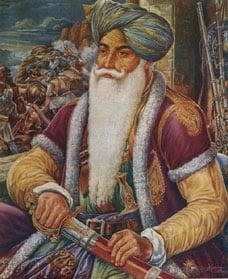
His commanders expected him to go. A Maharaja's grandson's wedding was not an occasion one declined. But Nalwa had spent thirty years developing an instinct that operated below the level of intelligence reports, in some region of the body where experience becomes reflex. Dost Muhammad Khan was out there, watching the passes, calculating with the patience of a man who had been waiting for exactly this: the great general absent, the fort lightly manned, the empire distracted by the music of celebration.
"I will not go," Nalwa said. "The frontier cannot be left unattended for a party."
He was correct. Almost immediately, reports confirmed his fear: Dost Muhammad Khan's forces, numbering in the thousands, had surrounded Jamrud Fort at the mouth of the Khyber Pass. Mahan Singh held the fort with six hundred men. The walls were stone; they would hold. The soldiers' courage was steel; it would hold. But without Nalwa, holding was all they could do; and the question of how to reach him through miles of enemy-held terrain appeared, to most people in that besieged fort, unanswerable.
A woman named Harsharan Kaur stepped forward.
She was a soldier's companion stationed at the fort; one of those women who followed the Khalsa army and whose bravery the histories have never sufficiently honoured. In the dim lamplight, with cannon fire rumbling somewhere in the dark beyond the walls and six hundred soldiers pressed against the stone, she faced Mahan Singh and spoke with a clarity that cut through every other sound in the room.
"I will not hesitate to lay down my life and will make every effort to reach Peshawar. If you hear cannon fire tomorrow morning, you will know I have succeeded. If you do not hear it, you may presume I have fallen."
The room was silent.
Then a voice, someone's voice, said softly: "What a fearless woman you are, dear sister."
She left at ten o'clock that night, alone, moving through terrain held entirely by Pathan soldiers, navigating darkness and danger by memory, nerve, and a will that had apparently decided it was not her night to die. She reached Peshawar at two in the morning. The cannon fire sounded at dawn.
******
Nalwa was ill. His body had been accumulating the debts of thirty years of relentless campaigning, and it had recently begun to demand repayment. He mounted his horse regardless. Illness has never been able to negotiate terms with duty, and he did not grant it the attempt.
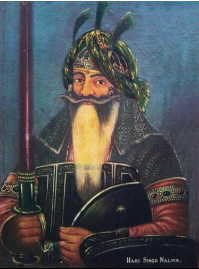 When word reached Dost Muhammad Khan's army that Nalwa was riding toward Jamrud, something happened that speaks more eloquently than any formal military account: an army vastly outnumbering the Sikh garrison hesitated. Paused. Recalculated. This is what a reputation built across three decades will do: it arrives before the man does, and it is larger than he is.
Nalwa reached Jamrud. He fought with everything that remained in him, and what remained was still formidable. But somewhere in the chaos and blood of that April battle, a wound found him that Will alone could not overcome. He called his commanders close. His voice, they would later say, was as steady as it had been over the body of the tiger thirty-three years before.
"Do not tell them I am dead," he said. "Not until Lahore sends reinforcements."
They obeyed. For hours, the fact of his death was kept sealed inside the walls of Jamrud Fort, and in that silence, in the not-knowing, Dost Muhammad Khan's forces continued to conduct themselves as though Nalwa still breathed. They withdrew. They fell back into the Khyber, not because they had been defeated, but because they could not be certain they hadn't been.
When the Afghan forces had retreated fully into the pass, the Sikhs released the news.
Dost Muhammad Khan stopped his horse. He turned to look back at the fort. A long silence settled over the mountain air, the particular silence of a man recalibrating everything he thought he understood.
"We have won the battle," he said at last, "but lost the war." Then, after a pause that carried the full weight of what he was acknowledging: "If such was the fight of the Sikhs without Nalwa, what would it have been with him alive?"
******
Hari Singh Nalwa was cremated inside Jamrud Fort on the thirtieth of April, 1837. He was forty-six years old. Within a decade, the British would annex the Punjab, and the Khyber Pass would become their imperial obsession. They would spend the remainder of the century and the early part of the next discovering what Nalwa had demonstrated in a single career: that these mountains did not yield to administrative confidence or superior numbers alone. They required someone the mountains recognized.
The poets came: Sikh, Hindu, Muslim alike, reaching across language and faith for adequate words and finding, as poets always find when confronted with the genuinely extraordinary, that adequate words do not quite exist. They wrote anyway. A nameless Kabbit was passed down through generations of Dhadi singers, keeping him alive in the oral tradition. Sikh mothers invoked his name to inspire courage in their sons. Pashtun mothers invoked the same name to frighten their children into silence. He inhabited both traditions simultaneously, saint in one, ghost in the other; perhaps the truest measure of how completely one human life had pressed itself into the consciousness of an entire region.
And in the Pathani suit: in the wide, wind-catching folds of the shalwar kameez that the Pashtun had worn for so long, they had forgotten its borrowed origins; something of him persisted, too. Not as mockery, and not as triumph. As the indelible record of power so absolute that it altered what people wore against their skin, how they moved through the world, what they became when they looked in the reflection of still mountain water and no longer recognized the shape of their own fear.
The mountains had known this was coming. They had been watching the Khyber for eight centuries, and they understood, better than any historian, that the most lasting conquests are never the ones written in treaties. They are written in habit, in cloth, in the small daily gestures of people who have forgotten why they do the things they do.
Hari Singh Nalwa died at Jamrud. The fort still stands at the mouth of the Khyber Pass, stone against the mountain wind. And according to the folklore that refuses to die, that the Wali of Swat still felt compelled to record two hundred years later, he is present still in the folds of the shalwar, fluttering in that same wind, the conquered wearing the shadow of the conqueror without knowing it, the mountains watching, as they always have, without comment.
******