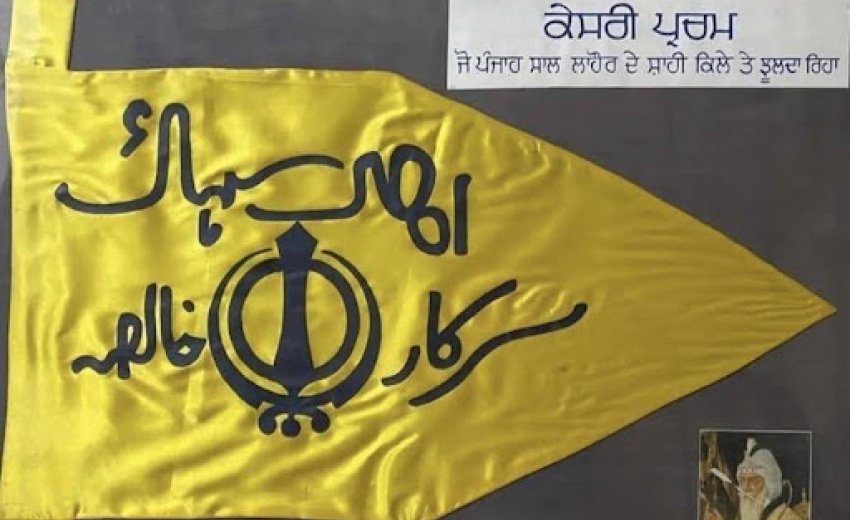

The Sikh invocation “Akal Sahāe” (ਅਕਾਲ ਸਹਾਇ / ਅਕਾਲ ਸਹਾਏ), meaning “May the Timeless One be my Helper” or “The Eternal One is my Support,” occupies a significant place in Sikh religious, military, and cultural traditions. More than a devotional expression, it represents a profound theological affirmation of absolute reliance upon Akal Purakh (the Timeless Supreme Being), whose sovereignty transcends temporal authority, political power, and worldly fear. Throughout Sikh history, especially during periods of persecution and armed resistance, this invocation became a declaration of unwavering faith, moral courage, and spiritual resilience.
The word Akal literally means “Timeless,” “Deathless,” or “Beyond Time.” It derives from the Sanskrit roots a (without) and kāla (time or death). In Sikh philosophy, Akal denotes the eternal, self-existent, and formless God who is beyond birth, death, and temporal limitations.
Guru Nanak describes the Eternal Being as:
Ādi Sach, Jugādi Sach, Hai Bhī Sach, Nānak Hosī Bhī Sach.
“True in the beginning, True throughout the ages, True now, and forever shall remain True.”
This concept finds its fullest expression in Guru Gobind Singh’s compositions, particularly in the Akal Ustat and Jaap Sahib, where God is repeatedly praised as the Timeless Sovereign beyond all distinctions of caste, creed, nation, or form.
Thus, “Akal Sahāe” is not merely a prayer for assistance but an affirmation that ultimate support comes only from the Eternal One.
The Persian-derived word Sahāe means helper, protector, supporter, or guardian. When joined with “Akal,” the phrase signifies complete dependence upon divine grace rather than worldly authority.
Unlike ordinary blessings that invoke human assistance, “Akal Sahāe” directs the believer exclusively toward the Divine.
Although the precise phrase “Akal Sahāe” does not appear verbatim in the Guru Granth Sahib, its theological essence permeates Sikh scripture.
Guru Arjan writes:
Tū Merā Pitā Tū Hai Merā Mātā.
“You are my Father; You are my Mother.”
Similarly:
Rākhā Ek Hamārā Swāmī.
“The One Lord alone is my Protector.”
Such verses establish the doctrinal foundation upon which the later Sikh salutation evolved.
The doctrine assumed greater practical significance during the time of Guru Hargobind Sahib (1595–1644). Following the martyrdom of Guru Arjan, the Sixth Guru introduced the doctrine of Miri-Piri, integrating temporal responsibility with spiritual authority.
The Sikh community increasingly viewed military resistance as an ethical obligation against oppression. Reliance upon Akal Purakh became inseparable from martial courage.
Before entering battle, Sikhs invoked the Divine rather than seeking protection from earthly rulers.
The phrase gained widespread prominence under Guru Gobind Singh (1666–1708), whose writings repeatedly affirm that victory belongs solely to the Timeless One.
The famous Khalsa salutation concludes:
“Waheguru Ji Ka Khalsa, Waheguru Ji Ki Fateh.”
Likewise, Guru Gobind Singh writes:
Deh Shiva Bar Mohe Eh…
This celebrated prayer asks not for worldly success but for steadfast courage to perform righteous deeds.
The invocation “Akal Sahāe” naturally complemented this spiritual outlook and gradually became a battlefield affirmation among the Khalsa.
During the eighteenth century, Sikh warriors commonly inscribed “Akal Sahāe” on: Letters, Military orders, Hukamnamas, Weapons, Standards and Official correspondence. It functioned as both a blessing and a declaration of confidence before military expeditions. Historical manuscripts reveal that many Sikh chiefs began their correspondence with invocations such as:
Akal Sahāe
Sri Waheguru Ji Ki Fateh
These expressions reflected the conviction that military victory depended upon divine justice rather than numerical strength.
Throughout the Misl era (c. 1748–1799), Sikh confederacies frequently employed “Akal Sahāe” in diplomatic correspondence. For warriors constantly confronting Afghan invasions and Mughal persecution, the phrase became synonymous with fearlessness. It reminded Sikhs that earthly kingdoms rise and fall, but Akal alone remains eternal.
Even under Maharaja Ranjit Singh, official seals, coins, and proclamations reflected the principle that sovereignty belonged to the Divine rather than the monarch. Although the royal coinage carried the names of Guru Nanak and Guru Gobind Singh, the underlying political philosophy remained rooted in the sovereignty of Akal Purakh.The ruler governed as a servant rather than an absolute monarch.
Numerous historical hukamnamas preserved in Sikh archives commence with sacred invocations emphasizing divine assistance.Several manuscripts bear headings such as: Akal Sahāe,Ik Oankar,Sri Waheguru Ji Ki Fateh.These opening formulas transformed administrative documents into expressions of spiritual consciousness.
“Akal Sahāe” embodies several interconnected Sikh principles:
Divine Sovereignty: Ultimate authority belongs only to Akal Purakh.
Fearlessness: Dependence upon God removes fear of worldly powers.
Humility: Human achievement is understood as the result of divine grace rather than personal pride.
Justice: Divine assistance is sought only in righteous causes.
Collective Identity: The invocation unites Sikhs across social, political, and geographical divisions.
The expression frequently appears in Sikh historical narratives, oral traditions, and family correspondence. Traditional Sikh letters often commenced with:
Akal Sahāe
followed by:
Waheguru Ji Ki Fateh
This convention conveyed respect, humility, and remembrance of God before worldly communication. Among Nihang Singhs and other traditional Sikh orders, the invocation continues to accompany martial ceremonies, religious gatherings, and historical commemorations.
In modern Sikh life, “Akal Sahāe” retains deep spiritual resonance. It reminds believers that true strength arises from ethical conduct, faith, and divine grace rather than political power or material success. Whether uttered before embarking on a difficult task, inscribed in correspondence, or remembered during moments of adversity, the invocation continues to inspire resilience, humility, and steadfast commitment to justice. In a world often marked by uncertainty, “Akal Sahāe” remains a timeless affirmation that the Eternal One alone is the ultimate source of guidance, protection, and hope.
The invocation “Akal Sahāe” encapsulates the essence of Sikh spirituality and historical consciousness. Rooted in the doctrine of the Timeless One and nurtured through the lived experiences of the Gurus, the Khalsa, and successive generations of Sikhs, it expresses absolute trust in divine sovereignty while encouraging fearless engagement with the moral challenges of the world. More than a customary greeting or blessing, it is a theological declaration that human endeavor attains its highest purpose only when guided by the Eternal. Consequently, “Akal Sahāe” continues to symbolize the inseparable union of faith, courage, humility, and righteous action that lies at the heart of the Sikh tradition.
Selected References
-
Guru Granth Sahib. Shiromani Gurdwara Parbandhak Committee, Amritsar.
-
Dasam Granth, especially Jaap Sahib, Akal Ustat, and Bachittar Natak.
-
Guru Gobind Singh. Shabad Hazare and related compositions.
-
Kapur Singh. Parasaraprasna. Singh Brothers, Amritsar, 1989.
-
Harbans Singh (ed.). The Encyclopaedia of Sikhism. Punjabi University, 1992–1998.
-
J. S. Grewal. The Sikhs of the Punjab. Cambridge University Press, 1990.
-
W. H. McLeod. Historical Dictionary of Sikhism. Scarecrow Press, 2005.
-
Ganda Singh (ed.). Hukamnamas. Punjabi University.
-
Rattan Singh Bhangu. Panth Prakash (various scholarly editions).
-
Kahn Singh Nabha. Mahan Kosh. Bhasha Vibhag Punjab, Patiala (reprint editions).