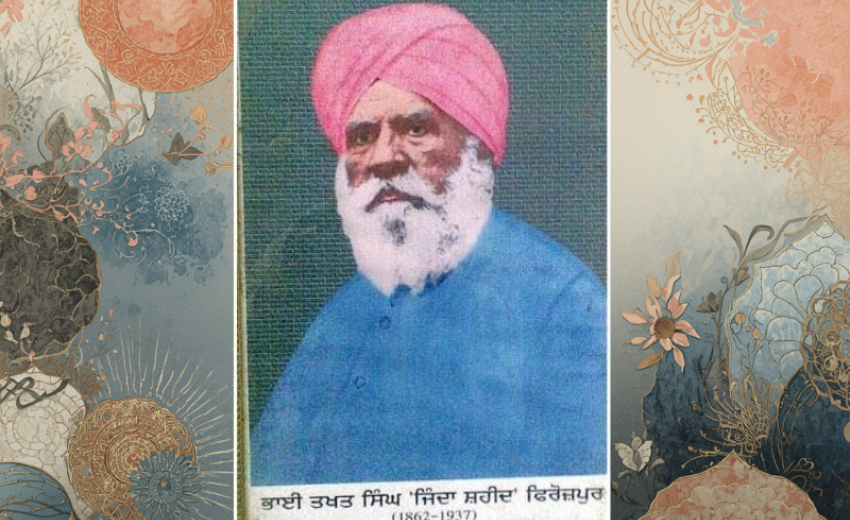

Bhai Takhat Singh Zinda Shaeed:
A Great Missionary and pioneer on Women Education
Prof Emeritus Desh Bhagat University
Bhai Takhat Singh of Ferozepur was a rare missionary and a pioneer of women education in nineteenth century. He was a great dedicated and committed Sikh Teacher and Preacher as well. He started a school for boys in 1890 and the first school for girls later known as Sikh Kanya Mahavidalya, Ferozepur in 1892. Those were the days when education for girls was a taboo. He had difficulty in finding students for starting classes. In his words, "When I approached Singh Sabha for opening a girl's school, only a few supported the idea. There were numerous objections. Someone said, "Are they to do service after studies?" Someone else said, "Girls will get spoiled after their studies. They will write letters to their boyfriends. No secrets can be safe from them." Another said, "Only the shameless will send their daughters to an unmarried man for schooling."
Bhai Takhat Singh cleared all their doubts and allayed their fears, and they finally agreed for a school for girls. The problem of students followed. No one was ready to send their daughters to the school, not even those who had agreed to open the school. Bhai Takhat Singh tried to convince some of the families to send their daughters to the school, but all in vain. All running and winning around proved fruitless. Many new objections cropped up. Non-supporters created further hurdles by propagating against the school and heated discussions on the topic in the city created a bad environment.
Finding all efforts turning fruitless, Bhai Takhat Singh entered into a prayer, requesting the Lord to help him in carrying forwards the aim. As Bhai Sahib went into deeper meditation, he felt relieved of his worries. It appeared to him as if he became light; reaching the feet of the Tenth Lord, Guru Gobind Singh. He found Guru Gobind Singh pleased who blessed him saying, "Don't worry, everything will be alright with the Grace of God."
This was a turning point. As he came out of his meditation, someone knocked on his door. It was the lawyer Chanda Singh, who broke the pleasant news, "Three girls have agreed to join school. Their studies will be at my house initially." Bhai Takhat Singh was amazed at the sudden outcome of his prayer. While the discussion about the processes and methodologies for teaching was going on, Sardar Prem Singh entered, "Congratulations, I have two girls who have agreed to go to school. They will go to Dharamsala." It appeared a real miracle.
With the two girls joining the school, another girl joined them. All three were over ten years. A wave of criticism started in the town. People started taunting the parents. The girls were stopped as a result. However, when their fathers went to work, these girls came to school stealthily. The mothers treated the girls shabbily. They were kept hungry. Their hair tied to the door, they were thrashed mercilessly, but the girls turned out to be brave and determined. The parents finally gave up. Their determination attracted other girls, and the number gradually grew.
The school was started in a Dharamsala, with a curtain dividing boys and girls. Bhai Takhat Singh was the teacher, manager and helper; running the school single-handed. Later Bibi Harnam Kaur joined him to assist in teaching and managing the girls as the number of girls grew. They both married subsequently and remained totally dedicated to the school. As the running of the school became difficult within the given resources, the family sold all the belongings. Bibi Harnam Kaur even sold her ornaments. As the number grew to over 300, the construction of the building and hostels became a dire necessity.
Bhai Sahib along with a group of missionaries left for East Asian countries and China with a begging bowl to meet the urgent requirement of Rs. 50,000/- for the construction of building and hostels. The ordinary pay of a teacher at that time was Rs 5/- or 6/- which now is around 20,000. If we consider the value of the required amount in the present context it turns out to be around 50,000 x 4,000= Rs. 200,000.00 - i.e. 20 crores. Collecting such a large amount in those days from the general public at a time when no one was in a position to even spare a rupee, was a tremendous task.
Bhai Takhat Singh started with a missionary zeal and set out for the unknown lands with a vow that, "He will only return if he collects Rs. 50,000". His friends and well-wishers prayed for his vow to be fulfilled but were clear that the collection of such a large amount was impossible and that he will have to give his life in a foreign land only. Hence, he was called Zinda Shaheed (living martyr). However, Bhai Takhat Singh made the impossible possible and returned with the amount much before the expected period of three years. The school was constructed with this collected amount and is a great architectural design and a historical monument. Not only he but also his entire family remained devoted to the school which flourished ever since despite numerous difficulties.
The school was only one of the important objectives of Bhai Sahib. He set up a very valuable library with rare manuscripts and books collected on Sikh history. This library was used as a reference library by such literary alumni as Bhai Kahn Singh Nabha, S. Karam Singh Historian and Bhai Teja Singh Panch khand Bhasod. He prepared 5 sets of 25 missionaries for preaching religion and had the best Sikh preacher of the period employed for this. He established Singh Sabha centre at Ferozepur and worked closely with Bhai Gurmukh Singh and Gyani Ditt Singh. He was very active in organizing and conducting the functions of Khalsa Diwan along with Bhai Jodh Singh and Sardar Harbans Singh Attari.
He helped Sikh scholars like Bhai Kahn Singh, Sardar Karam Singh Historians, Bawa Prem Singh Hoti Mardan, S Sardul Singh Kaveeshar, Bhai Teja Singh Panch khand Bhasaur, S. Harbans Singh Majithia of Khalsa Diwan, Bhai Jodh Singh, Gyani Ditt Singh and Bhai Veer Singh, to quote a few, but also provided them guidance, financial assistance and books from his libraries. He was in regular correspondence with most of them.
Some rare information available from the shelf of Bhai Tkhat Singh provides guidelines to the historians for future research. A few extracts are given below: -
1. The Tenth Guru had sent the translation of Sri Guru Granth Sahib in Persian to Aurangzeb. The same is available with father-in-law of S. Lehna Singh Gyani of Amritsar.
2. Guru Gobind Singh's signatures exist in the purohit vahi in Dharamsal Sodhian at Hardwar.
3. Sahibzadi Roshan Ara read Sri Guru Granth Sahib to Shah Jehan in jail.
4. Baba Banda was arrested at Bohl. An old Gurdwara commemorates the event.
5. Bhai Santokh Singh was born at Dattakar, wrote Suraj Parkash at Kaithal and Nanak Parkash at Boodia.
The contributions of Bhai Takhat Singh are monumental and needed to be inscribed in golden letters. His mission was carried forward by his son Pritam Singh daughters Pritam Kaur and Gurbaksh Kaur who remained the principals of the school until they moved for superior positions. The mission has now been taken over by his granddaughter Dolly Singh who started another school at Kapurthala, Sikh Kanya Mahavidyalia, which flourishes till this date with over 700 students.