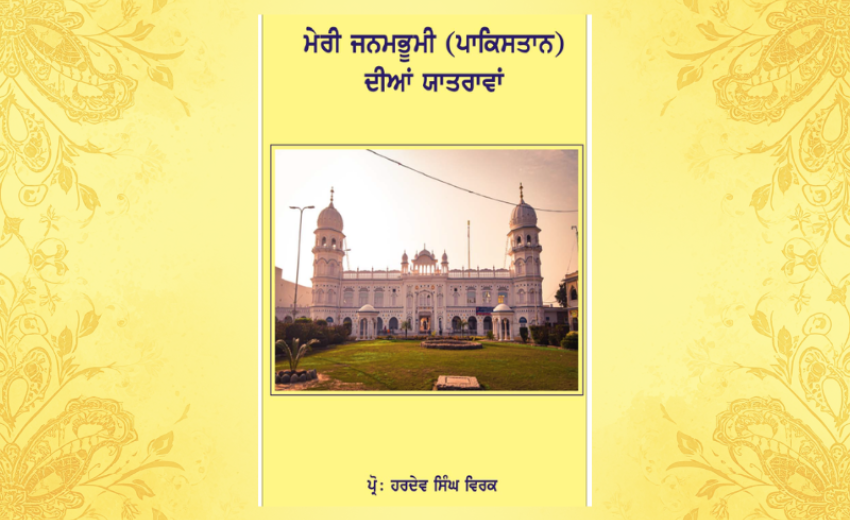

(My Travels to My Birthplace – Pakistan)
Book Title : Meri Janambhumi (Pakistan) Dian Yatravan
Author : Prof. Hardev Singh Virk
Published by : South Asia Research Center of India
Year of Publication : 2026; Price: Free Online Copy, Pages: 51
A Physicist's Pilgrimage Across a Divided Punjab
There is a particular kind of longing that only those displaced by Partition can truly understand: the yearning to return to the soil where one first breathed, where one's roots run deep beneath houses now occupied by strangers, beneath streets that carry different names, beneath a sky that belongs to a different nation. Hardev Singh Virk's Meri Janambhumi (Pakistan) Diyan Yatravan is an intimate, deeply personal account of that longing being fulfilled, not once but four times over four decades. Written in Punjabi, the book chronicles the author's journeys to Pakistan in 1981, 1983, 1988, and most recently in 2024, weaving together the threads of personal memory, scientific achievement, cultural observation, and the bittersweet experience of returning to a homeland forever altered by history.
Hardev Singh Virk is not an ordinary travel writer. A professor of physics at Guru Nanak Dev University, Amritsar, he is a man of science who has published nearly fifty books and contributed extensively to physics research across international platforms. That a scientist of his calibre should write with such tenderness and emotional depth about ancestral villages, Sikh shrines, and partition memories speaks to the complexity of identity that the 1947 division of Punjab produced in those who lived through it, or in Virk's case, who were carried through it as a six-year-old child.
The author is candid about his motivations in the preface. Two reasons compelled him to write: the desire to meet his goal of fifty published books, and the requests from friends and readers in his village to share the story of his birthplace. At eighty-four years of age, conscious that his health may not permit further travel, this book reads as both a memoir and a farewell; a final reckoning with the land he left behind as a child.
The account of the first Pakistan visit in 1981 is the most emotionally charged section of the book. Virk had travelled to Nathia Gali in Pakistan's hill station region to attend an international physics summer school organized under the auspices of ICTP (International Centre for Theoretical Physics, Trieste), under the patronage of the Nobel Laureate physicist Professor Abdus Salam. The summer school itself brought together physicists from across Asia and Africa, including Nobel Prize winners, in an intellectually stimulating environment set against the dramatic Himalayan landscape.
But it is the personal detours of the visit that form the narrative's emotional core. Virk's anxiety at crossing the Wagah border, the memory of the 1947 massacres still vivid through his mother's stories, is palpably rendered. His hesitation to step out of his French friend's house in Lahore, the near-paranoid sense that Pakistan was enemy territory, gives way gradually to the discovery of ordinary human warmth. A fellow passenger on the bus who addresses him as "Sardar ji" and helps him find his way; the residents of Lahore's streets going about their daily lives with an ease that dissolves his fear, these small moments constitute one of the book's central arguments: that the people of divided Punjab, separated by a political line, remain bound by language, culture, and an instinctive sense of kinship.
The visit to Kamoke, his ancestral town in Gujranwala district, is extraordinarily moving. Walking through the lanes of his childhood neighbourhood, recognizing the house where his family lived before the Partition exodus, being embraced by the descendants of Muslim families who remembered his people, Virk is reduced to tears by the widow Mirasan, who had once fed bread to his grandmother when she was left behind alone. The generosity of strangers who are not quite strangers, bound by the old ties of neighbourhood, emerges as one of the book's most powerful themes.
The second and third visits carry a dual character: part scientific mission, part emotional homecoming. The 1983 trip to Lahore for an international conference on Renewable Energy, and the 1988 visit for the 14th International Solid State Nuclear Track Detector Conference, both demonstrate how academic diplomacy can occasionally achieve what political diplomacy fails to do: bring people together across hostile borders.
Virk's descriptions of these conferences are rich in detail. He notes with pride that his research group submitted more papers than any other Indian delegation at the 1988 conference, and that an Australian professor was so impressed with his presentation that he offered to publish his research paper - a small but satisfying vindication of cross-border scientific collaboration. He also registers quiet indignation at the exclusion of Indian delegates from the Pakistani Prime Minister's special flight to Swat Valley, arranged for foreign delegates - a pointed reminder that political hostility can intrude even into the most collegial scientific settings.
The visits to Nankana Sahib, the birthplace of Guru Nanak, carry deep spiritual weight on each trip. Virk describes the gurdwara in its 1981 form, still in its original, unmodernized state. By the time of his 2024 visit, Nankana Sahib had transformed considerably: a new Baba Guru Nanak University had been established there by the Pakistani government, with its architecture echoing the gurdwara's domes. Virk delivers a lecture there on water pollution in Punjab's rivers, a subject that bridges the two nations' shared environmental crisis, and meets Pakistani academics with genuine warmth and scholarly curiosity.
The final and most recent journey, undertaken in December 2024 at the age of eighty-two, is the most expansive section of the book. This time, Virk travels not merely as a scientist attending a conference, but as an old man revisiting his roots, fully aware that this may be his last opportunity to do so. He travels to Kamoke again, to his mother's birthplace, Mazhiwala in Lyallpur (now Faisalabad) district, to Lahore's historic monuments, and to the birthplace of Bhagat Singh in the village of Banga.
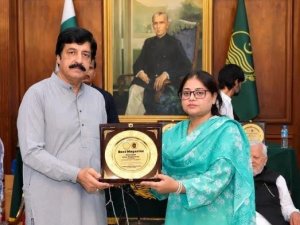
The visit to Mazhiwala is organized with remarkable hospitality by Mushtaq Ahmad Gill, an engineer whose family migrated from the village Nag Kalan in Amritsar district during Partition. Mushtaq's 90-year-old mother still lives in the village. A welcome ceremony is arranged at the local school, where girls shower him with rose petals, the first such reception of his life, he notes with touching humility. A tree is planted in the school compound bearing the names of Virk and his mother. The old peepal tree in the gurdwara courtyard, under which Mushtaq himself had received his primary education, still stands.
The visit to the Bhagat Singh museum in village Banga, maintained entirely through the private efforts of Chaudhri Saqib Ali Virk (a Muslim who shares Virk's clan name), is a remarkable moment of shared historical pride. The walls of the house display photographs of Bhagat Singh and his companions, and the berry hedge grown by Bhagat Singh himself is preserved. That a Muslim Pakistani family should devote itself to honouring a Sikh revolutionary martyr speaks eloquently to the tangled, inseparable histories of the two Punjabs.
Throughout all four journeys, Virk consistently challenges the media-driven narrative of Pakistan as an enemy nation. He observes that ordinary Pakistanis are welcoming, hospitable, and nostalgic for the pre-Partition bonds across communities. He notes, with some sadness, the visible spread of religious conservatism in Lahore, women in burqas even in universities, and reflects on how political Islam has constrained social life in ways that seem alien to the shared Punjabi culture he remembers. He is equally critical of India's border signage at Wagah, which reads "First Line of Defence" rather than "Welcome to India," a piece of state-sponsored hostility he finds petty and counterproductive.
His vision throughout is of two Punjabs that must find their way back to each other, not through political resolution alone, but through cultural exchange, trade, academic collaboration, and the simple human act of remembering that one's neighbour across the border was once one's neighbour down the street.
Meri Janambhumi (Pakistan) Diyan Yatravan is a book that belongs to a rare and precious genre: the Partition memoir that refuses bitterness. Hardev Singh Virk writes with the clarity of a scientist, the tenderness of a son, and the hope of a man who has lived long enough to know that hatred is a choice, not a destiny. This book deserves a wide readership in both Punjabs, and an English translation would extend its reach far beyond the Punjabi-speaking world. It is, ultimately, not just a travelogue but a testament, to the endurance of human connection across the most artificial of borders.