
Abstract
The rise of social media influencers has transformed the dynamics of communication, authority, and behavioural influence in contemporary society. Platforms such as Instagram, YouTube, and TikTok have enabled individuals to shape opinions, consumer habits, and even moral outlooks at an unprecedented scale. While much of this influence is transient and algorithm-driven, it raises deeper philosophical questions about the nature of influence, perception, and human consciousness. This paper examines social media engagement and influencer culture through a Sikh philosophical lens, particularly drawing upon concepts such as mann jeetai jag jeet (the conquest of the mind as the conquest of the world) and Gurbani’s articulation of Maya (illusion). By situating digital behaviour within Sikh metaphysics, the study explores how influencer culture can both entrap individuals in cycles of illusion and serve as a potential medium for ethical and spiritual dissemination. The paper argues that while social media often amplifies ego-driven and ephemeral engagement, Sikh teachings provide a framework for mindful participation, ethical influence, and liberation from psychological conditioning.
1. Introduction
The digital age has redefined human interaction, creating a virtual public sphere in which individuals, commonly referred to as influencers, hold significant authority over audience perceptions. Unlike traditional authority figures, influencers derive legitimacy from relatability, visibility, and engagement metrics rather than institutional validation. Consequently, influence has become democratized yet simultaneously commodified.
However, this phenomenon is not merely technological; it is deeply psychological and philosophical. The rapid consumption of curated content, the pursuit of validation through likes and shares, and the tendency to imitate admired figures reflect underlying processes of cognition, desire, and identity formation.
Sikh philosophy, as articulated in the teachings of Guru Nanak and subsequent Gurus, offers a profound framework for understanding such dynamics (Singh, 2024; Singh, 2025a). Central to this framework is the concept of the mind (mann) as both the source of bondage and liberation. The oft-quoted Gurbani verse, mann jeetai jag jeet (Jap (u), SGGS, p. 6), encapsulates the idea that mastery over one’s internal tendencies leads to true sovereignty over external influences.
This paper seeks to bridge contemporary digital culture with timeless Sikh insights, examining whether social media engagement represents a new manifestation of Maya and how individuals can navigate this space with spiritual awareness.
2. The Nature of Influence and Engagement in Social Media
Social media engagement operates through cycles of attention, emotional stimulation, and behavioural reinforcement. Influencers establish parasocial relationships with their followers by consistently producing relatable or aspirational content. These relationships often blur the boundary between authenticity and performance.
From a Sikh perspective, such engagement can be understood through the interplay of the five inner tendencies: kaam (desire), krodh (anger), lobh (greed), moh (attachment), and ahankar (ego). Influencer culture frequently activates these tendencies:
- Desire (Kaam): Through aspirational lifestyles and material displays
- Greed (Lobh): Through consumerist messaging and brand endorsements
- Attachment (Moh): Through emotional dependence on digital validation
- Ego (Ahankar): Through self-promotion and comparison
The algorithmic structure of platforms amplifies these tendencies, creating a feedback loop where both influencers and audiences become participants in a system driven by psychological impulses rather than conscious awareness.
3. Maya and the Digital Illusion
In Sikh thought, Maya does not merely refer to material wealth but encompasses the broader illusion that transient phenomena are permanent or ultimately fulfilling. Gurbani repeatedly emphasizes the deceptive nature of appearances and the human tendency to become entangled in them (Singh, 2025).
Social media can be interpreted as a contemporary manifestation of Maya:
- Curated realities present an illusion of perfection
- Metrics (likes, followers) create a false sense of worth
- Viral trends generate fleeting significance
These elements mirror Gurbani’s warning that worldly attractions, though captivating, are inherently unstable. The digital persona, carefully crafted and publicly consumed, becomes a modern extension of illusion, often detached from inner truth.
Yet, Sikh philosophy does not advocate withdrawal from the world but emphasizes living within it with awareness. Thus, social media is not inherently problematic; rather, unconscious engagement with it leads to entrapment.
4. Mann Jeetai Jag Jeet: Inner Mastery in a Digital Age
The principle "mann jeetai jag jeet" (Jap (u), SGGS, p. 6) offers a powerful counterpoint to the externalized nature of social media influence. It suggests that true empowerment lies not in controlling others or gaining followers but in mastering one’s own mind.
Applied to digital engagement, this principle implies:
- Critical Consumption: Recognizing the constructed nature of content
- Emotional Regulation: Avoiding reactive engagement driven by envy or validation- seeking
- Intentional Creation: Producing content that aligns with ethical and spiritual values
For influencers, this teaching challenges the pursuit of popularity at the cost of integrity. For audiences, it emphasizes discernment, choosing what to internalize and what to reject.
Thus, the locus of control shifts from the external (followers, views) to the internal (awareness, intention).
5. Ethical Influence and Seva in the Digital Sphere
Sikhism places great emphasis on Seva (selfless service) and Sarbat da Bhala (welfare of all) (Singh, 2019). When applied to social media, these principles redefine the purpose of influence.
Ethical influencers, from a Sikh perspective, would:
- Share knowledge that uplifts and educates
- Promote inclusivity and compassion
- Avoid manipulation, misinformation, or exploitation
In this sense, social media can become a tool for Gurmat-aligned dissemination: spreading wisdom, fostering community, and encouraging introspection.
However, this requires a conscious shift from self-centred expression to service-oriented communication, which is often at odds with prevailing digital incentives.
6. Audience Responsibility and Collective Consciousness
While influencers play a visible role, the audience is equally responsible for sustaining digital culture. Engagement patterns: likes, shares, comments, collectively determine what content thrives.
From a Sikh viewpoint, this reflects the principle of collective karma and consciousness. When audiences reward superficial or unethical content, they reinforce Maya-driven systems. Conversely, mindful engagement can elevate the quality of discourse.
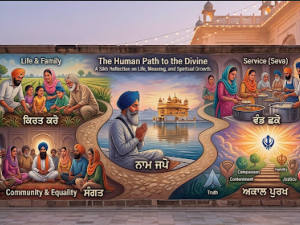
The Sikh emphasis on Sangat (community) highlights the importance of collective environments in shaping individual behaviour. Digital platforms can thus be seen as virtual Sangat, where the nature of interaction influences spiritual and psychological states.
7. Conclusion
Social media influencers and audience engagement represent a complex interplay of technology, psychology, and culture. While the digital ecosystem often promotes ephemeral, ego-driven influence, Sikh philosophy offers a timeless framework for navigating these challenges.
Through Maya's lens, social media can be understood as an illusory field, captivating yet transient. Through “mann jeetai jag jeet,” individuals are reminded that true mastery lies within, not in external validation (Singh, n.d). And through principles like Seva and Sarbat da Bhala, the potential of social media as a force for ethical and spiritual growth becomes evident.
Ultimately, the question is not whether influencers are beneficial or harmful, but whether individuals, both creators and consumers, engage with awareness. In aligning digital participation with inner discipline and ethical intent, one can transform social media from a space of distraction into a platform for meaningful influence and collective upliftment.
References
Singh, Devinder Pal (2019). Universal Relevance of Guru Nanak’s Teachings, The Sikh Review, Kolkata. WB. India. Part -I; 67(11). 15–21. Part-II 67(12). 19-30.
Singh, D. P. (2024, Nov. 4). Empowering Humanity: A Sikh Perspective on Artificial Intelligence. Asia Samachar. Malaysia. https://asiasamachar.com/2024/11/04/empowering-humanity-a-sikh-perspecti...
Singh, D. P. (2025). Maya – The Veil of Illusion. In: A Path to Truthful Living, by D. P. Singh. Amritsar, India: Singh Brothers
Singh, D. P. (2025a, Aug. 28). The Divine Light and the Digital Mind: A Sikh Critique of Artificial Intelligence. SikhNet. USA. https://www.sikhnet.com/news/divine-light-and-digital-mind%C2%A0
Singh, S. (n.d.). Sri Guru Granth Darpan. https://gurugranthdarpan.net/darpan.html
Sri Guru Granth Sahib (SGGS). (1983). Reprint. Amritsar, India: SGPC.