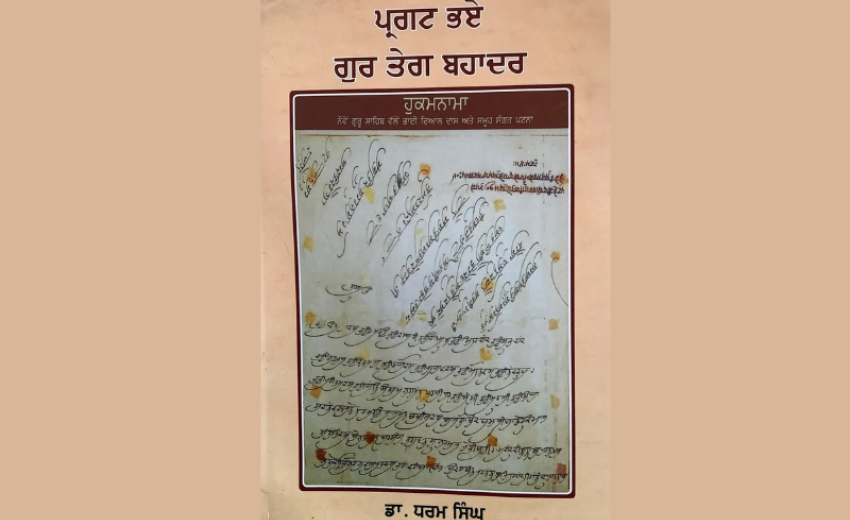

Re-reading Guru Tegh Bahadur: An Interdisciplinary Engagement with History, Bani, and Cultural Consciousness
The volume Pargat Bhai Gur Tegh Bahadur, authored by Dr. Dharam Singh and published by Navrang Publisher, constitutes a significant contribution to contemporary Sikh studies. Spread across 136 pages, this research-oriented work brings together a series of critical essays that seek to reinterpret the life, Bani, and historical positioning of Guru Tegh Bahadur through an interdisciplinary lens. The book emerges in the broader intellectual milieu shaped by the commemorations of the tercentenary of Guru Sahib’s martyrdom, a period marked by heightened scholarly engagement and renewed historiographical inquiry. At the outset, the author’s methodological stance deserves attention. Dr. Dharam Singh consciously negotiates between two dominant approaches in Sikh historiography: the empiricist-critical method grounded in modern historical analysis and the reverential interpretive mode rooted in Sikh sensibility. By attempting to synthesize these approaches, he avoids the pitfalls of reductionism—whether it be the over-reliance on speculative reasoning in the absence of sources or the uncritical acceptance of tradition. His work thus exemplifies a balanced historiographical framework that is both analytically rigorous and spiritually informed.
A central concern of the book is the semantic and theological exploration of divine praise in Gurbani, particularly in the hymns of Sri Guru Granth Sahib. The author’s discussion foregrounds the plurality of divine names, situating them within both Semitic and Indic linguistic traditions. This comparative insight not only enriches our understanding of Gurmat theology but also underscores the inclusive and universal character of Sikh thought. By examining the multiplicity of divine appellations, the study reveals how linguistic diversity becomes a vehicle for expressing theological unity.
Equally noteworthy is the author’s engagement with newly identified or underexplored textual traditions such as Sri Guru Amar Bilas and Sri Guru Arjan Bilas. These discussions reflect a philological sensitivity and a commitment to expanding the corpus of Sikh textual studies. The author critically evaluates the historical authenticity and interpretive potential of these sources, thereby opening new avenues for research in Sikh manuscript traditions. The book also makes a substantial contribution to the study of Guru Tegh Bahadur’s image in Sikh and non-Sikh sources. By juxtaposing narratives, Dr. Dharam Singh highlights the complexities and divergences in historical representation. His analysis of the Guru as the “Emperor of Sacrifice” is particularly compelling, as it situates the martyrdom within a broader ethical and civilizational framework rather than treating it as a mere historical incident. In doing so, the author aligns the Guru’s sacrifice with universal ideals of religious freedom and human dignity.
A distinctive feature of this work is its sustained engagement with the contemporary relevance of Guru Tegh Bahadur’s Bani. The author interprets Gurbani not as a static theological corpus but as a dynamic source of ethical guidance for modern multicultural societies. His reflections on themes such as social spirituality, universality, and the integration of individual and collective well-being resonate strongly with current sociological and philosophical debates. The emphasis on Gurmat as a model of socially engaged spirituality challenges the dichotomy between personal piety and social responsibility.
The technical essays included in the volume—dealing with aspects such as ‘Anjuli,’ ‘Karhale,’ ancient manuscript traditions, and Gurmukhi orthography—demonstrate the author’s scholarly versatility. These studies are particularly valuable for researchers interested in textual criticism, codicology, and the evolution of script and language. By addressing these often-overlooked dimensions, the book contributes to a more nuanced understanding of Sikh textual heritage.Furthermore, the discussion on the historical episode of the Kashmiri Pandits’ appeal to Guru Tegh Bahadur adds a critical dimension to the study of Sikh history. The author raises pertinent questions and encourages scholarly debate, thereby fostering a culture of critical inquiry rather than doctrinal closure. In terms of style, the essays are marked by clarity, coherence, and a measured scholarly tone. The author’s ability to integrate historical, literary, and philosophical perspectives results in a work that is both intellectually stimulating and accessible. While the brevity of the volume may limit exhaustive analysis on certain topics, it nonetheless succeeds in offering a cohesive and thought-provoking narrative.
In conclusion, Pargat Bhai Gur Tegh Bahadur stands as an important scholarly intervention in the field of Sikh studies. By combining historiographical rigor with theological insight and contemporary relevance, Dr. Dharam Singh has produced a work that not only deepens our understanding of Guru Tegh Bahadur but also invites readers to reconsider the broader implications of his life and teachings. The book is a valuable resource for scholars, students, and all those interested in exploring the enduring legacy of Guru Tegh Bahadur in a modern context.