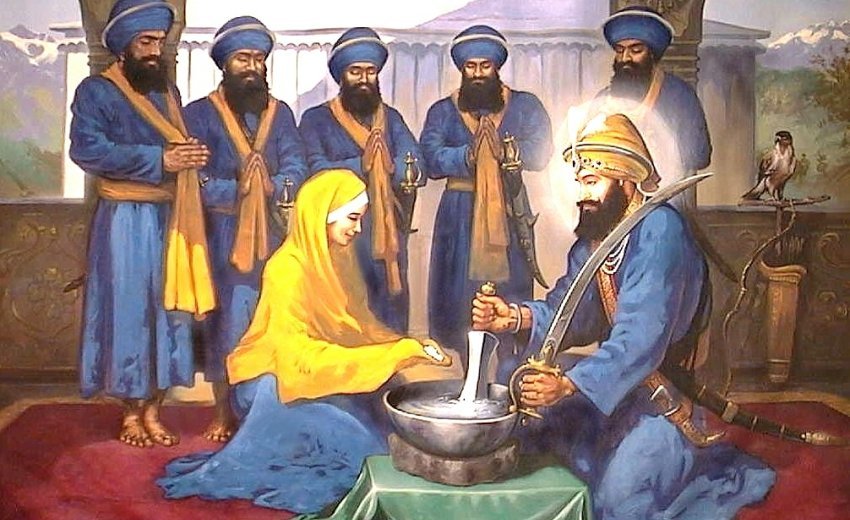

The Creation of the Khalsa
The creation of the Khalsa at Anandpur Sahib in Vaisakhi 1699 constitutes one of the most defining events in early modern South Asian religious and political history.
Emerging from decades of intensifying confrontation with Mughal absolutism, the Sikh community entered the final decades of the seventeenth century charged with a renewed moral and political purpose.
Guru Gobind Singh’s own autobiographical work, the Bachittar Natak, frames the martyrdom of Guru Tegh Bahadur as the catalytic rupture that compelled a fundamental re-shaping of the Sikh collective:
“Dharam het saka jin kiya, sis diya par sir na diya”¹
(“For the sake of Dharma, he gave his head but not his principles”).
Persian chroniclers corroborated this upheaval. Khwaja Abdullah, in the Bahādur Shāhnāma, notes that the execution caused “a frenzy of agitation among the Nanak-worshippers, who now seemed resolved to arm themselves”². Saif Khan’s administrative reports in the Akhbarat-i-Darbar-i-Mualla similarly record that “the faqirs of Nanak have adopted weapons in memory of their deceased Guru”³.
By the late seventeenth century, European travellers and Mughal officials alike observed the distinct militarization of the Sikhs. The French traveller François de La Boulaye wrote as early as 1670 that “the disciples of Nanac bear arms and ride like soldiers, though they call this a religious charge”⁴. This ideological fusion, mīrī-pīrī, prepared the ground for the revolutionary events of Vaisakhi 1699.
Early Sikh sources provide an unusually vivid reconstruction of that day. Sainapati’s Sri Gur Sobha⁵ (1711), written within a decade of Guru Gobind Singh’s passing and among the earliest extant Sikh historical texts, reports the Guru’s dramatic challenge to the assembled multitude: The earliest detailed Sikh accounts describe the Guru’s dramatic call for a head (sir chaahiye). Sainapati writes: “The Guru demanded true devotion that day; from the crowd arose the five who offered their heads. Sir chaahiye, The Guru demanded a head that day; from the sangat arose the five who offered theirs”⁶.
Regarding the Khande-di-Pahul Ceremony, primary Sikh texts unanimously mention that the initiation employed a double-edged sword (khanda), iron bowl (bati), and sweetened water (amrit) stirred with recitation of Gurbani. Verses recited included Japji Sahib, Jaap Sahib, Tav Parsād Svaiyye, Chaupai, and Anand Sahib (per Rehitnama Bhai Daya Singh, late 17th c.).
Multiple primary sources, including Rehitnama Chaupa Singh, record the unprecedented reversal without parallel in global religious history: “The Guru gave khande di Pahul to the Five, and the Five then gave khande di Pahul back to the Guru.” This inaugurated a community in which spiritual authority emanated from the collective (Guru Khalsa Panth).
The Bhatt Vahīs, bardic family records maintained contemporaneously, list the volunteers as Daya Ram of Lahore, Dharam Das of Hastinapur, Himmat Rai of Jagannath, Mohkam Chand of Dwarka, and Sahib Chand of Bidar. The Vahī Bhatts Talaunda manuscript notes: “They came from distant lands, from castes far apart, yet stood as one before the Guru”⁷ . Their geographic and caste diversity was deliberate, symbolizing the erasure of hereditary distinctions. The initiation that followed, known as khande-di-pahul, is recorded in several rehit texts.
The Rehitnama Bhai Daya Singh states: “The Guru stirred the sweetened water in an iron bowl with the double-edged sword, reciting Japji, Jaap, Tav Parsād Svaiyye, Chaupai, and Anand”⁸. The Rehitnama Chaupa Singh documents the unprecedented reversal in which Guru Gobind Singh received Amrit from the newly formed Five Beloved Ones: “The Guru gave Amrit to the Five; then the Five gave Amrit to the Guru, thus was the Khalsa created, equal in all ways”⁹. Scholars have often noted the uniqueness of this moment, unparalleled in global religious history, a founder submitting to the authority of his own initiates.
The Khalsa articulated a transformative ideology. In the Sarbloh Granth, Guru Gobind Singh declares:
“Khalsa mero roop hai khaas, Khalse meh hau karo nivās”
(“The Khalsa is my own special form; in the Khalsa I reside”).
Sainapati affirms the egalitarian intent of the new order:
“Ek jaat ke sabh kar dīne, He made all into one caste, erasing all social distinctions”¹⁰ . Mughal chroniclers were astonished by this dissolution of caste hierarchy. An entry in the Akhbarat (1700) remarks: “The Sikhs now claim no caste; they eat from the same vessel and dress as warriors”¹¹.
The Khalsa was, from its inception, also a political body. Guru Gobind Singh’s Zafarnāma, addressed to Aurangzeb in 1706, articulates this political-theological doctrine. The famed line -
“Chun kar az hameh heelt-e-dar guzasht,
halal ast burdan ba-shamsheer dast”
(“When all peaceful means fail, it is righteous to draw the sword”)¹², defined the ethical threshold for armed resistance. The Khalsa thus became, in the Guru’s words, “Akal’s army,” answerable only to divine justice. The declaration “The Khalsa shall rule” (Raj Karega Khalsa), attested in early Sikh and Persian sources, became a political program, fulfilled in the 18th century under Banda Singh Bahadur and later the Sikh misls.
Persian, Sikh, and European accounts all attest that after 1699 the Sikh community emerged with a strikingly new collective personality. The Akhbarat-i-Darbar-i-Mualla observes the rise of “a new order of Sikhs, calling themselves Khalsa, who obey no authority but their Guru and their scripture”¹³. George Forster, writing in 1783, describes the Khalsa as “a nation of zealous and disciplined warriors… inspired by a religion which knows no caste”¹⁴. B.H. Hodgson in the early nineteenth century similarly notes: “The Khalsa constitutes not merely a sect, but a political nation, sustained by a rigorous code and a sense of divine mission”¹⁵.
From these testimonies-Sikh, Mughal, and European,a coherent picture emerges. The events of Vaisakhi 1699 were not a simple religious initiation but a radical political and social re-founding. The Khalsa dissolved caste hierarchies, opposed imperial oppression, combined spiritual discipline with martial responsibility, and embodied a new mode of collective sovereignty.
The proclamation Raj Karega Khalsa (“The Khalsa shall rule”), attested in early Sikh and Persian sources, was therefore not merely eschatological; it expressed a political program that would be realized in the campaigns of Banda Singh Bahadur and the later Sikh misls who shaped the eighteenth-century Punjab.
Thus, the birth of the Khalsa stands as a revolution in ethics, identity, and sovereignty. Through the testimonies of primary sources, from Sri Gur Sobha and the Bhatt Vahīs to the Akhbarat, the Bahādur Shāhnāma, and early European observations, the Khalsa emerges as a consciously created spiritual nation, forged through sacrifice and animated by justice, equality, and divine mandate. Its legacy has continued to shape Sikh identity as a community that is at once spiritual and political, obedient yet sovereign, humble yet heroic.
The creation of the Khalsa in 1699 was a revolutionary act in the religious and political landscape of South Asia. It redefined identity, sovereignty, and resistance, creating a community capable of confronting imperial power while grounded in egalitarian and spiritual principles. Through primary sources, we see the Khalsa not merely as a religious order but as a conscious, divinely inspired nation- an instrument of justice, dignity, and collective mission.
Footnotes
¹ Guru Gobind Singh, Bachittar Natak, in Dasam Granth, ed. R. S. Jaggi, 6:8.
² Khwaja Abdullah, Bahādur Shāhnāma, fol. 212b.
³ Akhbarat-i-Darbar-i-Mualla, entries for 1675, 1700, 1701.
⁴ François de La Boulaye, Voyages dans les Indes Orientales (17th c.), 118.
⁵ Sainapati, Sri Gur Sobha (1711), ed. G. S. Talib.
⁶ Ibid., ch. 20.
⁷ Bhatt Vahīs, Talaunda manuscript, fol. 44a, c. 1690s.
⁸ Rehitnama Bhai Daya Singh, vv. 12–15.
⁹ Rehitnama Chaupa Singh, sec. 4.
¹⁰ Sarbloh Granth, ed. Santa Singh Nihang; Sainapati, Sri Gur Sobha, ch. 22.
¹¹ Akhbarat-i-Darbar-i-Mualla, entry for 1700.
¹² Guru Gobind Singh, Zafarnāma, v. 22.
¹³ Akhbarat-i-Darbar-i-Mualla, entry for 1701.
¹⁴ George Forster, Journey from Bengal to England, vol. 1 (1783), 287.
¹⁵ B. H. Hodgson, Essays on the Languages, Literature and Religion of Nepal and Tibet (1820), 54