
Among the Persian chronicles dealing with the eighteenth-century Punjab, Qazi Nur Muhammad's Jangnama occupies a position of singular importance. Historians regard it as one of the few surviving eyewitness accounts of the seventh invasion of Punjab in 1764–65. Although composed as a courtly narrative in praise of the Baloch ruler , its value extends far beyond its original literary purpose. Modern scholarship has consistently recognised it as an indispensable primary source for reconstructing the political, military, and social history of the Sikh-Afghan struggle.
The Jangnama must, however, be approached through the principles of source criticism. Nur Muhammad wrote as a participant in the Afghan-Baloch expedition and shared the religious assumptions and political objectives of the invading forces. His repeated denunciations of the Sikhs reflect the conventions of Persian court historiography rather than detached historical observation. Yet it is precisely because these acknowledgements come from an adversary that his descriptions of Sikh courage, discipline, military organisation, and ethical conduct acquire exceptional historical significance.
The chronicle is especially valuable because it preserves numerous details either absent from or only briefly mentioned in other contemporary sources. It provides an eyewitness account of the Afghan invasion, the desecration of the Darbar Sahib at Amritsar, the martyrdom of and his companions, and the expanding territorial influence of the Sikh misls beyond the Indus into Multan and the Derajat. These observations substantially enrich our understanding of the rapid rise of Sikh political power during the closing decades of the eighteenth century.
Equally noteworthy is Nur Muhammad's perception of the Sikhs as a distinct religious and political community. Unlike many earlier Persian chroniclers who viewed the Sikhs merely as a sect within the broader Hindu society, the Jangnama recognises them as an organised nation possessing independent institutions, military leadership, religious cohesion, and a clearly defined collective identity. This recognition represents an important milestone in contemporary perceptions of the Sikh Panth.
The celebrated Forty-First Biyān occupies a unique place in Sikh historiography. Here, Nur Muhammad reluctantly acknowledges the Sikhs' moral discipline, generosity, fearlessness, military skill, and steadfast adherence to ethical principles. His testimony illustrates that the strength of the Khalsa rested not merely upon military capability but upon a moral and spiritual discipline that inspired extraordinary courage and resilience. Such observations, coming from a hostile contemporary witness, constitute compelling historical evidence for the ethical foundations of Sikh resistance.
When read alongside the Persian chronicle of , the Sikh historical narrative of , and the modern critical analyses of , the Jangnama assumes even greater significance. These sources collectively enable historians to compare differing perspectives, identify authorial biases, and reconstruct a more balanced account of the Sikh-Afghan conflicts. Consequently, despite its unmistakable prejudices, the Jangnama remains one of the foundational primary sources for the study of eighteenth-century Sikh history.
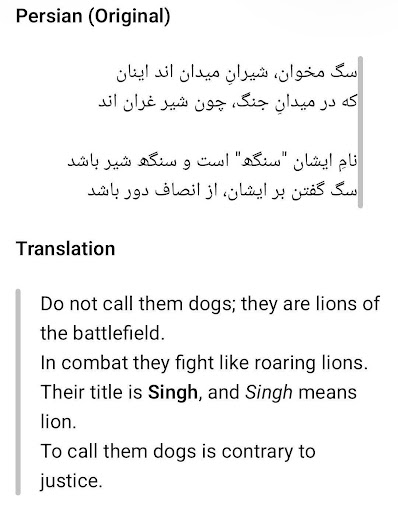
Some lines from the original text:

Select Bibliography
Ganda Singh (ed. & trans.). Qazi Nur Muhammad's Jang Nama. Amritsar: Sikh History Society, 1939.
Grewal, J. S. The Sikhs of the Punjab. Cambridge: Cambridge University Press, 1990.
Grewal, J. S., and Irfan Habib (eds.). Sikh History from Persian Sources: Translations of Major Texts. New Delhi: Tulika Books, 2001.
Gupta, Hari Ram. History of the Sikhs, Volume II: Evolution of Sikh Confederacies (1708–1769). New Delhi: Munshiram Manoharlal Publishers Pvt. Ltd., 2001 (reprint). [First published 1978].
Singh, Khushwant. A History of the Sikhs. Vol. I: 1469–1839. 2nd ed. New Delhi: Oxford University Press, 2004.
Singh, Khushwant. A History of the Sikhs. Vol. II: 1839–2004. 2nd ed. New Delhi: Oxford University Press, 2004.
Singh, Ratan Singh Bhangu. Sri Gur Panth Prakash. Edited by Bhai Vir Singh. Amritsar: Khalsa Samachar, 1935. (Punjabi).
Cunningham, Joseph Davey. A History of the Sikhs: From the Origin of the Nation to the Battles of the Sutlej. London: John Murray, 1849.