
Identity, Language, Demography, Theology, and Collective Responsibility
Abstract
The Sikh community in the twenty-first century faces a range of interconnected challenges that have significant implications for its religious identity, cultural continuity, and institutional vitality. This paper examines five major concerns frequently articulated within contemporary Sikh discourse: restrictions on the carrying of religious arms (shastar) by Sikhs outside Punjab, the perceived decline of the Punjabi language, demographic transformations within Punjab, the distinct theological position of Sikhism in relation to Sanatan traditions, and the continuing fragmentation of Sikh organizations. Through a historical and analytical approach, the study situates these concerns within the broader framework of Sikh religious doctrine, social history, and community development. It argues that while these issues vary in nature, they collectively raise fundamental questions about the preservation of Sikh identity, cultural heritage, and collective agency. The paper further emphasizes that constructive engagement, scholarly inquiry, and greater institutional unity are essential for addressing contemporary challenges while remaining faithful to the egalitarian, spiritual, and universal principles of the Sikh faith.
1. Restrictions on the Sikh Right to Bear Religious Arms Outside Punjab
A recurring concern among Sikhs residing outside Punjab is the increasing scrutiny and restriction surrounding the carrying of traditional Sikh arms (shastar), particularly by initiated Sikhs who regard them as an integral component of their religious identity. Numerous reports and grievances suggest that armed Sikhs are, at times, subjected to disproportionate surveillance, administrative difficulties, or legal obstacles.
Historically, the Sikh tradition of bearing arms emerged not as an expression of aggression but as a manifestation of the doctrine of Sant-Sipahi (Saint-Soldier), institutionalized by Guru Hargobind Sahib and further strengthened by Guru Gobind Singh through the creation of the Khalsa in 1699. In Sikh thought, shastar symbolize the defense of righteousness, justice, and protection of the oppressed.
Consequently, many Sikhs perceive restrictions on religiously mandated arms not merely as regulatory measures but as challenges to the visible expression of Sikh identity. This issue requires careful engagement with constitutional guarantees of religious freedom while simultaneously addressing legitimate public safety concerns.
2. The Gradual Marginalization of the Punjabi Language
Another major concern is the perceived decline of the Punjabi language in educational, administrative, and social spheres. Many scholars, writers, and cultural activists argue that Punjabi is facing systematic neglect despite being one of the world's major literary and cultural languages.
Language serves as the primary carrier of a community's historical memory, cultural values, and intellectual traditions. For Sikhs in particular, Punjabi occupies a unique position because the Sikh scriptural tradition, including the Guru Granth Sahib, is deeply connected with the Gurmukhi script and Punjabi literary culture.
The diminishing use of Punjabi among younger generations, especially in urban environments and diaspora communities, raises concerns regarding cultural continuity. Critics argue that inadequate policy support, changing educational priorities, and social preferences for other languages may gradually weaken Punjabi's public presence. The preservation and promotion of Punjabi therefore remains not merely a linguistic issue but also a matter of safeguarding an important component of Sikh and Punjabi cultural heritage.
3. Demographic Changes and Concerns Regarding Punjab's Social Composition
A further issue frequently debated within Sikh circles concerns the large-scale migration and settlement of people from other Indian states into Punjab. Some observers question whether sustained migration may gradually alter the demographic, linguistic, and cultural character of the region.
Historically, Punjab has been a land of mobility, trade, and cultural interaction. Migration itself is neither new nor inherently problematic. However, concerns arise when demographic changes are perceived as affecting political representation, language use, employment opportunities, or cultural institutions.
Those expressing concern argue that Punjab, as the homeland of Sikh history and the land sanctified by the Gurus, possesses a distinctive cultural and religious character that should be preserved. They fear that unchecked demographic shifts could gradually dilute the prominence of Punjabi language, Sikh institutions, and regional traditions.
At the same time, any discussion of demographic change must be approached through rigorous demographic research, constitutional principles, and social harmony rather than speculation. Scholarly inquiry should carefully distinguish between legitimate cultural concerns and unsubstantiated assumptions.
4. Sikhism as a Distinct Religious Tradition: Its Relationship with Sanatan Traditions
One of the most significant theological debates concerns the relationship between Sikhism and what is commonly described as the Sanatan religious tradition.
The term "Sanatan Dharma" has historically been used in different ways and does not refer to a single founder or a single moment of origin. It generally denotes a broad collection of religious, philosophical, and cultural traditions rooted in ancient Indian texts such as the Vedas, Upanishads, Puranas, and Dharmashastras.
Sikhism emerged in fifteenth-century Punjab under Guru Nanak Dev Ji and developed through the teachings of the Ten Gurus. While Sikh thought arose within the broader religious environment of South Asia and engaged critically with both Hindu and Islamic traditions, it established a distinct theological and social framework.
Classical Brahmanical social organization recognized the fourfold varna structure—Brahmin, Kshatriya, Vaishya, and Shudra. Sikh teachings challenged all forms of birth-based superiority and proclaimed the essential equality of humanity.
The famous principle:
“Manas Ki Jaat Sabhai Ekai Pehchanbo”
(“Recognize the entire human race as one”)
encapsulates the Sikh rejection of hereditary social hierarchy. Through the institutions of Sangat and Pangat (Langar), the Gurus translated equality into lived social practice, bringing people of all backgrounds together on equal terms.
The Sikh Gurus questioned the spiritual efficacy of numerous ritual practices, including pilgrimage bathing, sacrificial ceremonies, ancestor rites, ritual impurity concepts, astrological determinism, and external displays of religiosity.
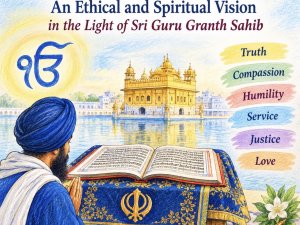
Instead, Sikh doctrine emphasized: Naam Simran (meditation on the Divine Name),Honest labour (Kirat Karni),Sharing one's earnings (Vand Chhakna),Truthful living (Sach Achar),Service to humanity (Seva). The Gurus consistently taught that inner spiritual transformation is superior to external ritual observance.
Many Hindu traditions incorporate devotion to multiple deities, divine manifestations, and incarnations, with image worship serving as an important component in numerous schools of practice. Sikhism, by contrast, affirms unwavering devotion to one formless, eternal, and transcendent Creator—Ik Oankar, the Akal Purakh. The Guru Granth Sahib repeatedly emphasizes the worship of the One Divine Reality and discourages dependence on idols, images, or intermediary deities.
Within Sikh theology, all beings, including gods and celestial entities, remain subject to the Divine Order and are not objects of worship.
Sikhism is therefore understood by its adherents as a distinct and original religious tradition. Its foundational principles include: Faith in One Universal Creator,
Harmony with nature, Honest labour, Sharing with others, Social equality, Collective welfare (Sarbat da Bhala),Human dignity and justice. These principles provide Sikhism with its own unique theological, ethical, and institutional identity.
5. The Need for Unity Among Sikh Organizations
Perhaps the most pressing challenge confronting the Sikh community today is the lack of organizational unity. Numerous Sikh institutions, religious bodies, and advocacy groups often pursue parallel or competing agendas, thereby weakening collective effectiveness. Throughout Sikh history, periods of unity have frequently coincided with significant achievements. The establishment of the Khalsa, the Misal period, and the reign of Maharaja Ranjit Singh all demonstrate the transformative potential of collective action guided by shared principles.
In the contemporary era, challenges relating to religious rights, education, language preservation, demographic change, historical interpretation, and community representation require coordinated responses. Fragmentation often limits the community's ability to articulate common concerns and pursue long-term objectives.
If Sikh organizations continue to remain divided, future generations may inherit weakened institutions and diminished influence. Conversely, unity based upon Gurmat principles, mutual respect, and collective responsibility can strengthen the community's ability to address emerging challenges while preserving its spiritual and cultural heritage.
Conclusion
The concerns discussed above—religious freedoms, linguistic preservation, demographic transformation, theological identity, and organizational unity—represent important subjects for reflection within the Sikh community. Addressing these issues requires informed scholarship, democratic engagement, institutional cooperation, and adherence to the egalitarian and universal values enshrined in Sikh teachings. The future vitality of Sikh identity will depend not only on recognizing these challenges but also on responding to them through wisdom, unity, and principled action grounded in the teachings of the Gurus.