The Entrance
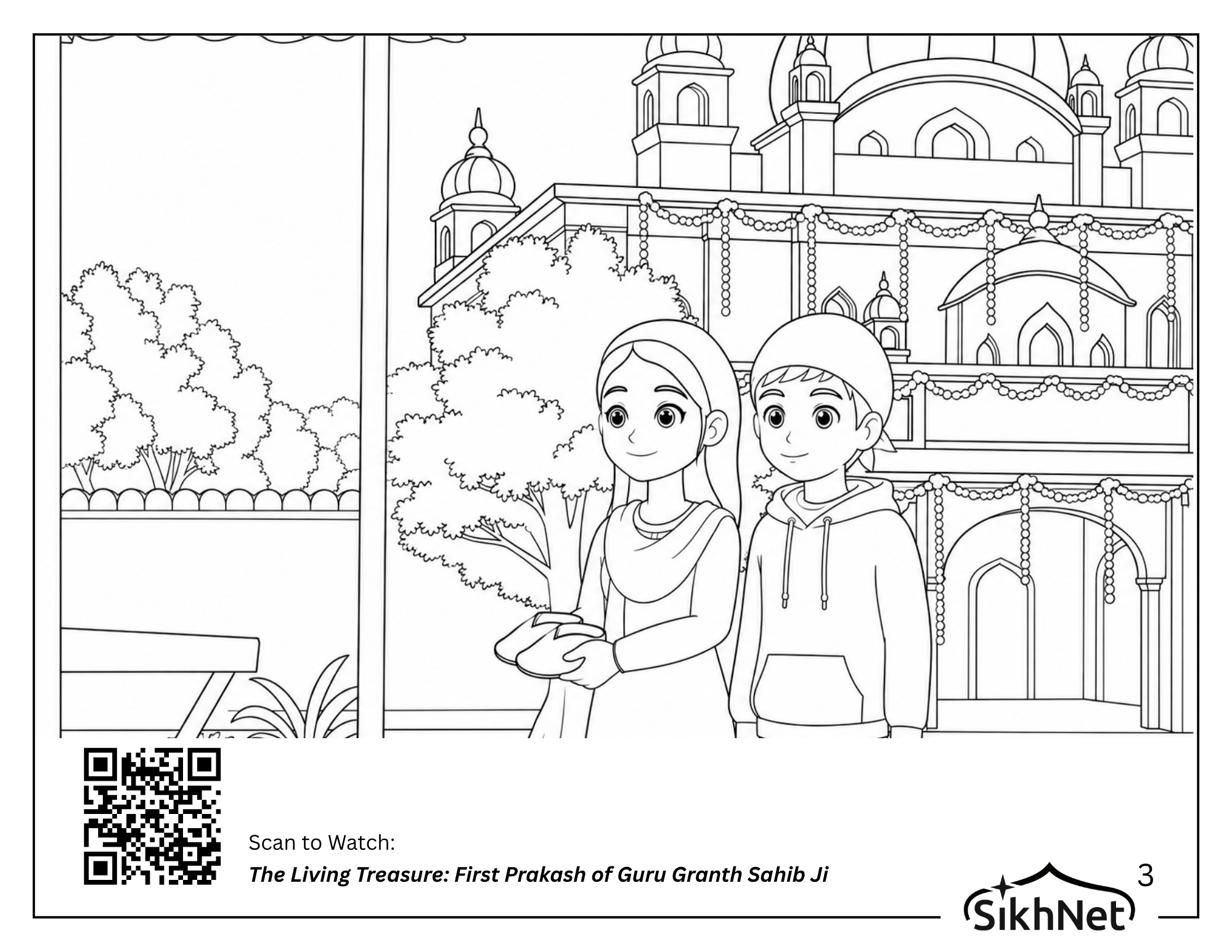
The Gurdwara was radiant that evening. Marigolds hung in garlands along the archways, and shimmering lights caught the eye from every corner. The soft sound of Kirtan hummed through the air like a gentle current. Simran and her best friend Leo made their way to the shoe stall, slipping off their shoes and covering their heads before stepping inside.
Leo had passed this building a thousand times, but today it felt different. Almost electric. He said so to Simran as they walked toward the Darbar Hall.
"That's because today is the First Prakash Purab," she told him. "We're celebrating the anniversary of the day Sri Guru Granth Sahib Ji was first brought to the Golden Temple in 1604."
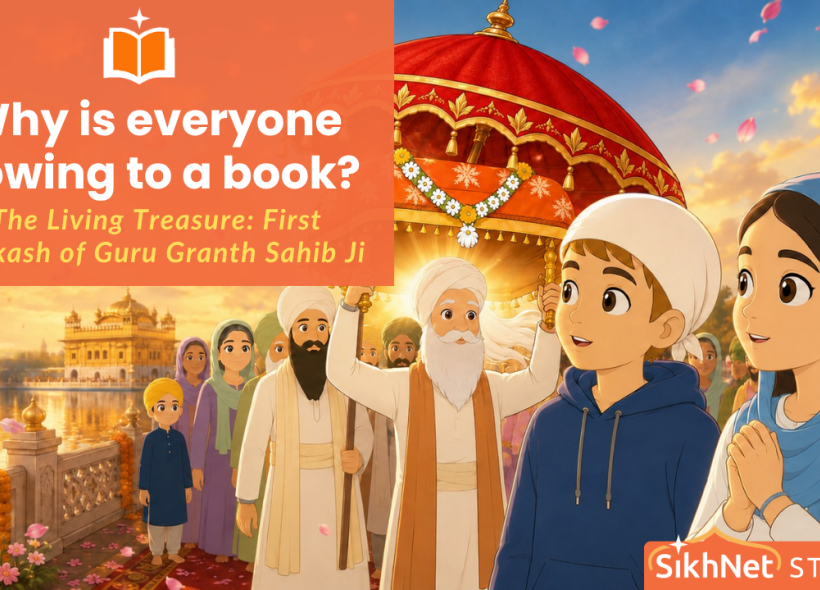
At the entrance to the Darbar Hall, Leo stopped. He watched as people walked forward one by one and bowed respectfully before a large, beautifully draped volume resting beneath a canopy. He turned to Simran and whispered, "Why is everyone bowing to a book?"
Simran paused. She looked toward Guru Granth Sahib Ji and searched for the right words. "Most books tell us stories or teach us about things," she said. "But to Sikhs, Guru Granth Sahib Ji isn't just paper and ink. Guru Granth Sahib Ji is our Living Guru. We call it Shabad Guru, the Guru in the form of the Divine Word."
"But how can words be alive?" Leo asked. "Do you mean alive like… breathing?"
Simran smiled. "Not exactly like you and me. Shabad is alive because its wisdom still speaks to us. It guides us when we feel lost, comforts us when we're hurting, and helps us understand how to live."
Leo thought about it. "So… it's like the words know what you need?"
"Kind of," Simran said. "But I don't think I'm explaining it very well. Come on. Let's find my dad. He's downstairs in the Ajaeb Ghar, the Gurdwara museum. He's much better at explaining the how and the why."
The Ajaeb Ghar
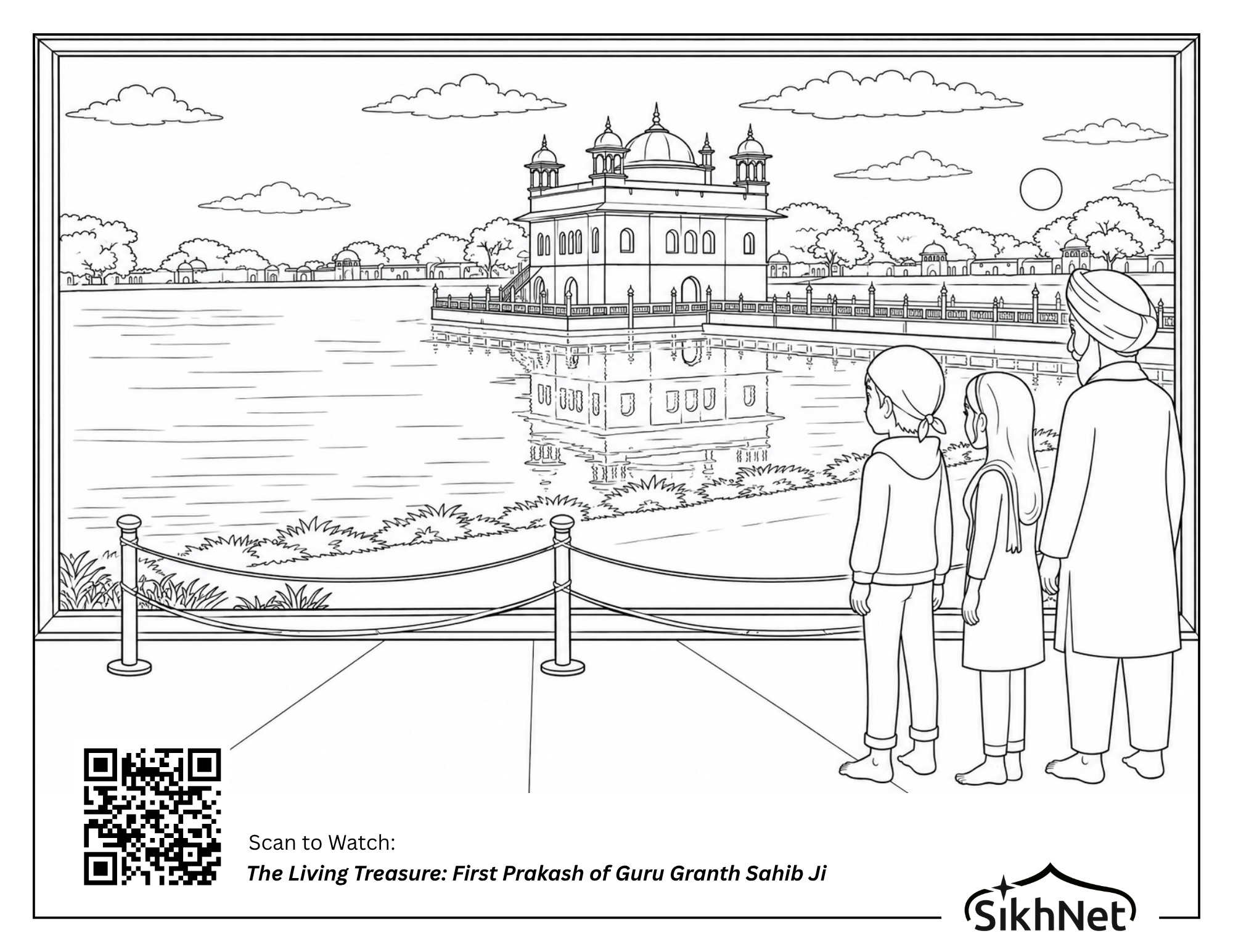
They found Daiji standing in the museum before a massive mural showing a peaceful lake surrounded by a grove of trees. Large displays and historical artifacts lined the walls.
Daiji turned when he heard them coming and smiled warmly. "Ah, Simran! And you must be Leo. You've come on the perfect day."
After they greeted each other, Leo asked, "Uncle, Simran told me that Guru Granth Sahib Ji is a Living Guru. I've never heard of a Guru in the form of sacred words before. How did that begin?"
"That is a wonderful question, Leo," Daiji said. "And to understand the answer, we have to travel more than four hundred years into the past."
He gestured toward the mural. "It all began with a vision of unity. Guru Arjan Dev Sahib Ji, our fifth Guru, wanted to protect the True Word so it would never be mixed with false verses. He gathered every sacred hymn at a peaceful place called Ramsar Sahib in Amritsar."
He tapped the wall, and the mural lit up. A shimmering three-dimensional model of the lake and the Beri tree rose from the display and slowly rotated in the air between them.
Leo's eyes widened. He walked around it, trying to see it from every angle. "Okay," he admitted, "that is actually really cool."
Simran smiled. She had known he would like this part.
"This exhibit recreates Ramsar Sahib from historical descriptions," Daiji said. "More than four hundred years ago, in 1604, beneath this very Beri tree and beside this peaceful lake, the work of a lifetime began."
The Compilation
The hologram slowly zoomed in, and a glowing animated recreation appeared. Guru Arjan Dev Sahib Ji sat peacefully beneath the Beri tree. Across from Guru Sahib, Bhai Gurdas Ji carefully wrote each word. The soft sound of a pen moving across paper filled the exhibit.
"This was no small task, Leo," Daiji said. "They used the finest Kashmiri paper because it was among the most durable paper available at the time. They even made their own special ink, designed so the sacred words would not fade."
"They made the ink themselves?" Leo asked.
"Every detail mattered. They were preserving these words not only for the people living then, but for generations they would never meet."
"People like us," Simran said quietly.
"Exactly," said Daiji. "And Guru Arjan Dev Sahib Ji did not include only His own Bani. Guru Sahib gathered voices from many different backgrounds, people whose Bani carried the same Divine Truth. He included the voices of fifteen Bhagats and eleven Bhatts, saints and poets from many walks of life."
The hologram changed. Glowing portraits of a weaver, a cobbler, and a farmer appeared, slowly orbiting like planets around a bright light.
"Wait," Leo said. "A weaver and a cobbler? Their words were included alongside the words of the Gurus?"
"Yes," Daiji said. "Bhagat Kabir Ji was a weaver, and Bhagat Ravidas Ji was a cobbler. In those days, society often judged people by their caste, family, or occupation. Some people were treated as if they were less important simply because of the work they did."
"That doesn't seem fair," Leo said.
"It wasn't," Simran agreed.
"Guru Sahib showed that Divine wisdom does not belong to only one caste, religion, profession, or social class," Daiji continued. "The Bhagats came from different communities and different walks of life, but their Bani carried the same truth, that there is One Creator, and no human being is higher or lower than another. What mattered was the Truth within their Bani."
Leo looked back at the glowing portraits. "All those different voices," he said softly, "together in one place."
"Different voices," Daiji said, "united through the same Divine Truth."
The Symphony of Raags
They moved toward an interactive station lined with traditional instruments under glass. A Rabab and a Saranda rested beneath soft lights. Daiji waved his hand over a sensor, and the strings began to glow and gently hum on their own.
"Wait," Leo said. "Why is there music in a museum about a book?"
Simran raised an eyebrow. "You really like calling it a book, don't you?"
"I'm learning!" he said, grinning.
"That is another reason Guru Granth Sahib Ji is so unique," Daiji said. "Gurbani isn't meant only to be read. It is meant to be sung. Guru Granth Sahib Ji is organized into thirty-one Raags, musical measures connected to different feelings and moods of the human soul."
Soft musical waves began flowing across the walls of the exhibit.
"Each Raag has its own feeling and character," Simran explained. "Raag Prabhati is connected to the early morning. Raag Sorath can feel like a deep conversation with a friend. Sri Raag can help push away the darkness within us."
"So the music changes how the words feel?" Leo asked.
"Sometimes your mind understands a message," Daiji said. "But when that same message is sung..." The music grew warmer. "Your heart can feel it too. Even before you understand every word."
"That happens to me during Kirtan sometimes," Simran said. "I may not understand the meaning of every line, but somehow I still feel peaceful."
"Music helps carry the Guru's message beyond our ears and deep into our hearts," Daiji said.
The Grand Procession
They stepped onto a glowing floor panel. The lights in the museum dimmed, and a wraparound screen surrounded them with a moving animated procession. The sound of Kirtan filled the room. A large Sangat walked together from Ramsar Sahib. At the centre of the procession, an elderly Sikh carried the sacred volume respectfully upon his head.
"Who is the elderly Sikh carrying the sacred volume?" Leo asked. "Everyone is following him with so much respect."
"That is Baba Buddha Ji," Daiji said. "He was ninety-eight years old and had known every Guru since the time of Guru Nanak Dev Ji himself."
"Ninety-eight?" Leo said softly.
"And look how peaceful he is," Simran said.
"On August 30, 1604," Daiji continued, "Baba Buddha Ji was given the honour of carrying the sacred volume upon his head, all the way from Ramsar Sahib to the Golden Temple."
Flower petals drifted across the screen. Leo noticed another figure walking behind the sacred volume. It was Guru Arjan Dev Sahib Ji, respectfully waving the Chaur Sahib over it.
"What is the Chaur Sahib?" Leo asked.
"It is a symbol of honour and sovereignty," Simran said. "But Guru Arjan Dev Ji was the Guru. Why would the Guru walk behind?"
Daiji answered quietly. "To show the world that the Shabad, the Divine Word, held the highest place. By walking behind and serving the sacred Granth, Guru Arjan Dev Sahib Ji showed that the wisdom of the Shabad was greater than any position, title, or worldly power."
"Even greater than a king?" Leo asked.
"Greater than any king," Daiji said.
The scene shifted to nighttime. The sacred volume rested on a high bed while the entire Sangat, including Guru Arjan Dev Sahib Ji, slept on the floor as an expression of deep respect.
"So Guru Arjan Dev Ji didn't just tell people to honour the Shabad," Leo said.
"Guru Sahib showed them how," Simran replied.
The First Hukamnama
The procession faded. The screen slowly filled with a glowing image of the Golden Temple at dawn, golden light reflecting across the water.
"So once they arrived at the Golden Temple, what happened?" Leo asked.
"Baba Buddha Ji opened the sacred volume for the very first time," Daiji said. The museum became quiet. The soft sound of turning pages could be heard. "Then the first Hukamnama, the first message, was read."
Daiji spoke the words gently: "Santa Ke Karaj Aap Khaloya, Har Kaam Karavan Aaya Ram."
The words appeared across the screen in glowing Gurmukhi script.
"What does that mean?" Leo asked.
"God Himself has stood up to resolve the affairs of the Saints," Simran said.
Leo was quiet for a moment. "God Himself… stood up to help?"
"It reminds us," Daiji said, "that when we walk with truth and place our trust in Waheguru, we are never facing life alone."
"That is a pretty amazing first message," Leo said.
"It really is," Simran agreed.
The Realization
The museum lights slowly brightened. The three of them walked back toward the Darbar Hall, the sound of live Kirtan growing louder with every step. Leo stopped just outside the doorway and looked through toward Guru Granth Sahib Ji.
"So all of this began more than four hundred and twenty years ago?" he said.
"Yes," Simran said. "And the Shabad still guides people all around the world today."
Leo looked through the doorway quietly. "I think I understand now. Why everyone bows. You aren't bowing to paper and ink. You're showing respect to the Shabad, the Divine wisdom that guides Sikhs as their Guru. And all those voices, the Gurus, the Bhagats, the Bhatts, they came from different backgrounds, but their Bani shared the same Divine Truth."
"Guru Granth Sahib Ji teaches us to remember Waheguru, live truthfully, serve others, and recognize the same Divine light in everyone," Simran said.
"But why do you call the Guru living?" Leo asked.
Simran thought for a moment. "Because the conversation never ended. When I feel sad, worried, or confused, I can turn to the Guru for guidance. The Shabad helps me see my problem in a completely different way."
"So the world keeps changing, but people can still turn to the Shabad to find their way," Leo said.
"Precisely," Daiji said.
Leo looked toward the Darbar Hall again. "It's almost like a light. Everything around you might feel dark or confusing, but the light helps you see which way to go."
"And perhaps now you understand the meaning of Prakash," Daiji said. "The First Prakash was not only the placing of the sacred Granth inside the Golden Temple. It was the illumination of Divine wisdom, a light that continues to guide people today."
"A light that never stopped shining," Leo said.
"Exactly," said Simran. "Now come. The Kirtan is about to reach its peak."
The Darbar Hall
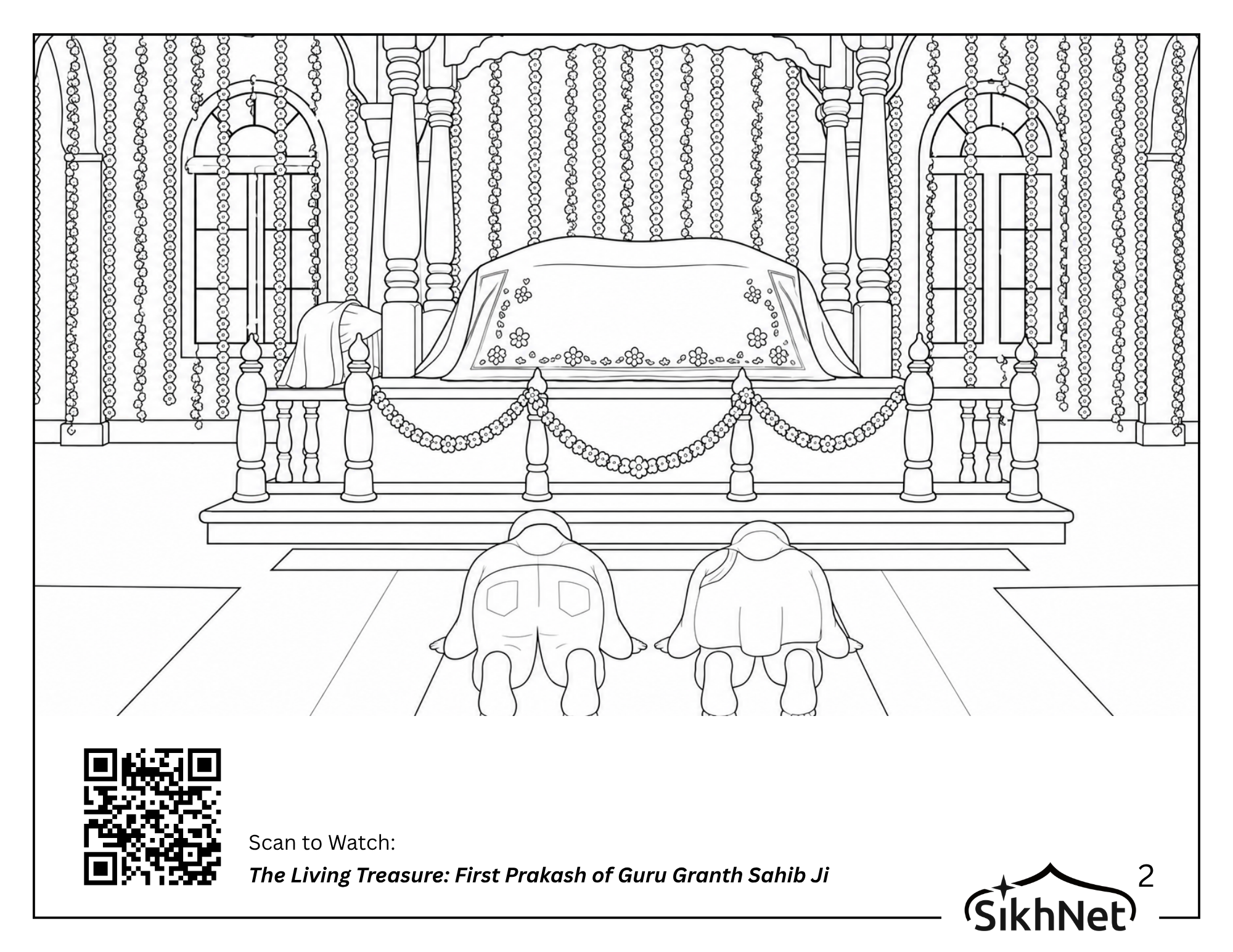
They walked upstairs and entered the main hall together. The sound of Kirtan surrounded them completely. Simran walked forward and bowed before Sri Guru Granth Sahib Ji. Leo watched her. This time, he understood what the gesture meant.
He gently folded his hands and lowered his head respectfully. Then he sat beside Simran and Daiji on the floor. The Raag filled the Darbar Hall. Children, elders, and families sat together as the Sangat sang with one voice.
Leo listened quietly for a few moments, then leaned toward Simran and whispered, "I think I understand what you meant earlier. About Shabad being alive. The words don't breathe like we do. But people have listened to them for hundreds of years. They've found courage in them, comfort in them, and they've changed how they live. So every time someone listens to the Shabad and carries its wisdom into the world, its light keeps shining."
Simran smiled. "That's how the Shabad lives."
The Kirtan rose around them, and golden light filled the Darbar Hall as the sound of Waheguru… Waheguru… continued softly into the evening.
A light that never stopped shining.