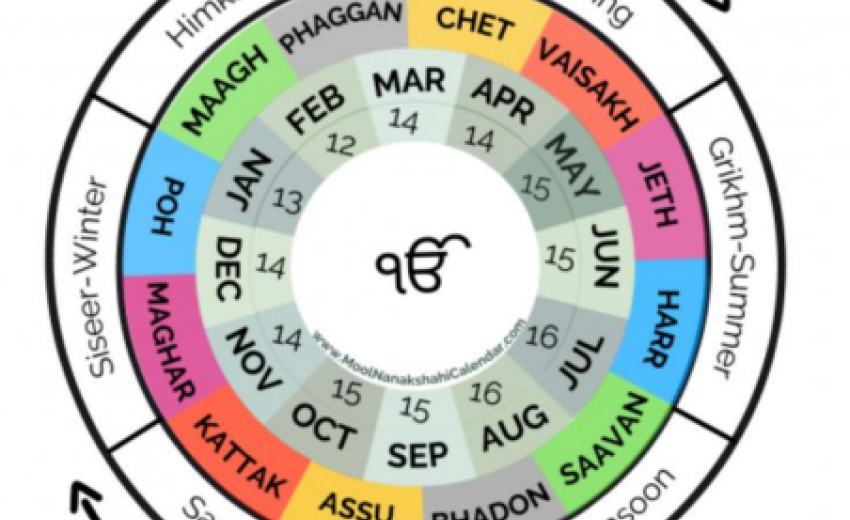

On 14 March, Sikhs around the world marked the beginning of Nanakshahi year 558, commemorating 558 years since the birth of Guru Nanak Dev Ji, the founder and first Guru of the Sikh faith. The Sikh calendar, known as the Nanakshahi Calendar, was introduced to give Sikhs a distinct historical framework rooted in Sikh history and Gurbani, rather than relying on older lunar calendars that had traditionally shaped religious observances in South Asia.
Now that the day has just passed, it offers a moment to pause and reflect not only on the significance of the date itself, but also on what the Sikh calendar means in our lives.
For a long time, I struggled to understand the relevance of another calendar. Like many people, my daily life is structured around the civil calendar used by the society around me. The idea of marking time through another system did not initially feel particularly meaningful or connected to my everyday experience.
My thinking began to shift when I encountered a beautiful composition in the Guru Granth Sahib known as Barah Maha — literally “the twelve months.” In this hymn, the months of the year are not simply markers of time but metaphors for the spiritual journey of the human soul.
Each of the twelve months reflects different emotional and spiritual states: longing, separation, reflection, hope, and ultimately union with the Divine. The changing seasons mirror the internal journey of the soul as it seeks connection with Waheguru, the Divine. Through this lens, time itself becomes a teacher — a reminder that life moves through cycles of growth, struggle, and renewal.
Encountering Barah Maha transformed my understanding of the Sikh calendar. It helped me realise that the Nanakshahi year is not simply about recording dates or observing anniversaries. Rather, it can serve as a reminder of our own spiritual journey — an invitation to reflect on how we are growing, changing, and deepening our connection with the Divine.
Sikh philosophy offers a profound perspective on human existence. Instead of seeing ourselves simply as humans who occasionally seek spiritual experiences, Sikhi encourages us to recognise that we are, at our core, spiritual beings living a human life. In other words, we are not merely humans having a spiritual experience, but spiritual beings having a human experience. This understanding reminds us that the Divine light exists within all of us, and that our lives are part of a much deeper spiritual reality.
At the same time, Sikh teachings make it clear that spiritual connection is not dependent on special dates, lucky moments, or astrologically favourable times. The Gurus rejected the idea that certain moments are inherently more sacred than others. Instead, they taught that the Divine is present in every moment.
The Guru Granth Sahib captures this beautifully:
ਮਾਹ ਦਿਵਸ ਮੂਰਤ ਭਲੇ ਦਿਸੁ ਕਉ ਨਿਦਰ ਕਰੇ ॥
“Mahā divas mūrat bhale jis kā nadar kare.”
Blessed are the months, days, and moments when the Divine bestows grace.
This verse reminds us that what truly makes a moment meaningful is not the date on the calendar but the presence of Divine grace and our awareness of it. Any moment can become sacred when we remember the Divine.
Seen in this way, the Sikh New Year is less about the beginning of a new calendar cycle and more about a moment of reflection. As the 14th of March has now passed and Nanakshahi year 558 has begun, it provides an opportunity to ask ourselves deeper questions: Are we living with compassion? Are we serving others? Are we remembering Waheguru in our daily lives?
The Nanakshahi Calendar also anchors us in the collective memory of the Sikh community. By marking time through the life and teachings of Guru Nanak Dev Ji and the Gurus who followed him, it reminds us of the extraordinary spiritual legacy that continues to shape Sikh identity today. Guru Nanak’s message of equality, humility, justice, and devotion remains profoundly relevant in our world.
For me, the Sikh calendar is no longer simply about time and dates. It is about moments of awareness. It encourages reflection on Sikh history, engagement with the wisdom of Gurbani, and a renewed commitment to personal spiritual growth.
Now that the Sikh New Year has begun, perhaps its greatest gift is the reminder that every day, not just special dates, carries the possibility of connection with the Divine.
In the end, the Sikh calendar is not really about measuring time. It is about reminding us that every moment of this human experience is part of a deeper spiritual journey.