
Voices of Shabad: An Introduction by GAAVANI
In honor of the 350th commemorative year of Guru Tegh Bahadur, GAAVANI is presenting a special essay series on SikhNet featuring reflections from Sikh women on their personal journeys with Sikh spirituality and the living presence of the Guru’s Shabad.
With the first two reflections shared, we now present the third essay in this series, continuing the exploration of how Gurbani becomes more than words to be read or recited, it becomes a source of guidance, reflection, and companionship in everyday life.
Launched on International Women's Day (March 8), a new essay from this collection is released every two days, inviting the Sangat to deepen their connection with the wisdom of the Guru’s Shabad.
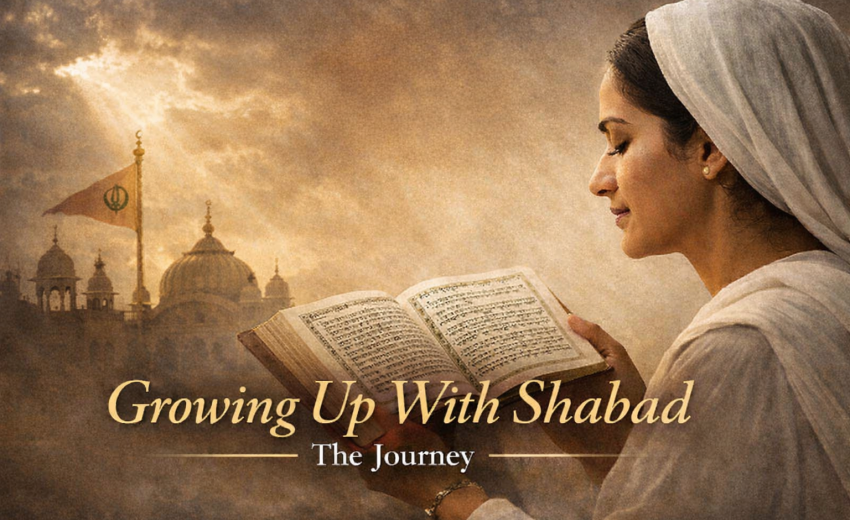
Growing Up With Shabad
The Journey
Like in many Sikh households, Gurbani was a daily companion while I was growing up and has become the way I process life circumstances and filter my actions. A vak was taken for the mundane and the consequential. This ritual began as soon as I was born. In fact, a hukam was the inspiration for the first letter of my name, followed by the verse that marks the halfway point in Sukhmani Sahib:
“Pavitr pavitr pavitr puneet, Nam japay nanak man preet” (“Holy, holy, holy, and sublimely pure, chant the Naam, O Nanak, with heart felt love”).
Thereafter, hukam came with every milestone that followed, traveling with me like a growth chart tracking my height, birthdays, graduations, jobs, marriage, and children. When my very capable parents endured inevitable challenges, I came to see their gesture of Ardas followed by hukam both as a way of seeking answers and as an act of humility. From what I gather, this way of coping has been in practice in my family for generations, passed along to serve as a bedrock for making sense of triumph, suffering, and the unknowable.
Growing up outside of Punjab as a young girl with little influence, I found myself navigating many unchartered spaces where even a progressive society didn’t expect much from me. Gurbani took on a sort of magical quality in those settings, daring me to develop a voice in defense of myself and others. I was bullied often, but with the power of Guru Gobind Singh Ji’s Chaupai Sahib, uttered protectively by my mother, I too developed a voice. I understood that not everyone will like me, but it was up to me to stay true to my values anyway: “Je koi nindh karay har jan ki, apna gun na gavavay.” Courage and protective instinct evolved into a desire to advocate for and to heal others, inspiring a career in medicine. Indeed, companionship with Gurbani bears many fruit, but on any given day, a shabad isn’t always transformative. Often, it begins with a single line remembered in the middle of a busy day, a melody humming beneath the noise of responsibilities, or a pause before reacting in anger. Over time, a single line becomes a lifeline. The melody that accompanies it becomes orientation. And the pause becomes freedom.
Gurbani also teaches us that our spiritual journey is not toward a distant heaven nor is it toward perfection. Instead, in seeking guidance from the Guru Granth Sahib, our efforts concentrate toward alignment with Hukam, with truth, and with the luminous presence of Naam. This is why taking hukam is an act of humility. In moments when I feel the most righteous, defensive, or insecure, Gurbani finds a way to soften my orientation to the recognition that there may be a bigger plan at play. Shabad becomes a mirror that reveals both my ego and my potential. It names my restlessness and then soothes it. It exposes my attachments and then teaches me how to act with love, without clinging. My “destination” transforms from a place to the practice of a Braham Giani: to be alive, fearless, compassionate, and anchored in remembrance of my humble place in the world.
Finally, I’d like to share a brief note about my journey with Shabad kirtan. I began reciting kirtan as a young child, focusing on practice and performance. I learned gurmat sangeet, participated in kirtan samelans, amassed knowledge and mastered technical skills that were sufficiently discerning that I could one day evaluate those very skills in others. At some point, however, my desire to acquire skills shifted from performance to listening. Suniai, or deep listening, became a doorway for discovery of a host of everyday feelings I was experiencing, like anxiety, ambition, jealousy, loneliness, injustice, grief, and longing. When my daughter today says that she picks up her dil ruba when she is happy, sad, and angry, I realize that kirtan is not a relic of the past.
By reciting kirtan, we address both the pressure to perform and the fear of not being enough. It dismantles hierarchies of skill and status, reminding us that divine light shines equally in all of us, whether novice or experienced. As we navigate modern expectations, doing kirtan can be profoundly liberating, where our worth is not negotiated in classrooms or boardrooms or validated through social approval. Instead, our worth is rooted in the Creator’s imprint within us. And, as our listening of kirtan deepens, so does its role as our companion, gently whispering, “You are not alone.” The Guru is not an abstract authority but an active participant in our inner lives. Through daily recitation, reflection, and kirtan, I find comfort in knowing that I am always walking with guidance. My decisions become less reactive, my speech more measured, and service becomes less about recognition, and more about gratitude.
My experience is that Sikh spirituality is profoundly livable thanks to Shabad Guru. Shabad is not confined to the gurdwara: it grows with us, and walks with us into clinics and classrooms, kitchens and courtrooms, art studios and board meetings. It informs how we raise children, how we navigate conflict, how we care for our bodies, and how we respond to injustice. It offers not escape from modern life, but tools to inhabit it with integrity and grace.
Dr. Manpreet Kaur