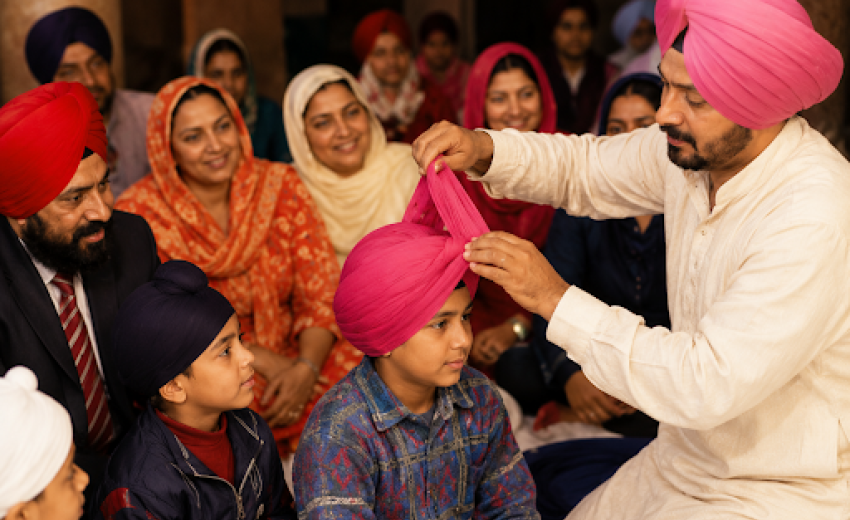

Dastar Bandi is the day a Sikh child ties their first turban. That's the simple version. The fuller version is harder to put into words, and if you've ever stood in a Gurdwara watching a small child in an oversized dastar, you already know what I mean.
What's quietly heartening is how alive this tradition still is - and in some ways, how much further it's reaching. It's not unusual anymore to hear about Dastar Bandi happening in small Gurdwaras far from Punjab, in diaspora communities where grandparents never expected to see a dastar again, or among Sikhs who came to the faith later in life and are now passing it on to their own children for the first time. A tradition that could easily have stayed confined to certain regions or certain families keeps finding its way into new homes instead.
The Meaning Behind It
The turban isn’t just decoration and it isn’t only a fashion accessory for special occasions, it’s what our Gurus gave us so that no one could hide who they were, and no one could get told they were less than anyone else. Every Sikh who ties a dastar is repeating the same idea: I’m not blending in, I’m not ashamed, I belong to this faith and I’m not going to pretend otherwise.
So when it's a child's first time, it hits different. Parents will tell you it's a strange mix of pride and something close to grief - pride because their child is stepping into their own identity, grief because it means the baby years are properly behind them now. This isn't identity being handed down like an heirloom and left in a drawer. It's identity the child now has to hold onto themselves, every single morning, whether they feel like it or not.
And kids feel it too, even the ones too young to explain why. They know they're being trusted with something. Ask any adult who had a Dastar Bandi as a child and, chances are, they'll still remember exactly how it felt to be looked at that way - like they'd grown into something.
There's something else happening too, quietly, at the edges of this tradition: families who didn't grow up with a strong connection to the practice, or who lost touch with it for a generation or two, choosing to bring it back. A parent who never had their own Dastar Bandi will sometimes make sure their child does. A family that moved somewhere far from a large Sikh community will still find a way to gather people together for the day. It’s a small act, repeated in more places than it used to be. and each time it happens, the tradition gets a bit more room to keep going, even if nobody says it out loud.
When It Typically Happens
Ask five families when they did Dastar Bandi and you'll probably get five different answers, and that's completely normal. Some go early, wanting the dastar to just be part of growing up from the start. Others wait - maybe until the child is old enough to actually understand what's happening and ask their own questions about it.
A lot of families end up just following the child's lead. Maybe he's been watching his older cousin tie a patka every morning and finally asks, "when's mine?" Maybe he's been eyeing his dad's turban collection for months. There's no age you're supposed to hit, no calendar to follow - just whatever feels right for that particular child, in that particular family.
What Happens During the Ceremony
No two Dastar Bandis look exactly alike, but there are things you'll usually see. Most families hold it at the Gurdwara, though plenty do it at home instead, just among close family. Either way, there's an ardas - a prayer asking for the child to be given strength and courage as they take this on.
Everyone shows up for this one. Parents, grandparents, aunts, uncles, cousins, and often a good chunk of the sangat too. Sometimes a grandparent or respected elder does the actual tying; other times the child does it mostly on their own with someone's hands hovering close by, just in case. There's usually kirtan going on in the background, karah parshad being passed around, and no shortage of people leaning down to tell the child how proud they are.
Somebody's always taking photos that'll get pulled out again fifteen years later. There's a meal after, plenty of hugging, plenty of "he looks so grown up now" from the relatives. It doesn't feel formal or heavy - it feels like a celebration, because that's exactly what it is.
The Practical Basics of Tying a First Dastar
Nobody expects a five or seven-year-old to tie a full adult-style turban on day one, and honestly, nobody should try to make that happen. Most families start smaller and simpler - a style that's manageable for a little head that's still getting used to the weight of it.
At its core, it's not complicated: a long length of cloth, wound around the head in layers, tucked in at the end so it sits comfortably and doesn't come undone the second the child runs off to play. The goal early on isn't a flawless finish. It's the child feeling proud of what's sitting on their head, crooked bits and all. Usually a parent or older sibling does the tying at first, and that itself becomes part of the memory - hands helping hands, nobody rushing.
Give it time and the child starts picking up more of it themselves. First they just watch. Then they hold the fabric while someone else wraps. Eventually they're doing most of the folding on their own, asking for help only with the last tricky bit. Nobody gets it right immediately, and that's fine - this is a skill you grow into, not one you're born knowing.
What It Means Going Forward
Here's the thing people sometimes miss: Dastar Bandi isn't the finish line, it's the start. After that day, tying the dastar becomes something the child does every morning - sometimes eagerly, sometimes grumbling about being late for school, but doing it all the same.
That relationship keeps shifting as the years go by. A ten-year-old's turban won't look like what they're tying at sixteen, and neither will match what they're doing at thirty, and that's exactly how it should go. What doesn't change is the reason underneath all of it - the same sense of who they are and where they belong that got planted on that very first day. Every ordinary morning they wrap that cloth, in some quiet way, they're back at that Gurdwara again, being looked at with pride.
The first dastar isn't really an ending of childhood so much as a door swinging open - one that stays open for the rest of their life, changing shape as they do. And that feeling from the first day rarely fades completely. It has a habit of showing back up, unannounced, on some perfectly ordinary Tuesday morning years later.
Closing
Long after the ladoos are gone and the photos are tucked into some old album nobody opens enough, what stays is quieter than all of that - just a child, standing a little taller than before, learning what it feels like to carry something sacred with their own two hands.