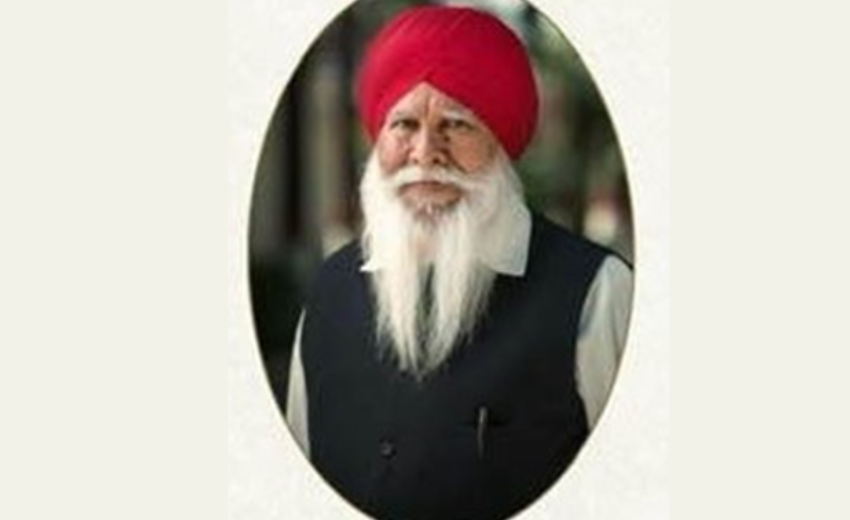

50 years ago, Texla TV was the talk of the town in Punjab. If you go to any house, you would see this TV set in the drawing rooms. The era of TV had begun in India a few years earlier, but a selected few could enjoy this by importing TV sets from abroad. Texla TV had set up its factories in Delhi and Ludhiana and brought a revolution to Punjab. S. Raja Singh, who was the owner of Texla TV, came to India as a refugee from Rawalpindi, Pakistan. He started his career as a laborer in a vegetable shop in Delhi. See his humility that he kept this photograph of serving there in his office permanently.
The biggest contribution of Texla TV, which brought appreciation for them in the entire Sikh world, was when they booked a 15 minutes Kirtan program on the All India Radio. This popular program used to start with the shabad 'Koi Bole Ram-Ram, Koi Khudai.' Every Sikh family used to enjoy the kirtan. Soon after, on the demand of the public, Texla TV produced Kirtan shabad cassettes, which had created international demand. They also started organizing Kirtan Darbars in various cities. I remember the legendary Kirtan Darbar in Ashoka Hall of Rashtrapti Bhawan in 1983.
To provide proper education to the children of the American Sikh families, S. Raja Singh opened Guru Ram Das Academy on Rajpura Road in Dehradun. Yogi Harbhajan Singh, who spread Sikhi in the Western Hemisphere, inaugurated the academy himself. Hundreds of American Sikh students used to study here. After some time, a similar academy was established in Ludhiana. Both these educational institutions are still running successfully.
During the bloody massacre that took place in Delhi in 1984, Texla TV factories suffered huge losses. In spite of that, S. Raja Singh went on helping the affected families in the camps. He established a colony in Ludhiana for the displaced families of Delhi.
S. Raja Singh, at the age of 88, passed away for his heavenly abode in Ludhiana on 28th February.