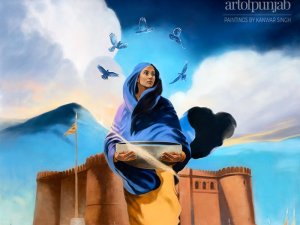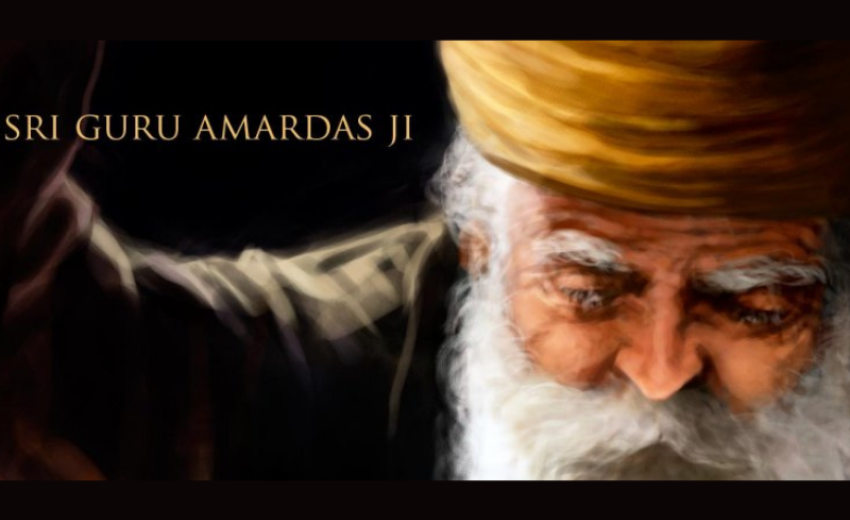

Today we celebrate the Gurugaddi of Sri Guru Amar Das ji. While so much can be said about the life and lasting legacy of the third Guru, this painting by artist Kanwar Singh from artofpunjab encapsulates the essence of how Sikhs reflect on Guru Amar Das ji.
Guru Amar Das ji is remembered as the Third Guru, a leader, a role model, a tremendous organizer, a women’s advocate, an inspired poet, and most of all as being uniquely true to himself – for he embodied Sat Naam and served as Sat Guru to his Sikhs.
At the beginning, Amar Das was none of that. He lived with his family in the town of Basarke, near present-day Amritsar. He learned from his father to be a tradesman, married Mansa Devi and they had children.
As Amar Das, he fasted every eleventh day and studied the scriptures of his Hindu heritage. Once or twice a year, he pilgrimaged to Haridwar on the banks of the Ganges River, a journey of ten days by foot. But Amar Das’s soul thirsted for more. It craved an end of rituals and pilgrimages and fasting. His soul longed for a True Guru.
Early one morning, it was Amar Das’s good fortune to hear the sweet sound of his brother’s son’s wife Bibi Amro singing a sacred Verse she had learned from her father and his guru. The Verse enchanted Amar Das. He asked her to repeat it for him as it had touched his soul.
And so Bibi Amro sang:
“Actions are paper, and mind the ink. Acts, both good and depraved, are recorded by turn. From their past deeds, people are driven to act and react. Your virtues are endless, O great one! Why not keep that virtuous one in your mind, O crazy fool? Forgetting the living, loving Lord, your own virtues will melt away. Pause and reflect. Night and day are nets. Traps as many as there are moments. With zest and delight, you ever gnaw at the bait. What is your plan of escape, O crazy fool? The body is a furnace. Within it, the iron of mind is heated by five fires fueled by misdeeds and worked by the tongs of worry and dread. But that which was turned to slag becomes gold again if one meets the Guru. Giving the one life-giving name, O Nanak, the disciple’s body finds peace.” (Ang 990)
Amar Das, who was all of sixty years old, asked his young niece where she had learned the Verse. She told him about her father, Guru Angad ji who lived just a couple of hours’ walk away. A few days later, with permission from her mother-in-law, Bibi Amro set out with Baba Amar Das for the village of Khadur where the Second Guru lived.
Meeting Guru Angad, the old man’s soul was satisfied. The Second Guru was just thirty-five years old and had inherited his responsibility as guru from his master, Guru Nanak Dev only a few months before. What Angad lacked in life experience, he more than made up for in love, insight, and an uncanny spirit of service to all who came to him.
Just as Guru Nanak’s Verse had enchanted Amar Das’s heart, so the presence of Guru Angad, the True Guru, now enraptured his soul and the pilgrim put his old body to work in service of the Guru.
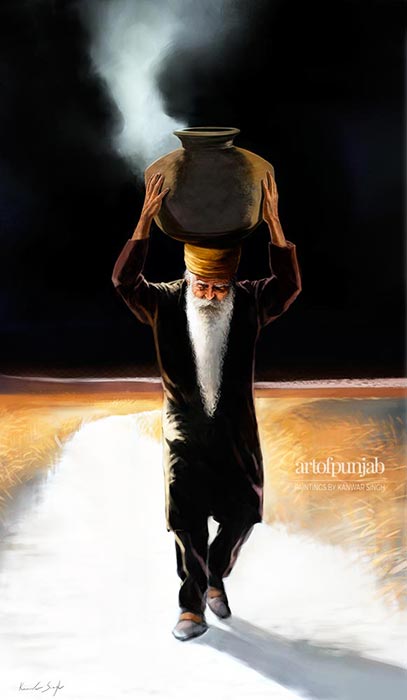
Baba Amar Das resolved to each day bring the Guru his morning bath water from the Beas River. After the morning congregation, he would bring water for the langar, clean the cooking utensils, and gather firewood from the forest. Late in the evening, Amar Das would massage away the stress from the Guru’s muscles, then return home backwards so as not to turn his back on his beloved Master.
Mean-spirited people insulted the elderly Amar Das and his one-pointed service of his Guru. They said he had abandoned his family, that he was homeless, that he had lost his mind.
Addressing the slanderers, Guru Angad said, “You describe him as homeless and unworthy, but he will be the home of the homeless, the honour of the unhonoured, the strength of the strengthless, the support of the unsupported, the shelter of the unsheltered, the protector of the unprotected, the restorer of what is lost, the liberator of the enslaved.”
After twelve years of loving service, the Second Guru introduced Baba Amar Das to his beloved Sikh disciples as their Third Guru. Knowing that Guru Nanak’s legacy of Sat Naam was in good hands, Angad Dev then breathed his last.
Guru Amar Das proved to be an organizational dynamo and, despite his advanced age, remained in robust health. His accomplishments are legion.
While Guru Amar Das taught, trained, and organized his Sikhs, Guru Angad’s widow Mata Khivi continued her tireless seva of feeding the community and guests in the Guru’s langar. In their lives, Mata Khivi and Mata Mansa Devi, Amar Das’s wife embodied the equality taught by the Guru who discouraged the Islamic practice of keeping wives and mother out of sight in purdah, as also the Hindu practice of the burning of widows on their husband’s funeral pyres. When Guru Amar Das established a system of twenty-two local teachers and representatives, he did not neglect to include dedicated women in leadership roles as “manjidars”. He also trained women as “piris” to go out and teach the women of that time, segregated by gender, the Sikh way of life.
In order to cultivate a unified spirit among his growing and diverse Sangat, Guru Amar Das established a unique well with 84 steps at Goindwal as a place of pilgrimage and encouraged everyone to come celebrate together twice a year, at Baisakhi and Diwali.
The Third Guru hosted the friendly Mughal emperor Akbar, stipulating that the king of kings could only see him after partaking in the langar. Akbar was so moved by his visit that he donated land for the establishment of the town of Amritsar.
Loving the peaceful ambience around the pool of Amritsar, Guru Amar Das set in motion events that would lead to the founding of the Sikh spiritual capital there surrounding a temple of marble and gold.
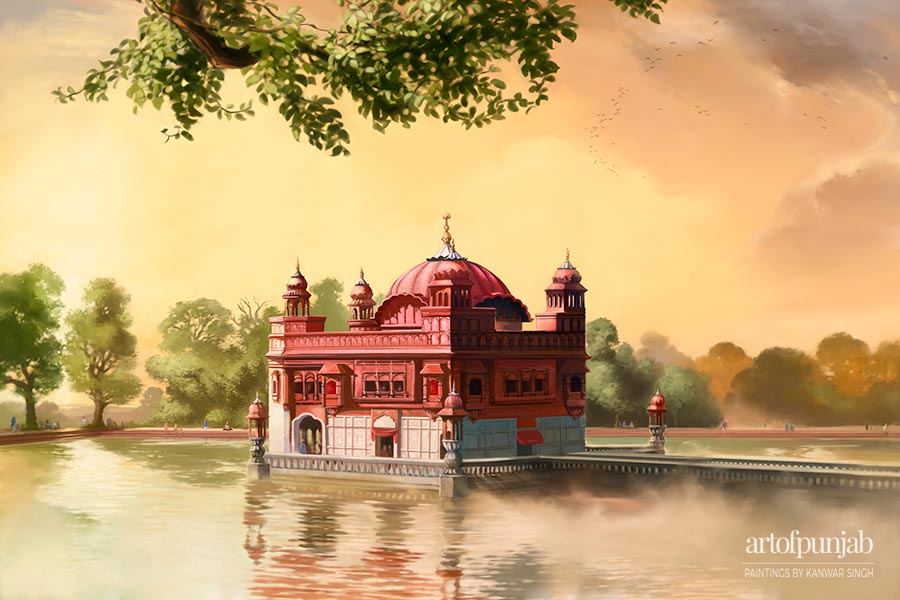
Guru Amar Das was prolifically inspired. Like Guru Nanak and Guru Angad before him, he channelled divine Verses. The Anand Sahib, the Song of Bliss, performed at every gathering even today was penned by the great Third Guru. In it, the Master proclaims the basis of his flourishing spirit: “Sat Naam is my support. Sat Naam, support of mine, satisfies all hunger. It has brought peace and joy to mind and quenched all my desires.“ (Ang 917)
Like Guru Angad before him, the Third Guru maintained the purity of the teachings. And like Guru Nanak, he also trained and inspired his followers until one of them showed they were capable of carrying the load of the Guruship. For Guru Amar Das, it was twenty-two years, and he was ninety-five, before he could confidently transmit his yoke of responsibility onto Bhai Jetha, his humblest, most loving disciple, thence known as Guru Ram Das, the Fourth Guru.
“Blessed is your place, and true is your magnificent glory. You are Nanak, you are Angad, and you are Amar Daas. So do I recognize you.” (Ang 968)

Guru Amardas Ji painting on display at Queen’s Museum, New York. artofpunjab