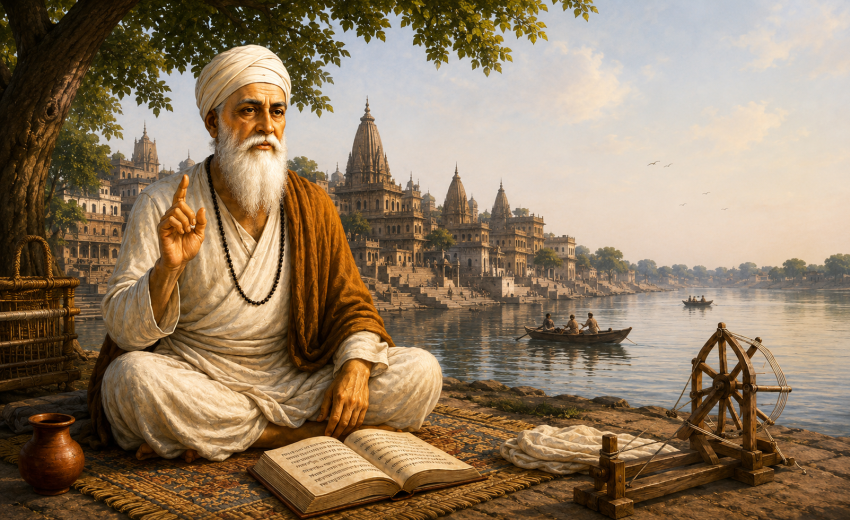

Sant Kabir’s words are closely linked to the Bhakti movement in which he spoke of devotion to one God without dependence on rituals or intermediaries.
Sant Kabir is remembered across India as a spiritual poet whose words reached people from different backgrounds. His verses form an important part of the Guru Granth Sahib, where 227 padas in 17 ragas and 237 shlokas are included under his name. His bani is read and sung in many traditions, and people from Hindu, Muslim, and Sikh communities hold him in high regard.
Early life
Born in Varanasi around 1398, Sant Kabir was raised by a Muslim weaver couple, Neeru and Neema, and grew up in the Julaha community. He worked as a weaver and lived as a householder. He married Mata Loi and had two children, Kamal and Kamali. Though raised in a Muslim household, he came into contact with Hindu traditions and is believed to have been associated with the saint Ramananda. His life moved across different social and religious settings, and this background appears clearly in his verses.
Voice in the Bhakti movement
Sant Kabir’s words are closely linked with the Bhakti movement. He spoke of devotion to one God without dependence on rituals or intermediaries. He did not accept idol worship, caste divisions, or religious formalities carried out without understanding.
His language remained simple and direct. He used examples from daily life and spoke in a way that people could easily follow. At the same time, he used sharp words to question practices that he saw around him. He spoke against both Brahmanical customs and the rigid practices followed by some Muslim clerics.
Because of this, he faced opposition from different groups. Accounts mention that Sikandar Lodi ordered punishments against him, including attempts to drown him, burn him, or have him trampled. Despite this, Sant Kabir did not change the way he spoke.
Teachings on equality
Sant Kabir spoke clearly about the unity of all people. His verses often return to this idea. One well-known composition from the Guru Granth Sahib says:
“ਅਵਲਿ ਅਲਹ ਨੂਰੁ ਉਪਾਇਆ ਕੁਦਰਤਿ ਕੇ ਸਭ ਬੰਦੇ ॥
Aval Aleh Noor Oupaaeiaa Kudharath Kae Sabh Bandhae ||
First, Allah created the Light; then, by His Creative Power, He made all mortal beings.ਏਕ ਨੂਰ ਤੇ ਸਭੁ ਜਗੁ ਉਪਜਿਆ ਕਉਨ ਭਲੇ ਕੋ ਮੰਦੇ ॥੧॥
Eaek Noor Thae Sabh Jag Oupajiaa Koun Bhalae Ko Mandhae ||1||
From the One Light, the entire universe welled up. So who is good, and who is bad? ||1||”
Through such verses, Sant Kabir spoke against ideas of superiority and difference. He questioned caste identity and the way people were judged by birth.
Significant influence in Sikhism
Sant Kabir’s bani holds an important place in Sikh tradition. The Guru Granth Sahib includes writings not only of Sikh Gurus but also of Bhagats like Sant Kabir and Ravidas. All of these are given equal respect, and Sikhs bow before the Guru Granth Sahib as one whole.
There are clear similarities between the teachings of Sant Kabir and Guru Nanak Dev Ji. Both spoke about one God, questioned ritual practices, and spoke about equality among people. Both addressed daily life and spoke in a language that people understood.
Sant Kabir’s verses appear in different ragas in the Guru Granth Sahib, often placed at the beginning of sections that include Bhagat Bani. His words form a part of daily recitation and kirtan in Sikh practice.
Life in Varanasi and Maghar
Sant Kabir spent much of his life in Varanasi, a city known for Brahmin learning and religious activity. He spoke openly against practices that he saw around him. People gathered to listen to him, including those from communities that were often ignored. He later moved to Maghar, where he spent his final days. After his death, both Hindus and Muslims claimed him. According to tradition, a tomb and a samadhi were built side by side in his memory.
The Kabir Panth follows his teachings. This community includes people from both Hindu and Muslim backgrounds and carries forward his message in daily practice.
A shared place across traditions
Sant Kabir is remembered in different ways across traditions, but his words remain the common link. He lived as a householder, worked as a weaver, and stayed connected with people around him. His verses speak about God, daily life, and the way people treat each other. His bani is read in Gurdwaras as part of the Guru Granth Sahib. It is also sung in other settings, showing how widely his words have travelled.
In the Bhakti tradition and in the Sikh scripture, Sant Kabir’s presence shows how his words reached different communities. His verses speak about one God, question divisions among people, and use simple language. His bani remains part of daily life for many, and his words are remembered across generations.
References:
Bhagat Kabir - SikhiWiki
https://www.sikhiwiki.org/index.php/Bhagat_Kabir
It provides a detailed overview of Bhagat Kabir, covering his life, teachings, verses in the Guru Granth Sahib, and his role as a spiritual poet who challenged ritualism and promoted equality and devotion to one God.
Kabir Panthi - Sikhiwiki
https://www.sikhiwiki.org/index.php/Kabir_Panthi
It explains the Kabir Panthi community, their beliefs, practices, and connection to Sant Kabir, including how they blend elements of Hindu and Muslim traditions and relate to Sikh thought.
Spiritual Synthesis: Kabir's Influence on the Divine Discourse of Shri Guru Granth Sahib - Research Gate
Examines how Sant Kabir’s teachings and verses influenced the spiritual ideas and themes found in the Guru Granth Sahib, particularly in relation to divine unity and religious thought.
Bhagat Kabir: A Spiritual Master Bridging Divides - Sikhnet
https://www.sikhnet.com/news/bhagat-kabir-spiritual-master-bridging-divides
Gives an overview of Sant Kabir’s life, teachings, and role as a spiritual figure who spoke against religious divisions while promoting unity, equality, and devotion to one God across different communities.
Kabir the Weaver - Sikhnet
https://www.sikhnet.com/news/kabir-weaver
Introduces Sant Kabir as a weaver and spiritual teacher, highlighting his poetry, his simple way of living, and his connection with Ramananda.