
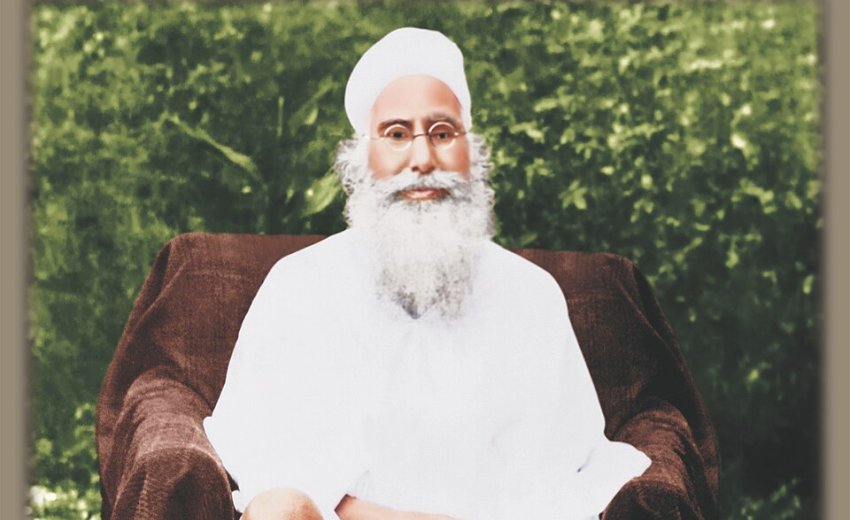

A Life That Awakened Souls, Enlightened Minds and Served Humanity
A legacy to preserve. A life to understand. A spiritual vision to inspire and uplift generations to come.
Sant Attar Singh Ji of Mastuana Sahib is remembered not merely for the reverence he inspired or the institutions that arose through his vision, but for a life that united Naam with action, spirituality with education, inner discipline with public service, and Sikh identity with universal human dignity. From a life immersed in Gurbani and Simran emerged a far-reaching mission of kirtan, Amrit Sanchar, education, equality and selfless service.
To describe him only as a contemplative saint would leave his public mission unexplained; to remember him only as an educator or institution-builder would miss the spiritual power from which that mission arose. In Sant Ji's life, the inner and outer worlds were inseparable. Naam was not a retreat from humanity. It became the source of a life devoted to awakening souls, educating young people, rebuilding confidence and serving society.
His life demonstrated that spirituality must become character; education must enlighten as well as inform; power must bow before humility; faith must rise above caste and prejudice; and leadership must become service rather than domination. These were not merely ideas he preached. They were principles he first laboured to embody.
A Life First Earned in Naam
Born in 1866 at village Cheema in the Sangrur region, Sant Attar Singh Ji grew up in the farming household of Sardar Karam Singh and Mata Bholi. His early life was grounded in rural simplicity, honest labor, Gurmukhi and familiarity with Gurbani. He later entered military service, where discipline became another part of his formation. Yet the call of the inner life steadily grew stronger.
Sant Ji received Amrit during his military years and eventually turned away from the ordinary path of worldly advancement. His journey led him to Takht Sri Hazur Sahib and later to Kanoha, now in Pakistan, which the biographical tradition remembers as an important place of sustained Naam-Simran and spiritual discipline. Dr. Amar Singh's research records three concentrated periods of spiritual practice there. Yet Naam-Simran was not merely a stage of preparation that ended when his public mission began. It remained the spiritual current running through his life, giving depth to his kirtan, direction to his Amrit parchaar, strength to his seva, and purpose to the educational, social and institutional work that followed.
These years of Simran, Gurbani, solitude and self-discipline were not an escape from the world. They were the preparation for the immense public work that followed. Before seeking to awaken others, he undertook the more difficult conquest of the self. The authority that later accompanied his kirtan and preaching arose from kamai, from first attempting to live the discipline he asked of others.
That principle provides a key to understanding his entire life. Naam cultivated inwardly flowed outward through kirtan and Amrit; transformed lives became Sangat and seva; and seva took institutional form in schools, colleges, gurdwaras and centers of learning.
When Spiritual Awakening Became a Movement
When Sant Attar Singh Ji entered public religious life, he did not place his own personality at the centre. He directed people toward Sri Guru Granth Sahib, Shabad kirtan, Naam Simran, Amrit and disciplined Sikh living. He travelled widely through villages and towns, holding diwans and conducting Amrit Sanchar wherever the Sangat was ready.
His method was direct: awaken love for the Guru through Gurbani, encourage Amrit-vela and Naam, bring people toward Amrit and rehit, honest work and freedom from intoxicants, and turn personal spiritual awakening toward seva. Religious revival was therefore not an occasional emotion experienced at a great gathering. It meant the transformation of everyday life.
His kirtan was remembered for a sweet, powerful and resonant voice, but the biographical record attributes its influence to more than musical ability. It depicts Sant Ji becoming deeply absorbed in Shabad as he sang, drawing the Sangat into that spiritual atmosphere. The voice heard by great congregations had first been formed through remembrance and self-discipline. It was, in that sense, an earned voice.
Amrit Sanchar consequently became one of the defining features of his public mission. Amrit was not separated from everyday conduct. It was joined with Naam, Gurbani, rehit, honest work and a reshaping of life itself.
Equality, Human Dignity and Seva
Sant Ji's spirituality was also tested in how human beings were treated. He opposed caste exclusion and untouchability because such practices contradicted the equality proclaimed by the Sikh Gurus.
One of the most moving examples concerns the renowned scholar Giani Ditt Singh. According to the account preserved through Sant Teja Singh Ji, Giani Ditt Singh explained that caste prejudice had led some Sangats to deny him equal treatment in the distribution of Karah Prasad. Sant Attar Singh Ji was deeply affected by this humiliation. The episode exposed the painful distance that could exist between the teachings of the Gurus and actual social behavior.
Sant Ji did not invent a new doctrine of equality. The Gurus had already given it. His contribution was to insist that the Sangat live what the Guru had taught.
The same spiritual conscience shaped his concern for women and education. Sources associated with his legacy record an early girls' school at Mastuana in 1906-07. In the environment of early twentieth-century rural Punjab, giving girls' education a place within the wider educational movement represented an important commitment.
Sant Ji also challenged intoxicants, superstition and practices harmful to human dignity. His method was not merely condemnation. The recurring pattern in the sources is Gurbani, persuasion, Sangat, Amrit and changed conduct. His social vision therefore grew naturally from Gurmat rather than existing as a separate programme alongside his spirituality.
Mastuana Sahib: Giving the Vision an Institutional Home
The establishment of Guru Sagar Sahib at Mastuana gave Sant Ji's mission an enduring center. Work began in 1901, and Mastuana developed as a place where worship, education, Gurmat teaching and community service could strengthen one another.
Its gurdwaras, sarovar, schools and college should therefore not be understood as disconnected projects. They reflected a unified conviction: spiritual life should produce enlightened and responsible human beings, while education should remain rooted in character and service.
Sant Ji understood that the Sikh community needed teachers, scholars, administrators and young people equipped with modern knowledge. His educational vision did not require Sikhs to choose between modern learning and Sikhi. It sought to bring intellectual development and Gurmat together.
Akal College at Mastuana became a major expression of this thinking. Dr. Amar Singh records that its foundation was laid in 1919, with classes beginning in 1920.
His educational standing also extended beyond Sikh institutions. Pandit Madan Mohan Malaviya invited Sant Ji to Banaras in connection with the foundation of the Sanskrit College associated with the developing Banaras Hindu University project in 1914. The episode illustrates the remarkable breadth of his public standing: a Sikh spiritual leader formed in rural Punjab had become a respected presence in education at an all-India level.
Sant Teja Singh Ji: Carrying the Vision Beyond Punjab
Perhaps no episode better demonstrates Sant Attar Singh Ji's educational foresight than his relationship with Sant Teja Singh Ji.
Already highly educated, Teja Singh came under Sant Attar Singh Ji's influence, received Amrit and later became an important scholar and educational servant of the Panth. Sant Ji sent him abroad with other young Sikhs for higher education. Biographical records describe his studies in London, at Teachers College, Columbia University, and at Harvard, while also sharing the message revealed through Guru Nanak Sahib and carried forward through the Ten Gurus as One Jot in Britain, the United States, Canada and other countries.
This was far more significant than helping a talented student secure an overseas education. It reflected Sant Ji's conviction that Sikh scholars should be capable of engaging the modern intellectual world without surrendering their spiritual center. Higher learning and the Guru's message could travel together.
Sant Teja Singh Ji later returned to serve educational institutions in India and became closely associated with Akal Degree College, Mastuana. His extensive Punjabi biography of Sant Attar Singh Ji, written from the perspective of a disciple and participant in the work, also became an important source for remembering his mentor's life.
Spiritual Authority in Panthic and Public Life
Sant Attar Singh Ji lived during an era of Sikh religious reform, educational awakening, gurdwara agitation and growing political consciousness. His influence entered these spheres without losing its spiritual foundation.
Sources record his presence at the gathering connected with the Nankana Sahib martyrs and his later invitation to Jaito in connection with the conclusion of the Akali morcha. At Jaito, historical material records continuing diwans and also practical assistance when the langar faced strain. The episode captures something characteristic of his outlook: religious leadership meant sustaining the Sangat spiritually while serving its practical needs.
His appearance at the 1911 Delhi Durbar similarly reflected the public recognition his life had acquired. Dr. Amar Singh's research records his presence there as a Sikh religious representative and states that George V removed his hat and bowed to him. Such an episode is best preserved without embellishment. Its deeper significance lies not in imperial ceremony, but in contrast between worldly rank and an authority grounded in Gurbani, Naam and humility.
Sant Ji's relationship to the reform movements of the age is equally important. Rather than becoming primarily a political theorist or polemical writer, his distinctive contribution was to give reform a lived spiritual foundation through Naam, Amrit-vela, kirtan, Amrit, rehit and community service.
The Measure of His Legacy
The greatness of Sant Attar Singh Ji cannot be confined to one institution, title or historical episode. His life joined together realities that are too often separated: contemplation and action, faith and education, personal discipline and public responsibility, Sikh identity and universal human dignity.
He was the seeker who turned away from worldly advancement for spiritual discipline, and the contemplative who returned among the people. He brought Sangats toward Gurbani and Amrit; challenged caste humiliation and harmful social practices; supported women's education; encouraged schools and colleges; and envisioned Sikh scholarship capable of engaging the wider world.
Yet perhaps his greatest institutions were human beings whose lives he awakened. Buildings endure because people continually give them purpose; Sant Ji's deeper legacy was a culture in which Naam, education and seva could continue producing people committed to Gurmat and service.
And perhaps the essence of that entire life can be expressed most simply:
Naam must become a character.
Character must become service.
And service must uplift humanity.
A century later, Sant Attar Singh Ji stands before us not merely as a revered figure from the past, but as a spiritual standard for the future:
Selected Historical Sources
• Sant Teja Singh, Jivan Katha / Jeevan Katha Gurmukh Piare Sant Attar Singh Ji Maharaj.
• Dr. Amar Singh, Sant Attar Singh Ji Di Dharmic Ate Smajic Kheter Vich Den, Baikunth Publications, Patiala; first edition 2012, second edition 2024.