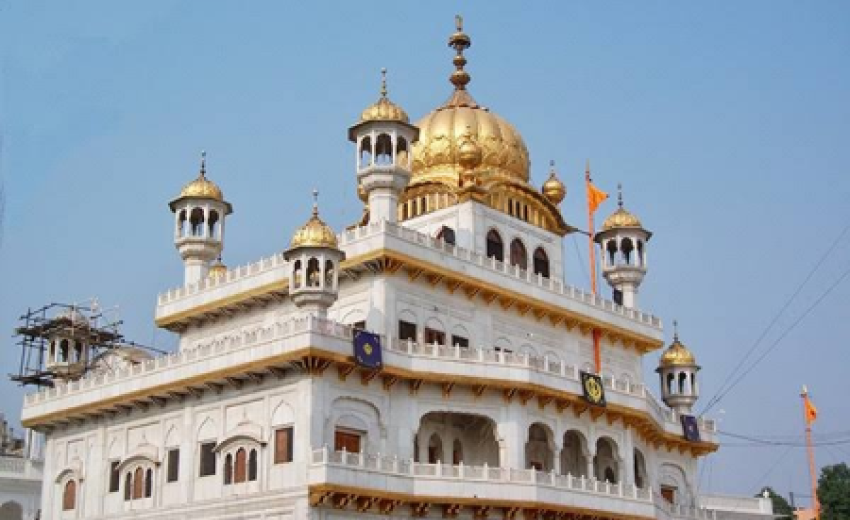

The fragrance of the Gandharba flower, enhanced by its petals, spreads throughout the environment, yet this fragrance stands upon the architecture of its stem, which serves as its primary source.
Within the core consciousness of the Panth, the unified form of Sri Akal Takht Sahib is the very manifestation of that architecture, along whose path the beautiful garden of the Panth is blooming.
The divine power manifested through the path of the "Shabad Guru," envisioned by the True Gurus, is so deeply rooted in its form and narrative that whenever Panthic consciousness becomes fragmented, Sri Akal Takht Sahib—with its source of unity—reconnects the Panth with the prayer "Ek Pita Ekas Ke Ham Barik" (The One Father, we are children of the One) and steers it back toward its supreme national goal.
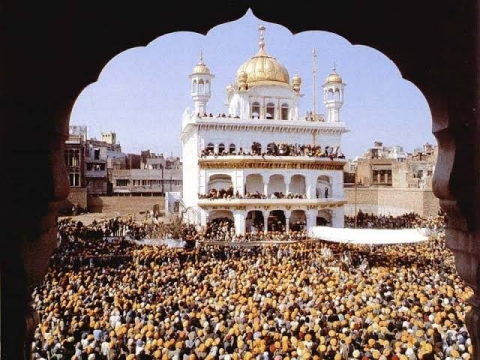
In the sweeping dynamics of modern civilization where any social unit or structure struggles to maintain its sovereign relevance, Sri Akal Takht Sahib firmly anchors its stability amidst this turbulent storm, humbling the worldly apparatus of temporal power before the sovereignty born from the source of Akali (divine/timeless) power. There is no greater testament of power than the authority of Sri Akal Takht Sahib.
A Sikh's individual and collective stable unity cannot be shaken as long as Sri Akal Takht Sahib stands firm on its sacred, unshakeable principle of the "True Immortal, True Sovereignty" (Sachchi Patshahi). While democratic systems remain confined to multi-faceted interpretations, the drum of universal brotherhood—"Sabhe Sanjhiwal"—continues to resound from Sri Akal Takht Sahib to this day.
The Indian interpretation of the democratic structure, born from colonial and Western dynamics and aligned with majoritarian psychology, has ultimately reduced itself to serving the majority. All structures of justice and governance have been framed through the lens of this pluralistic democratic interpretation, creating an illusion that captures people's trust—making them believe that these theoretical rules derived from rational aggregates are the only ones capable of maintaining a stable
state. Living under such a system, Sikhs must abandon the hope that this judicial and political system will ever be capable of fulfilling their distinct sovereign destiny.
Only the centralization of Sikh power can fulfill the goal of Sikh self-determination and success, a center established by the True Guru, Sachay Patshah, in the form of Sri Akal Takht Sahib. The limitations of this thought arise when an individual steps outside this framework to become a compliant apologist for the secular state, following blindly behind it. Today, this has become the plight of the majority of Panthic organizations and sects—they claim to be heirs of the Akal Takht, yet they bow in servitude and sycophancy to majoritarian power structures.
If Sri Akal Takht Sahib is the throne of Sikh central sovereignty, then the proclamation of its spiritual power is manifested through a Sikh's absolute and unwavering faith in Sri Akal Takht Sahib. To fulfill the vision of this institution of the Guru-Panth and move forward under correct guidance, every Sikh must maintain Sri Akal Takht Sahib as their ultimate and steadfast pillar of strength.
The five Singh Sahibs sitting in the presence of Sri Akal Takht Sahib are embodiments of the spirit of Sri Dashmesh Ji (Guru Gobind Singh Ji), tasked with propagating the absolute supremacy and leadership of Sri Guru Granth Sahib within the Panth. Every sentinel connected to Sri Akal Takht Sahib is granted the sacred opportunity to uphold the guidance of the "Shabad Guru" and, through conscious wisdom, keep the Sikh political philosophy firmly rooted and mature. This can only be fully realized when Sri Akal Takht Sahib retains an independent sovereign status, staying true to Panthic codes and traditions.
When we shackle this sovereign source provided by the Guru Sahib within rigid institutional structures, its proponents cease to be sentinels of the Panthic resolve and instead degrade into mere bureaucratic employees of an institution. The pages of history bear witness to how Sri Akal Takht Sahib—the fountainhead of Sikh power—in its absolute sovereign existence, brought the mightiest empires of the world to their knees. If the sanctity of this very Akal Takht is compromised to serve personal political interests, we not only tarnish its supreme glory but actively participate in eroding the sovereign identity of Sikhism.
Sikhism is a political resolve born from the bedrock of devotion (bhagti), which continues to awaken Sikh consciousness today, urging unity and the supremacy of the One Standard (Ek Nishan). By recognizing this awakened voice, every Sikh can fulfill the ultimate goal of establishing the absolute supremacy of the Khalsa (Khalsa Ji Ke Bol Bale).