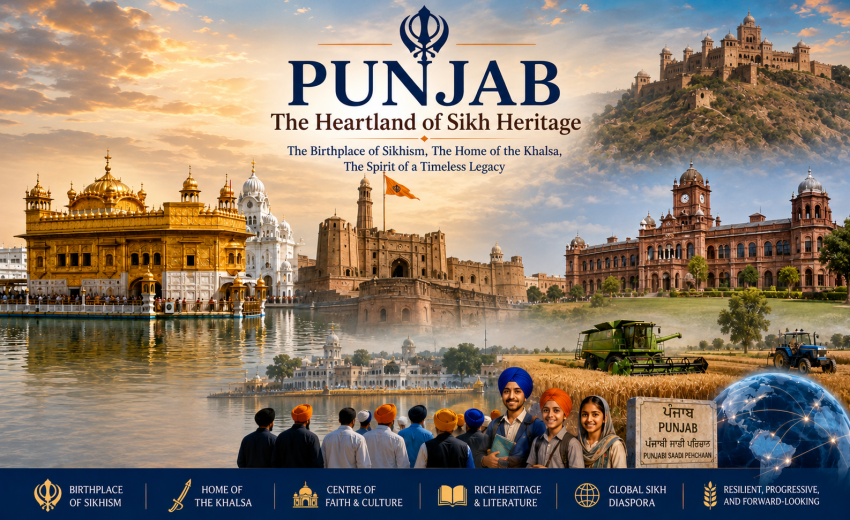

Punjab occupies a unique position in Sikh history, civilization, and collective consciousness. It is not merely a geographical region but the birthplace of Sikhism, the arena of its institutional development, and the homeland where Sikh religious, political, literary, and cultural traditions evolved over more than five centuries. The intimate relationship between Punjab and the Sikhs has been shaped through spiritual revelation, political struggle, social reform, and cultural continuity. Consequently, Punjab has long been regarded as the heartland of the Sikh nation.
The Historical Landscape before Sikhism
The name Punjab, derived from the Persian words panj (five) and ab (water), refers to the land watered by the five rivers of the Indus system. Since antiquity, Punjab has served as a gateway to the Indian subcontinent, witnessing the rise and fall of numerous civilizations, including the Indus Valley Civilization, Vedic culture, Persian, Greek, Kushan, and Mughal empires. This historical diversity created a fertile environment for intellectual exchange while also exposing the region to repeated invasions and political instability.
By the fifteenth century, rigid social hierarchies, sectarian divisions, and political oppression had generated conditions that inspired profound religious and social reform. It was within this milieu that Guru Nanak (1469–1539) inaugurated the Sikh faith.
The Birth of Sikhism in Punjab
Guru Nanak was born at Rai Bhoi di Talwandi (now Nankana Sahib in present-day Pakistan). His teachings emphasized belief in one universal God, equality of all humanity, honest labour, service, and remembrance of the Divine. Throughout his extensive journeys (Udasis), Guru Nanak spread a message transcending religious and caste distinctions, while Punjab remained the principal centre of his ministry.
The nine succeeding Gurus consolidated Sikh institutions within Punjab. They established new towns, strengthened congregational life (Sangat), introduced the institution of Langar, and laid the foundations of a distinct religious community. Guru Arjan’s compilation of the Adi Granth in 1604 and the construction of Harmandir Sahib at Amritsar transformed Punjab into the spiritual centre of Sikhism.
Punjab and the Rise of the Khalsa
A decisive transformation occurred in 1699 when Guru Gobind Singh founded the Khalsa at Anandpur Sahib. The initiation of the Khalsa represented not merely a religious ceremony but the creation of a disciplined community committed to justice, equality, and the defence of religious freedom.
Following the martyrdoms of Guru Arjan and Guru Tegh Bahadur, Punjab became the principal theatre of Sikh resistance against Mughal persecution. The eighteenth century witnessed prolonged struggles between the Sikhs and successive Mughal and Afghan rulers. Despite severe persecution, the Sikh community preserved its institutions through remarkable resilience and eventually organized itself into autonomous Misls.
The Sikh Empire
The political unification of Punjab reached its zenith under Maharaja Ranjit Singh (1780–1839). By consolidating the Misls, he established the Sikh Empire, extending from the Khyber Pass to the Sutlej and from Kashmir to Multan.
The Sikh Empire became renowned for religious tolerance, administrative efficiency, military modernization, and economic prosperity. Lahore emerged as a flourishing political and cultural capital, while Amritsar retained its central religious significance. This period represented the first sovereign Sikh state and remains a defining chapter in Sikh political history.
Colonial Punjab and Sikh Reform
Following the annexation of Punjab by the British in 1849, Sikh institutions underwent profound changes. Colonial policies altered land administration, military recruitment, and educational systems while simultaneously encouraging the codification of religious identities.
The late nineteenth and early twentieth centuries witnessed significant Sikh reform movements, particularly the Singh Sabha Movement, which revitalized Sikh theology, education, literature, and historical scholarship. Subsequently, the Gurdwara Reform Movement restored Sikh control over major historical gurdwaras, culminating in the establishment of the Shiromani Gurdwara Parbandhak Committee (SGPC) in 1925.
Partition of Punjab
The Partition of India in 1947 constituted one of the most traumatic events in Sikh history. Punjab was divided between India and Pakistan, resulting in the displacement of millions and the loss of numerous historic Sikh shrines located in West Punjab, including Nankana Sahib, Panja Sahib, and Dera Sahib Lahore.
Despite immense human suffering, Sikh communities rebuilt their lives in Indian Punjab while maintaining enduring spiritual ties with their historic shrines across the international border.
Punjabi Suba and Modern Punjab
The linguistic reorganization of Punjab in 1966 led to the creation of the present Indian state of Punjab, where Punjabi written in the Gurmukhi script became the official language. The state subsequently emerged as India’s agricultural powerhouse during the Green Revolution.
Punjab today remains the principal centre of Sikh religious life. Sri Harmandir Sahib (Golden Temple), Akal Takht Sahib, Anandpur Sahib, Tarn Taran, Fatehgarh Sahib, and numerous other historical gurdwaras continue to attract millions of pilgrims annually.
Punjab and the Global Sikh Diaspora
Over the past century, Sikh migration has transformed the community into a global diaspora extending across the United Kingdom, Canada, the United States, Australia, New Zealand, Southeast Asia, East Africa, and Europe. These communities have established gurdwaras, educational institutions, charitable organizations, and academic centres that preserve Sikh heritage worldwide.
Nevertheless, Punjab continues to function as the spiritual, linguistic, and cultural nucleus of global Sikh identity. Pilgrimage, family connections, religious education, literature, and collective memory sustain enduring links between the diaspora and their ancestral homeland.
Contemporary Challenges
Modern Punjab faces significant challenges, including economic diversification beyond agriculture, environmental degradation, declining groundwater resources, youth migration, unemployment, drug abuse, and the preservation of Punjabi language and cultural heritage.
At the same time, Sikh institutions, universities, historians, and civil society organizations continue to promote religious education, historical preservation, manuscript conservation, interfaith dialogue, and global engagement. The worldwide Sikh diaspora also contributes substantially to Punjab’s educational, humanitarian, and cultural development.
Punjab has remained inseparable from Sikh history since the birth of Guru Nanak more than five centuries ago. It is the birthplace of the Sikh Gurus, the homeland of the Khalsa, the setting of Sikh martyrdoms and victories, the centre of Sikh religious institutions, and the repository of Sikh collective memory. Although Sikhs today constitute a vibrant global community, Punjab continues to occupy an unparalleled place in their historical consciousness and spiritual identity. Its sacred geography, cultural heritage, and historical legacy ensure that Punjab remains, in every meaningful sense, the enduring heartland of the Sikh people.