
Voices of Shabad: A Reflection by GAAVANI
In honor of the 350th commemorative year of Guru Tegh Bahadur, GAAVANI continues its special essay series on SikhNet, sharing reflections from Sikh women on their personal journeys with Sikh spirituality and the living presence of the Guru’s Shabad.
Following the earlier reflections in this series, we now present the fourth essay, which explores how Gurbani becomes a guiding presence—mirroring our inner world, shaping our understanding, and inspiring us to live with awareness, compassion, and courage in everyday life.
Launched on International Women's Day (March 8), this collection releases a new essay every two days, inviting the Sangat to reflect on a living relationship with the Guru’s Shabad.
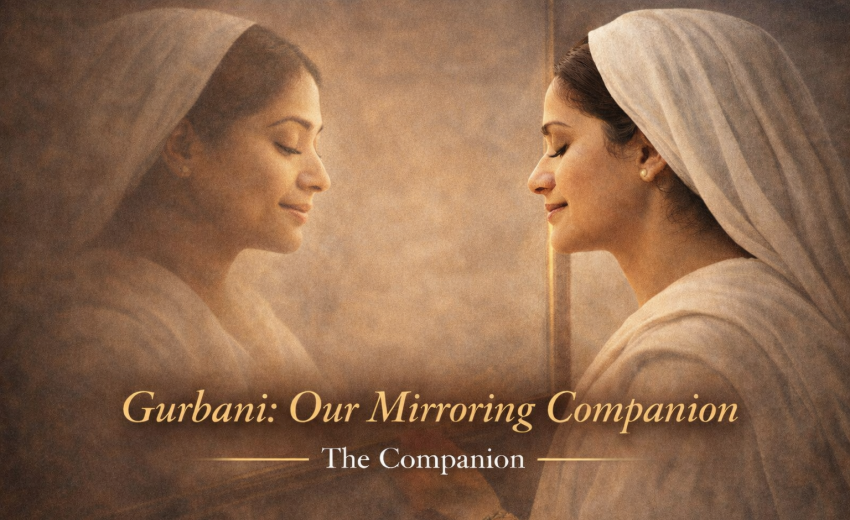
Gurbani: Our Mirroring Companion
The Companion
It is wonderful to join GAAVANI to commemorate the 350th anniversary of Guru Tegh Bahadur’s martyrdom. Each drop of the Guru’s blood spilled by the cruel execution reveals the fundamental unicity of the Divine, and the plurality of Its existential expressions. The ninth Guru is an ever-enduring priceless mirror for humanity, showing us true courage - not in seeking one’s own survival but in ensuring the survival of justice and liberty for others. Saturated in the love of the absolute One, Guru Tegh Bahadur’s melodic repertoire of fifty-nine shabads (hymns) and fifty- seven shaloks (couplets) fosters kinship with all fellow beings. By engaging visual, perceptual, syntactic, and semantic processes, Sikh scriptural verses overall produce a powerful, mysterious spiritual effect upon us readers, singers, reciters, or listeners. My lifelong academic pursuit has been to grasp their metaphysical ingredients, and I thank the GAAVANI team for prompting me to consciously articulate my constant unconscious resonant companion Gurbani.
We honor the Guru’s anniversary by remembering his personal voice of sacrifice synchronized with the universal longing for justice, truth, and freedom. Stepping out of my house in the morning I am charged to recognize the Divine One shared by everybody and everything for “there is no second/no other - dūsar nahin koe” Guru Tegh Bahadur categorically proclaims (GGS: 1426). There is of course no opposition between the One and the many, nor is there any antithesis between unity and plurality: “nānā rūpu dhare bahu rangī sabh te rahai Niārā - the One takes on myriad forms and multiple colours, yet remains ever unique” he celebrates (Rag Bairagara, GGS: 537). In a world fractured by religion, race, ethnicity, gender, politics, economics, it is more important than ever to rediscover our common matrix. This rediscovery is not mere acknowledgement; rather, it is a rejoicing in the colorful radiance of countless forms all around – birds and people and plants - each sparkling uniquely with the uniqueness of that Unique One. How could feet not bounce to such sublime verses?
Upon entering my professional home, the academic halls of Colby College, I am pedagogically inspired by Guru Tegh Bahadur. “Just like the perfume in a flower, like the reflection in a mirror - puhap madhi jio bāsu basatu hai mukar māhi jaise chhāī,” the Divine exists within (GGS: 684). The scent cannot be seen, nor the mirror’s reflective power, but both do exist within the fibers of my being. Like neurons firing across to connect gaps in the nervous system, Guru Tegh Bahadur’s literary ornaments, alankar, create a synaptic effect. They spark the imagination, they evoke emotions. His imaginative utilization of similes and metaphors is a valuable practical model for my own teaching. By drawing upon his strategies, dry abstract classroom exercises can turn into engaging and meaningful processes; assigned texts can be intellectually rigorous and accessible to my students; our textual interpretations can metamorphose into lived experiences.
Over and again, the Guru highlights the ephemerality of life as it vanishes like a Hailstone - (oré), like a dream (supanai), like a wall of sand (bārū kī bhīti), and - like a cloud’s shadow (badar kī chhāi) (GGS: 219 and 1231); each instant “life drips away like water from a cracked pitcher - chhinu chhinu audh bihātu hai phūṭe ghaṭu jio pānī” (GGS: 726) Yet his striking analogies do not produce any pessimistic or static effect; paradoxically, by confronting us with the finitude of death, our Prophet and Martyr helps us affirm death as a natural part of our existence, without denial or illusion. For the German philosopher Martin Heidegger, human existence (Dasein) is characterized by Being-towards-death: through anticipating death, one becomes free, liberated from the inauthenticity of lostness (Being and Time, 1927). Centuries earlier, Guru Tegh Bahadur reminded us that death is always before us, and that such awareness is precisely what enables us to live authentically. As soon as I realize that finitude defines the horizon of life, each instant becomes precious. I long to live freely, genuinely, ethically. Antithetical to a “stone-like existence - jaise pāhanu” (Guru Tegh Bahadur’s simile, GGS: 831), people around me suddenly become more important; my relationships, deeper. The world itself projects its meaning in ever fuller and richer ways.
Instructively, Guru Tegh Bahadur’s mirror (mukar or darpani) reappears in Raga Sorath with the added importance of justice (niāī): “That One dwells within everybody equally, says Nanak, like a mirror of justice—so tum hī mahi vasai nirantari nanak darpani niāī ”(GGS: 632). This inner mirror reflects the egalitarian justice of the Divine while exposing our blind spots - greed, lies, pride, prejudices, divisions, hegemonies, and so forth. Guru Tegh Bahadur’s transformative similes and metaphors are not about submission to authoritarian dictates and external notions of justice; in fact, they serve as companions - polishing the inner mirror of selfishness, empowering readers, singers, listeners, and reciters to align themselves with clarity, equality, transparency, and fairness. And this state of confident, expansive, liberated being (muktā) is no different from the Divine Itself (tihi nar hari antaru nahī) affirms Guru Tegh Bahadur (GGS: 1428).
Essentially, then, the aesthetically resonant Gurbani melodies are a training to feel that One, guiding me in how I think, write, act, choose, perform, and relate with everyone.
Dr. Nikky-Guninder Kaur Singh