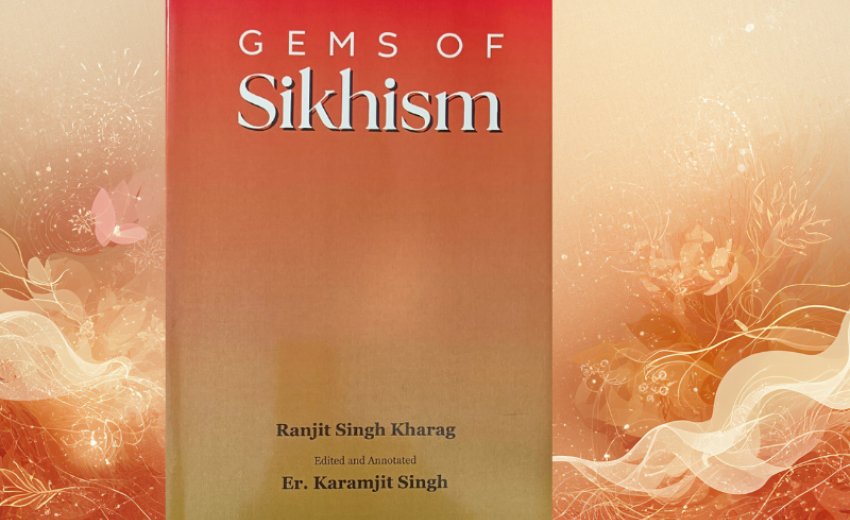

Title: GEMS OF SIKHISM
Author: Ranjit Singh Kharag
Edited and Annotated
Er. Karamjit Singh
Published by Tarlochan Publishers, Chandigarh
Price: Rs 700 (25 $); First Edition: 2024
Ranjit Singh Kharag is not known in academic circles as his writings in English and Punjabi remained unpublished before his death in 1971. Er Karamjit Singh, his devoted son, took up the cudgels to publish his father’s manuscripts. 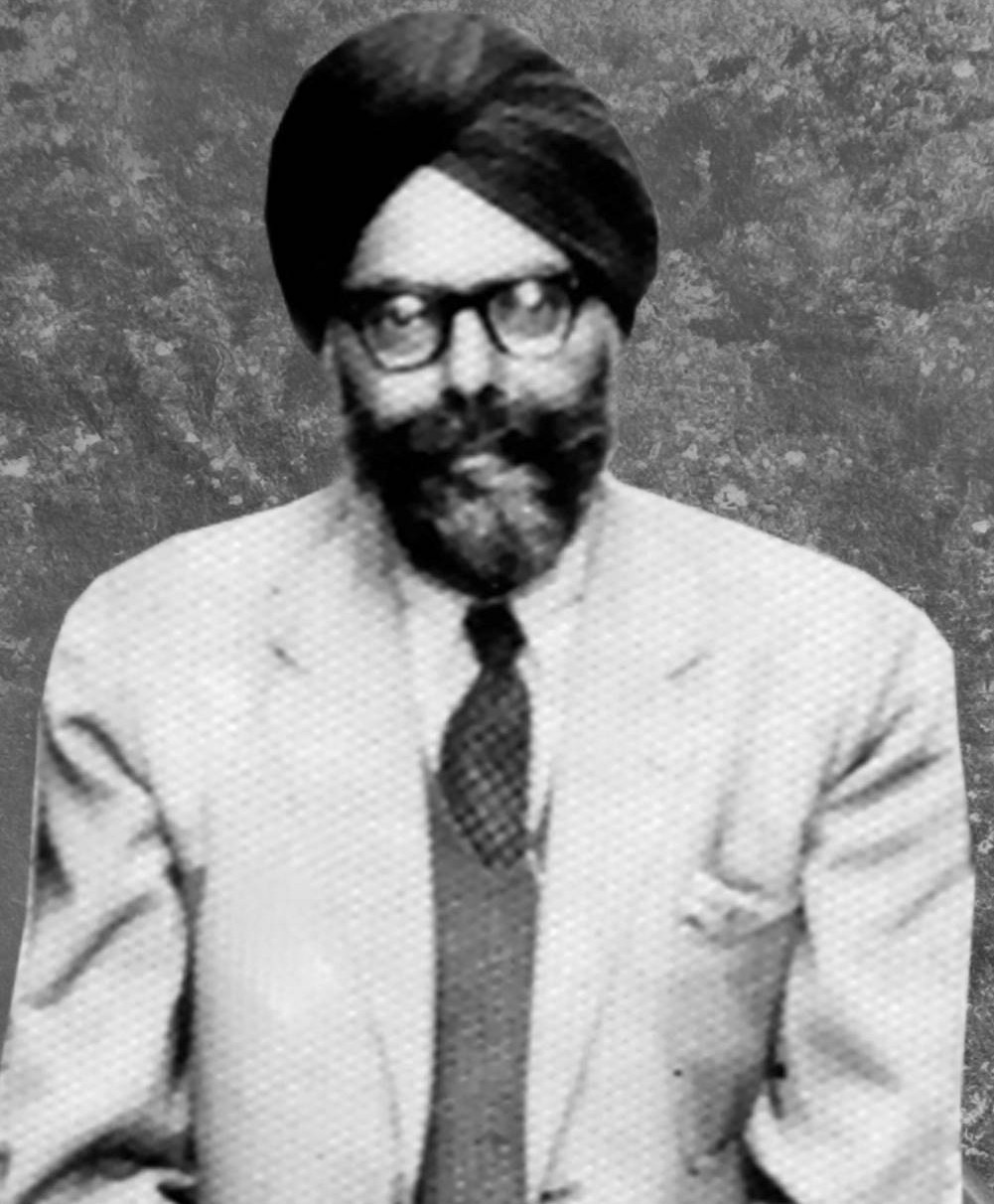 Ranjit Singh Kharag never went to a college or a university for higher education. After Matriculation, he went to Lahore in search of a job and in 1932 joined a vernacular paper as a profession. Kharag was a born poet and he wrote 562 poems which have been compiled in three volumes by his son. After a few ups and downs in his life, he was able to find a permanent job in Accountant General Office of Posts and Telegraphs, Shimla in 1945.
 In the introduction about the author, Karamjit Singh, Editor and Annotator of this book, writes about his father: “Having studied Punjabi, Hindi, Urdu, English and Persian, he was very fond of Sher-o-Shayri and often quoted couplets of Ghalib, Shakespeare and other favourite poets as per situation. Since his coming to Shimla, he religiously went to Sri Guru Singh Sabha, Cart Road Shimla. His contribution to the Gurdwara Sahib was immense and was appreciated by all. Father was a true humanist and an idealist. But he did not look back, ten years of evolution of mind and his literary pursuit brought him on pedestal of the first line of writers”.
Dr Asa Singh Ghuman writes in his Preface: “I have always appreciated the efforts being made by respected Er. Karamjit Singh Ji to compile and edit the valuable writings of his father, Sardar Ranjit Singh Ji Kharag. The present volume is also a rosary or a mosaic of very precious articles, written on various aspects or anecdotes of Sikh history”. Asa Singh has appreciated the knowledge of modern historiography found in the writings of Ranjit Singh Kharag. He has reviewed almost all the Chapters of this book and found a stream of Sikh thought flowing uninterrupted in these Chapters.
The book under review has 23 Chapters. Bulk of the Chapters are focussed on Sikh history of the Sikh Gurus and Maharaja Ranjit Singh and his family. In Chapter 1“Warning of History”, Kharag displays his knowledge of world history:
“History is the fifth Veda according to ancient Indians. In the words of Napoleon, "History is a set of lies agreed upon." He is, however reputed to have proclaimed: 'let my son read and reflect upon history - it is the only philosophy. Further, he elaborates the role of history: “The history of a country is a great museum. Nor does it only record wars and changes of dynasties of revolutions and rebellions, but also political intellectual, religious, social, economic and industrial development of a people”.
All Chapters of this book comprise the articles published by Ranjit Singh Kharag in Spokesman Weekly published in Delhi under the patronage of Sardar Hukam Singh, the Speaker of Lok Sabha. Chapter 2 “A Study in the Life and Thoughts of Bhagat Namdev” is a brilliant exposition of Saint-Poet’s life, travels, compositions and revolutionary ideas against untouchability. In addition to Namdev’s bani recorded in the Sikh Scripture (Sri Guru Granth Sahib), Kharag found ten other volumes written by Bhagat Namdev. His passing away at village Ghuman in Gurdaspur district of Punjab, establishes his credentials to unite people of Punjab and Marathas of Maharashtra. I find this article as most informative about Bhagat Namdev.
Chapters 3-7 are based on Akal Takhat, battles of Bhangani and Chamkaur, Pir Buddhu Shah, and Banda Singh Bahadur.
The author has used all available sources in Sikh literature and history to describe these Chapters. He refers to research work of Dr Ganda Singh, the topmost Sikh historian, in the form of a book published by Punjabi University, Patiala: “Guru Gobind Singh clearly perceived what was yet vital in the youthful ascetic and resumed it with Promethean fire. He availed himself of the psychological moment, dressed him like a Sikh and administered to him the immortal draught, the Amrit of the Khalsa Church. He was given the name of Banda Singh”.
Chapter 8 “Great Holocaust of 1762” is better known as “Vadda Ghallughara” in Sikh history. The author has quoted twenty different sources, including Persian and English, to enumerate the loss suffered by the Sikhs. It is a rough estimate that half the Sikh population in Punjab was decimated by the marauding army of Ahmad Shah Abdali, when the Vaheer (the moving caravan) was attacked at village Kup Rahira in Malerkotla state. All Sikh leaders, including Jassa Singh Ahluwalia, Charhat Singh Sukarchakia, and Jassa Singh Ramgarhia, joined hands in this battle of survival. Sikh leaders fought to protect their women, children and other non-combatants, but lost their most valued Scriptures prepared by Guru Arjun (Aad Guru Granth Sahib) and Damdami Bir, prepared by Guru Gobind Singh Jee at Talwandi Sabo.
Chapters 9 and 10 narrate the rise of Khalsa army to conquer Lahore and appoint Jassa Singh Ahluwalia as their King (Padshah). Chapters 11-15 are focussed on Maharaja Ranjit Singh and his victories. The author also gives description of Bhangian Di Tope, Akali Phula Singh and Hari Singh Nalwa, the two great Generals who helped the Maharaja to expand his territories. Hari Singh lost favour of Ranjit Singh as he opposed to his meeting with the British Governor General at Ropar. He was also not in favour of Prince Kharak Singh as successor of Ranjit Singh. Cunnigham, the historian of the Sikhs, records this episode: "That Ranjit Singh was jealous personally, of Hari Singh, or that the servant would have proved a traitor to the living master, is not probable: but Hari Singh was a zealous Sikh and an ambitious man, and Kharak
Singh was always full of doubts and apprehensions with respect of his succession and even his safety”. The author provides valuable information about Hari Singh Nalwa’s family.
Chapter 15 “Coins of Lahore Darbar” is an important Chapter in this book. It is one of the most informative for those who work in the field of numismatics of Sikh coins. The author refers to coins struck by Sardar Jassa Singh Ahluwalia, Maharaja Ranjit Singh, and Baba Ala Singh. The Sikhs conquered Lahore on 17 November 1761 and struck coins in Lahore mint in name of Jassa Singh Ahluwalia, the “Sultan-ul-Quam”. The coins bore the following Persian inscription:
Sikka zad dar Jahan ba fazle Akal, Mulk-i-Ahmed grift jassa kalal.
It was considered derogatory to the honour of Jassa Singh Ahluwalia. This coin was again struck in the Amritsar mint as a Nanak Shahi coin, with a changed inscription:
Akal Sahai Guru Nanak Ji (in Gurmukhi)
Sar Tegh-i-Nanak az Fazli-i-Fateh-i-
Gobind Singh Shah-i-Shahan Sahib Sikka
zad bar Simo-Zar (in Persian).
When Sikhs conquered Lahore, second time in 1765, they struck a coin, called Gobind Shahi coin, with the following inscription in Persian:
Obverse: Deg teg 'o fateh nusrat bedrang yafat az
Nanak, Guru Gobind Singh
Reverse: Zarb Darrul Saltanat Lahore, Sambat
1822, maimanat manus.
To keep my review in limits, I jump frog to Chapters 18 (Kanwar Nau Nihal Singh) and 20 (Maharaja Dalip Singh). Both these Chapters describe the downfall of Sikh Kingdom of Maharaja Ranjit Singh and its consequences. The details given by the author about the death of Kanwar Nau Nihal Singh, the role of Dogras, the conspiracy of Sandhanwalias, and extradition of Maharaja Dalip Singh to England are full of poignant details. It exposes the chicanery and wickedness of Dogra brothers, who enjoyed unbridled power in the Darbar of Maharaja Ranjit Singh, and the British rulers of India who wanted to usurp the Kingdom of Lahore by hook or by crook. The author writes about the fate of Sikh Kingdom of Lahore:
“Dalip Singh was the youngest and most unlucky son of Maharaja Ranjit Singh, being born of Maharani Jindan
at Lahore on September 4, 1838. Though born with a silver spoon yet died a pauper. What an irony of fate that he
was destined to sign the death warrant of the Kingdom of Punjab!”
Chapter 22 “They fought for Freedom” narrates the story of bravery of Sikhs in the following words: “Sikhs and their cult, over the years has developed into a nation. A large number of patriots right from Sikh Gurus, Sikh generals and Sikh fighters who stood for welfare and uplift of humanity and sacrificed their lives against the tyranny and oppression of Mughals and Britishers”. The author goes on to narrate the brief history of Kuka Movement, Babbar Akalis, Ghadar Party, Jallianwala Bagh, Guru Ka Bagh, Quit India Movement, Kartar Singh Sarabha, and Bhagat Singh. Editor Karamjit Singh, in his References and Notes, describes the story of Bhai Maharaj Singh, the first freedom fighter against the British, and his associate Wazir Ram Singh, who was a Minister in the services of Maharani Jindan.
Summing up my review, I can conclude without any bias that the author, Ranjit Singh Kharag, was a topmost historian of Punjab without any formal training in history. How he achieved such a high pedestal as a historian of the Sikhs is beyond my comprehension. I have been a student of science throughout my life but my love for history of Punjab, in general, and the Sikhs, in particular, has been my lifelong pursuit. In my estimation, Ranjit Singh Kharag, created a niche for himself by his dedication and devotion to Sikhi. His references include British historians (Malcolm & Cunnigham), India historians (GC Narang, Sita Ram Kohli, Bawa Prem Singh, and Ganda Singh), and Persian sources at the disposal of author. The editor of this book has provided a list of fourteen books written by his father (Ranjit Singh Kharag) and published by the Editor. Most of these books are published in Punjabi but the present one and another, “Golden Crystals-Essays in Sikh History” are both published in English. I wish the Scholars of History to evaluate the work of Ranjit Singh Kharag, including the Notes of Editor, Er Karamjit Singh. I recommend this book as a window on Sikh History.