
Punjabi is not merely a means of communication; it is the living embodiment of the historical consciousness, cultural memory, and spiritual inheritance of the people of Punjab. It is the language in which the soul of Punjab breathes, remembers, and expresses itself. To weaken Punjabi is to weaken the very foundations of Punjab’s civilization. To remove Punjabi from schools is not an innocent administrative decision, but a profound cultural and political act aimed at severing future generations from their linguistic roots, literary heritage, and historical identity.
Punjabi: One of the Great Languages of the World
Punjabi occupies a distinguished position among the major languages of humanity. With approximately 150 million speakers worldwide, it ranks among the ten most spoken languages on earth. It is the most widely spoken language in Pakistan, one of the leading languages in India, and among the most commonly spoken languages in countries such as Canada and United Kingdom.
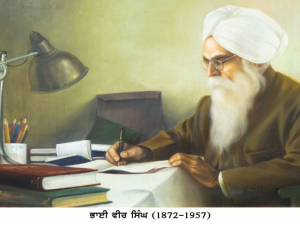
Written in the Gurmukhi script in East Punjab and in the Shahmukhi script in West Punjab, Punjabi possesses a rich literary tradition stretching over many centuries. It is the language of Baba Farid, Guru Nanak Dev , Guru Angad Dev , Waris Shah, Sultan Bahu, Bulleh Shah, Bhai Vir Singh, and Shah Muhammad. A language that has produced such spiritual and literary giants cannot, by any standard, be dismissed as the language of the uneducated or socially marginalized.
Mother Tongue and the Formation of Human Consciousness
Modern educational psychology and linguistic research have repeatedly demonstrated that a child learns most effectively in the mother tongue. The language acquired from the mother’s lap is not simply a medium of instruction; it is the primary instrument through which a child organizes thought, emotion, and identity.
When children are compelled to begin education in an unfamiliar language, cognitive development is often hindered. Alienation from the language of home creates psychological distance from the learning process itself. International organizations, including UNESCO, have consistently emphasized the importance of mother-tongue education in the early years of schooling.
Thus, the systematic neglect of Punjabi in Punjab’s schools is educationally unsound, psychologically harmful, and culturally destructive.
Punjabi and the Sikh Spiritual Tradition
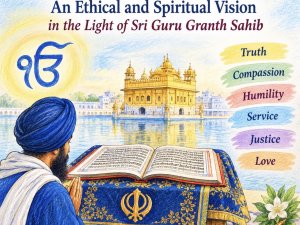
For the Sikh community, Punjabi occupies an even more sacred significance. The Guru Granth Sahib, though linguistically diverse, is preserved and transmitted through the Gurmukhi script. The script was standardized by Guru Angad Dev Ji to democratize literacy and provide the people with a distinct literary and spiritual identity.
The Sikh Gurus consciously chose the language of the common people rather than the exclusive languages of courtly elites. This decision was revolutionary. It established that divine wisdom should be accessible to all, irrespective of caste or status.
Any attempt to marginalize Punjabi, therefore, also weakens the community’s direct connection with Gurbani, Sikh history, and the intellectual heritage of the Panth. A Sikh cut off from Punjabi is increasingly cut off from the original language and script through which the Gurus communicated their message.
The Global Lesson: Progress Flourishes in Native Languages
The argument that English alone guarantees progress is contradicted by global experience. Germany, France, Russia, Japan, China, and South Korea have achieved remarkable scientific and technological advancement while educating children primarily in their native languages.
These nations demonstrate that mastery of one’s mother tongue strengthens, rather than impedes, the acquisition of additional languages. A solid foundation in Punjabi during the early years would enable children to learn English and other languages more effectively and with greater confidence.
The issue, therefore, is not opposition to English. English is a valuable global language and should certainly be learned. The real concern arises when English is promoted at the expense of Punjabi, leading children to regard their own mother tongue as inferior.
Linguistic Displacement as Cultural Disinheritance
History shows that the erosion of a people’s language is often the first stage in the erosion of their identity. Language carries oral traditions, folklore, historical narratives, ethical values, and collective memory. When a language is abandoned, a civilization begins to lose its continuity with the past.
Punjab has already endured repeated historical upheavals, including partition, migration, and political trauma. In such circumstances, the preservation of Punjabi is not merely a cultural preference; it is a civilizational necessity.
The gradual removal of Punjabi from schools, administrative institutions, and public life represents a subtle yet dangerous form of cultural disinheritance. It distances younger generations from their literature, their script, and their spiritual inheritance.
A Conspiracy Against Punjab’s Roots
The weakening of Punjabi in Punjab cannot be viewed as a neutral educational policy. It has far-reaching implications. By diminishing Punjabi, future generations may be detached from the writings of the Gurus, the Sufi saints, and the great literary figures who shaped Punjab’s moral imagination.
For Sikhs in particular, this process threatens the continuity of scriptural literacy and historical understanding. A community that loses command over its sacred language risks losing its intimate connection with its foundational texts and traditions.
The defence of Punjabi is therefore inseparable from the defence of Punjab’s distinct cultural and spiritual identity.
Where Are Punjab’s Political Parties?
This is a moment that demands principled leadership. Political parties in Punjab, regardless of ideology, must recognize that language is not a secondary issue but the cornerstone of collective identity. Any party that claims to represent the aspirations of Punjab must unequivocally support compulsory Punjabi education and the expanded use of Punjabi in governance and public institutions.
Silence on this issue amounts to acquiescence.
The Historic Responsibility of the Shiromani Gurdwara Parbandhak Committee
Shiromani Gurdwara Parbandhak Committee (SGPC), as one of the foremost custodians of Sikh religious and cultural heritage, bears a special responsibility in this regard. The institution entrusted with preserving the legacy of the Gurus must actively champion Punjabi and Gurmukhi.
The SGPC should:
- Launch a comprehensive campaign for Punjabi literacy.
- Support Punjabi-medium educational initiatives.
- Publish high-quality educational materials.
- Encourage youth to master Gurmukhi.
- Advocate before governments for stronger language protections.
To preserve Sikh heritage while neglecting Punjabi would be a contradiction in terms.
A Call to Collective Awakening
The present moment calls for vigilance and action. Parents, educators, writers, religious institutions, and policymakers must unite in defence of Punjabi. Every home should nurture the language; every school should teach it with dignity; every institution should use it with pride. Punjabi should be visible on house nameplates, shop signs, milestones, official forms, and public notices. More importantly, it should remain the natural language of affection, thought, scholarship, and spiritual reflection.
Conclusion
Punjabi is the flight of our soul. It carries the songs of our ancestors, the wisdom of the Gurus, the verses of saints, and the collective memory of a resilient people. To preserve Punjabi is to preserve the identity, dignity, and continuity of Punjab itself.
A civilization survives not only through economic progress or political institutions, but through the language in which its people dream, pray, and remember.
Let us therefore resolve, with scholarly conviction and moral courage, to defend Punjabi in our schools, our institutions, and our homes. The protection of Punjabi is the protection of Punjab. The preservation of Punjabi is the preservation of Sikh heritage. And the future of Punjab depends upon our willingness to safeguard the language that gives voice to our soul.