
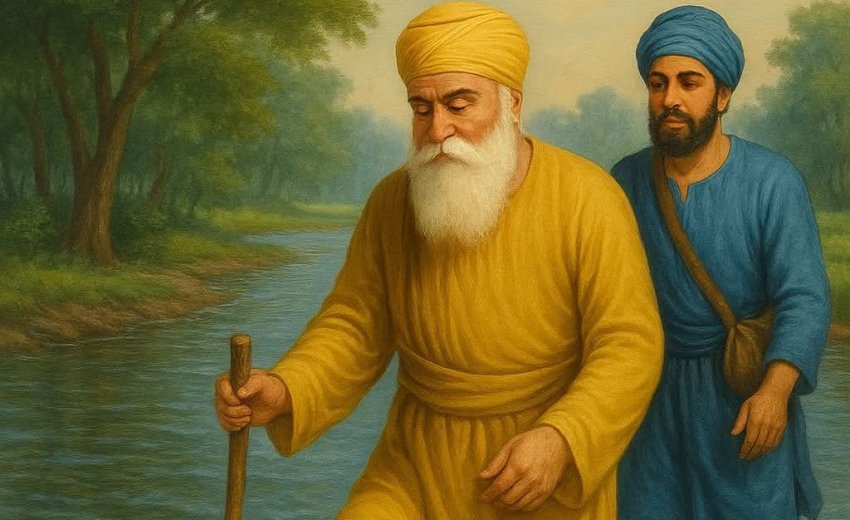

A major change in Bhai Mardana Ji's life came when he met Guru Nanak Dev Ji.
Bhai Mardana Ji remains one of the most respected figures in Sikh history. People remember him as the lifelong companion of Guru Nanak Dev Ji and as a musician who helped carry the Guru's message across different regions and communities. His life shows how music can bring people closer to spiritual teachings and create connections that rise above religious and social differences. Through his devotion, humility, and skill with the rabab, Bhai Mardana Ji contributed significantly to the growth of Sikh spiritual tradition.
Early life and musical roots
Bhai Mardana Ji was born in 1459 in Rai Bhoi di Talwandi, now known as Nankana Sahib in present-day Pakistan. He was born into a Muslim family to Bhai Badra Ji and Mata Lakkho Ji. Music played an important role in his family. His father was a skilled musician, and this musical heritage shaped Mardana's early years.
From childhood, he showed a natural talent for music. He developed exceptional skill in playing the rabab, a stringed instrument that later became closely associated with his name. His ability to create soulful melodies touched listeners and prepared him for the role he would later play alongside Guru Nanak Dev Ji.
Meeting Guru Nanak Dev Ji
A major change in Bhai Mardana Ji's life came when he met Guru Nanak Dev Ji. Their relationship grew through shared spiritual discussions, mutual respect, and a common search for truth. Guru Nanak recognized Mardana's sincerity and devotion, while Mardana found in the Guru a spiritual guide whose teachings spoke to people of all backgrounds.
Guru Nanak invited Bhai Mardana to join him on his journeys, and Mardana gladly accepted. This decision began a lifelong partnership that would leave a lasting impact on Sikh history.
Music as a way to share spiritual wisdom
Music stood at the center of the partnership between Guru Nanak and Bhai Mardana. Guru Nanak sang divine hymns, while Bhai Mardana accompanied him on the rabab. Together, they shared spiritual teachings in a way that people could easily understand and remember.
Guru Nanak understood the effect music could have on the human mind and spirit. A hymn set to melody could reach people more deeply than ordinary speech. Through kirtan, the singing of sacred hymns, his message reached both scholars and common people.
This partnership marked the beginning of the Sikh tradition of devotional music. Guru Nanak sang his spiritual compositions, and Bhai Mardana's rabab brought those words to life. Their performances created an atmosphere of devotion and encouraged people to think about the deeper questions of life.
The Udasis and the spread of sikh teachings
Bhai Mardana accompanied Guru Nanak on the Udasis, the long journeys undertaken to share spiritual teachings. Together they traveled across the Indian subcontinent and to parts of Central Asia and the Middle East. Their goal was to spread a message centered on the oneness of God, equality, compassion, and honest living.
Music remained an important part of these travels. People gathered to listen to Guru Nanak's hymns and teachings while Bhai Mardana played the rabab. Many heard these ideas for the first time through these musical gatherings. The combination of poetry, melody, and conversation helped people connect with the teachings regardless of their caste, religion, language, or social status.
Even when listeners did not fully understand the language of the hymns, they could still feel their spiritual depth. Music carried the message beyond words and connected directly with the hearts of the people.
Spreading Guru Ji’s teachings
Bhai Mardana's contribution extended beyond music. He served as a trusted companion and took part in many discussions with religious leaders, scholars, rulers, and ordinary people. Historical accounts and Janam Sakhis often present him as someone who asked questions, sought understanding, and helped make spiritual ideas more accessible.
His role highlights an important aspect of Guru Nanak's teachings. The Guru encouraged discussion and reflection rather than blind acceptance. Through conversations with Mardana and others, he explored questions about faith, morality, and the nature of God.
Mardana's presence also showed the inclusive nature of Guru Nanak's mission. Although he came from a Muslim family, he remained one of the Guru's closest companions throughout his life. Their friendship demonstrated that spiritual wisdom belongs to all humanity and cannot be limited by religious identity.
Standing beside the guru in difficult times
Bhai Mardana remained with Guru Nanak during periods of political unrest and social uncertainty. During Babur's invasions, many people lived in fear. Despite these circumstances, Guru Nanak continued to speak against injustice and highlight the suffering of ordinary people.
Mardana supported this mission through his music and companionship. Together, they used poetry and song to address social issues and encourage people to uphold truth and compassion. Their work showed that spirituality and social awareness can go hand in hand.
This approach later became an important feature of Sikh thought. Mardana's contribution helped carry these values to people across different regions and communities.
The lasting place of music in Sikh tradition
The partnership between Guru Nanak and Bhai Mardana established music as an essential part of Sikh worship. Today, kirtan remains central to Sikh religious practice, with hymns from the Guru Granth Sahib sung in prescribed raags.
The roots of this tradition go back to the musical partnership between Guru Nanak's voice and Bhai Mardana's rabab. Together, they showed that music can support meditation, strengthen devotion, and bring people closer to God. They used music not as entertainment but as a means of spiritual growth.
For this reason, Bhai Mardana continues to hold a special place in the history of Sikh sacred music.
A legacy that continues to inspire
Bhai Mardana Ji spent his life serving Guru Nanak and supporting the spread of spiritual teachings. He remained a devoted companion through years of travel, dialogue, and service. Historical accounts place his passing in 1534 at Kartarpur, bringing to an end a remarkable life dedicated to faith and devotion.
Through his partnership with Guru Nanak Dev Ji, music became a powerful way to share divine wisdom, encourage dialogue, and bring people together. His skill with the rabab strengthened the impact of Guru Nanak's hymns and helped establish kirtan as a central practice in Sikh worship. His story also speaks of friendship, humility, service, and inclusivity. More than five centuries later, his legacy continues to inspire people to seek truth, remember the Divine, and recognize the shared humanity that connects all people.
Reference links:
Dooja Rubabi Mardana - Sikhnet
https://www.sikhnet.com/news/dooja-rubabi-mardana%C2%A0
It shows how Bhai Mardana used music, companionship, and devotion to support Guru Nanak’s mission and connect people across social and religious boundaries.
Bhai Mardana Ji: Guru Nanak’s Loyal Companion - Sikhnet
https://dvnetwork.org/page/bhai-mardana-ji-guru-nanaks-loyal-companion
The article explores how Bhai Mardana’s loyalty, humility, and musical gifts contributed to the growth of Guru Nanak’s teachings.
Tracing Golden Age’s Sikh Musical Traditions - Sikhnet
https://www.sikhnet.com/news/tracing-golden-ages-sikh-musical-traditions
It explains how generations of musicians and practitioners helped sustain and enrich the Sikh tradition through sacred music and performance.
Singing Praises to God - Sikhnet
https://www.sikhnet.com/news/singing-praises-god
The article is about the music and sacred verse used to cultivate devotion and bring people closer to the divine.