
The martyrdom of Guru Arjun had profoundly shocked the entire Sikh community. It proved to be a turning point in their history.
Young Hargobind, Guru Arjun’s son, had enthusiastically learnt the skills of wielding weapons and riding horses.
After ascending as the sixth Sikh Guru, he started girding on two swords – one indicating Miri (temporal power), and the other Piri (spiritual power). He instructed his Sikhs to bring offerings of arms and horses instead of money.
Guru Hargobind encouraged his Sikhs to build strong bodies by engaging in martial exercises. He also asked them to come forward to join his unique army in large numbers.
As instructed by him, a fort known as Lohgarh (the fort of steel) was built in Amritsar. Across the Harimandir, Akal Takhat (the immortal throne) was also established.
The Guru ensured that the number of soldiers, weapons, and horses in his army kept on increasing phenomenally. According to Muhsin Fani (as mentioned in Dabistan), “The Guru had eight hundred horses in his stables, three hundred troopers on horseback, and sixty men with firearms were always in his service.”
The Guru’s rapid militarization and symbols of independence alarmed Emperor Jahangir. Several Hindu feudal lords also conspired against the Guru.
It is said that the Mughal ruler ordered the arrest of Guru Hargobind on the flimsy ground that he had not paid the fine which had been imposed om Guru Arjun. Hence, the Guru was arrested sometime in 1613. He was lodged in the Imperial Jail in Gwalior Fort. He was in the prison probably for about one year. (Various writers/historians have mentioned different durations for the Guru’s imprisonment ranging from 40 days to 12 years).
Bandi Chhor Guru
Guru Hargobind’s prolonged incarceration in the prison at Gwalior Fort immensely perturbed the Sikhs and they were getting restless. The entire Punjab was in turmoil and a revolt could take place any time.
Some eminent peace-loving noble Muslims like Mian Mir (the Sufi saint who had laid the foundation stone of Harimandir in Amritsar because of the request from Guru Arjun), Malika Noor Jahan, and Wazir Khan had also urged Emperor Jahangir to release Guru Hargobind without any further delay.
Emperor Jahangir finally agreed to release the Guru, but the Guru refused to leave the prison unless all of the Rajas, who had been imprisoned unjustly, were also released. These Rajas had great respect for the Guru because of his friendly nature and spiritual leadership.
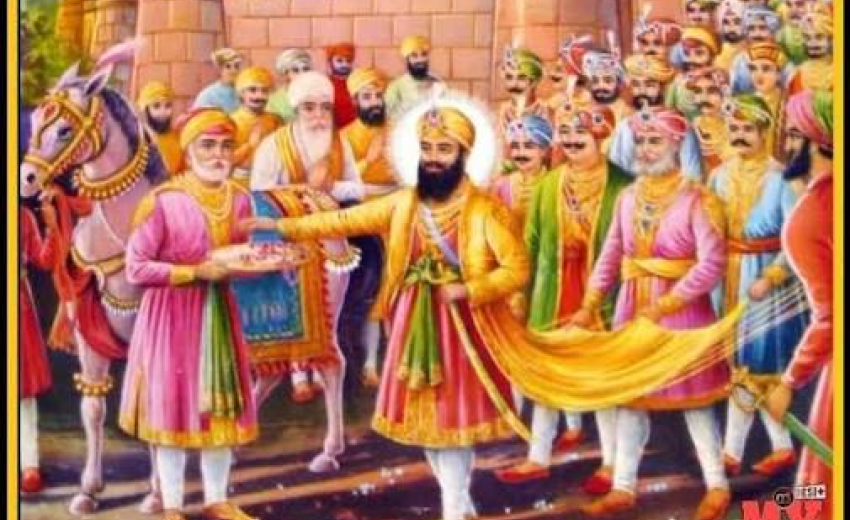
While Jahangir agreed to release 51 short-term Rajas immediately, he insisted that only those long-term Rajas would be released who could hold on to the Guru’s dress while the Guru was leaving the prison. Very shrewdly, the Guru got a special robe made which had 52 apron strings attached to it. Hence, the 52 Rajas also came out of the prison while holding on to the apron strings. According to Bhattavahis, this happened on 26 October 1619. From that time onward, Guru Hargobind came to be known as Bandi Chhor (Liberator of Prisoners).
Names of Interned Rajas & Their Kingdoms
When Guru Hargobind was imprisoned at Gwalior Fort prison, there were also 51 short-term and 52 long-term Rajas in the prison. Just like the Sikh Guru, these Rajas had also been incarcerated on the orders of Emperor Jahangir. Who were these rulers, and what were the names of their kingdoms?
It appears that a complete and authentic historical list mentioning the names of 51 short-term and 52 long-term rulers, their kingdoms, and the corresponding modern Indian states simply does not presently exist in the mainstream historical archives and traditional Sikh texts.
Dr. Jasbir Singh Sarna did some outstanding research to find out the names of 52 long-term Rajas, and their kingdoms. This list was duly published in October 2025 issue of The Sikh Review, and also in his monumental book titled The Sikh Spectrum. It has been the eminent scholar’s humble effort to fill in “the dots left by time and fragmentary records, so that scholars may have a point of reference in their studies.”
These 52 Rajas/chieftains/princes were probably from the present-day Rajasthan, Himachal Pradesh, Uttarakhand, and regional territories in Punjab and neighbouring areas. Some historical records mention the names of Raja Kalyan Chand of Kahlur (Bilaspur), and Raja Himmat Chand of Hindur (Nalagarh); both of these are located in the present state of Himachal Pradesh. The names of these two Rajas, however, are not included in Dr. Sarna’s list of 52 Rajas. It is obvious that more research on a prolonged basis is required to finally have an authentic list of the 51 short-term and 52 long-term Rajas/chieftains/princes along with the names of the concerned kingdoms, and the corresponding modern-day provinces.
Bandi Chhor Divas
When Guru Hargobind returned to Amritsar on 28 December 1620, the people there lit the city with thousands of lamps to celebrate his joyful return. This historic day came to be known as Bandi Chhor Divas (Day of Liberation for Prisoners or Release of Prisoners Day). This unique Sikh celebratory day, which coincides with the Hindu festival of Diwali, is now viewed as a testament to Guru Hargobind’s true commitment for liberty and solidarity.
Every year, Bandi Chhor Divas is celebrated in Amritsar on a grand scale. Akhand Paths as well as special prayers and Kirtans are organized as integral parts of the celebration. Oil lamps and floating candles can be seen on a massive scale along the periphery of Amritsar’s holy pool. Special lightings outline Harimandir’s domes and other areas. Captivating fireworks light up the night sky over the Golden Temple complex.
In Madhya Pradesh, Bandi Chhor Divas is celebrated joyfully in Gwalior at the historic Gwalior Fort and Gurdwara Data Bandi Chhor Sahib (located at the place of the Guru’s incarceration in Gwalior Fort) by hosting special prayers and illuminations.
Formal Adoption into the Sikh Calendar
In 2003, Shiromani Gurdwara Parbandhak Committee (SGPC) formally included Bandi Chhor Divas in the Sikh calendar (Nanakshahi calendar). It was adopted under the SGPC’s then-President Prof. Kirpal Singh Badungar.
Since then, this historic day is celebrated by the Sikhs at important gurdwaras all over India and also in foreign countries where the Sikhs live in sizable numbers. Now, Bandi Chhor Divas serves as “a powerful reminder of human rights, collective freedom, compassion, and advocating for the oppressed.”
Celebrations in Foreign Countries
At present times, Bandi Chhor Divas is enthusiastically celebrated in numerous countries. A brief description of the same may be provided as follows:
In Canada, which is home to almost 8 lakhs Sikhs (more than 2 percent of the country’s total population), Bandi Chhor Divas is celebrated in major cities and provinces throughout the country. However, the main celebrations are in the provinces of Ontario, British Columbia, and Alberta. As more than half of all Sikhs in Canada live in the four cities of Brampton, Surrey, Calgary, and Edmonton, the most significant celebrations are held in these cities. Additionally, the Sikhs celebrate this unique festival in Toronto, Ottawa, Abbotsford, and Vancouver also.
In the USA, important gurdwaras in states like California, New York, and New Jersey illuminate their buildings and organize special events to celebrate the Sikh festival. As regards the important cities, joyful celebrations take place in various American cities like Los Angeles, San Francisco, Fremont, Sacramento, Stockton (home to the oldest gurdwara in the country), New York City, Jersey City, Woodbridge, Seattle, Houston, Dallas, Irving, Austin , and Chicago. Celebrations are also held in states/region like Arizona (such as Phoenix), Washington D.C. (spanning Maryland and Virginia), Georgia (Atlanta), and Tennessee (Nashville).
In the UK, which is home to one of the largest Sikh communities outside India, major gurdwaras located in various cities like London, Birmingham, Wolverhampton, and Leicester celebrate Bandi Chhor Divas in a befitting way.
With a population of over 2 lakhs, the Sikh diaspora in Australia celebrates the special day by lighting lamps and organizing special events at gurdwaras in major cities like Melbourne and Sydney.
In Malaysia, which is home to the largest Sikh population in Southeast Asia, extensive celebrations are held in Kuala Lumpur. The festival is also joyfully celebrated in cities and satellite towns like Petaling Jaya, Klang, Rawang, Subang, and Ampang. In the state of Perak, Bandi Chhor Divas is celebrated in a major way in Ipoh, Taiping, Kampar, and Malim Nawar.
The festival is celebrated across the unified city-state of Singapore. The main events are held at the historic Central Sikh Temple on Towner Road, and Silat Road Sikh Temple (Jalan Bukit Merah). The Singapore Khalsa Association plays an important role in organizing the events.
Concluding Remarks
Many Sikhs have some basic knowledge about Bandi Chhor Guru Hargobind, and the celebrations associated with Bandi Chhor Divas. But most non-Sikhs in India know almost nothing about Guru Hargobind and the role played by him to get the freedom for 51 short-term and 52 long-term Hindu rulers from Gwalior Fort prison.
This position definitely needs to be changed now. The Sikh intellectuals and Dharam Parcharaks need to tell the people of concerned places that their former Hindu rulers, who had been incarcerated in Gwalior Fort prison on the orders of Emperor Jahangir, were once freed from captivity due to the efforts of Guru Hargobind. If the general public of those places come to know that a former ruler of their region was freed from prison due to the efforts of a Sikh Guru, their attitude towards Sikhs and Sikhism will definitely improve significantly.
Premier Sikh institutions like Shiromani Gurdwara Parbandhak Committee (SGPC) and Delhi Sikh Gurdwara Management Committee (DSGMC) should publish suitable Punjabi, Hindi and English booklets on Bandi Chhor Guru Hargobind and the role played by him to get freedom for 51 short-term and 52 long-term Hindu rulers. These booklets should be freely distributed in Rajasthan, Himachal Pradesh, Uttarakhand, and regional territories in Punjab and neighbouring areas from where concerned Hindu Rajas/chieftains/princes hailed.