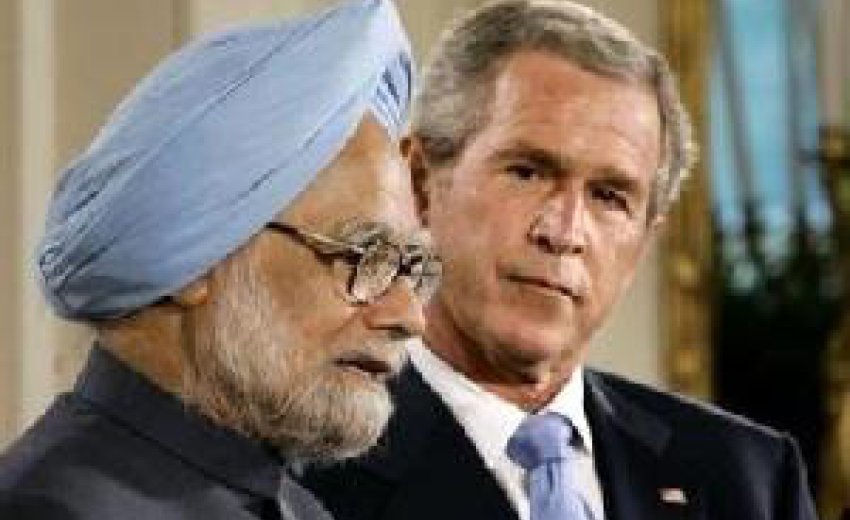
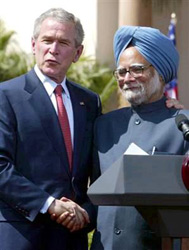
 The successful confidence vote for Prime Minister Manmohan Singh's government in India, which had been shaken by his standing behind the nuclear deal with the United States, prompted me to reflect on the undercurrents and implications of this exceptional agreement. The 2005 announcement of the agreement on sharing nuclear knowhow was certainly a coup for India, and it is a pity that it took so long for the Indian government to cut loose its obstructionist communist allies.
Why did the U.S. make a nuclear exception for India? According to the Washington Post in 2005, "much of the plan was conceived by Robert Blackwill, former ambassador to India and a deputy national security adviser under Condoleezza Rice, along with his close confidant, Ashley J. Tellis, a specialist on U.S.-India relations" at the Carnegie Endowment for International Peace. Tellis had earlier laid out a vision for India-U.S. relations in a paper titled "India as a New Global Power," promoting strategic cooperation between the two countries rooted in U.S. defense sales to India, and support for India's growing military nuclear capability. This is an easy connection to see, between the explicit agreement on "civilian nuclear technology" and the strategic, military goals of both nations. It is also clear that competition for natural resources, the oldest (and traditionally the only) driver of geopolitics, remains a salient factor in these interactions. India's push for a natural gas pipeline from Iran, which failed to get a positive response from the U.S., also falls in this category. India's current attractiveness to the U.S. comes from its potential role as a partner against terrorism and as a fellow democracy – pragmatism and principle, as the Prime Minister put it, in his 2005 address to the Joint Session of the U.S. Congress. On the Indian side, abandonment of the "holier-than-thou" attitude that characterized India's earlier approach to diplomacy is welcome. Instead, India seems to be falling more in line with the Chinese realpolitik stance, to achieve some degree of nuclear parity with China.
 While acknowledging the importance of security, and of access to natural resources, it is imperative to take a broader view of what constitutes "success" for a country like India. International prestige and military clout should not be goals that divert attention from raising the economic wellbeing of the population. It is better to be a Japan, than a Soviet Union. While the nuclear deal's avowed purpose is to serve India's future energy needs, one should take that objective with a grain of salt. There are other things that India's policymakers can do that would provide greater immediate and lasting benefits, including more rational energy pricing and organizational reform of public sector energy suppliers.
In fact, economic growth should be the main goal where India benchmarks itself against China. It is also where India falls short. Comparing how the two countries tackle some of the means to achieve this end of high growth is illuminating. Begin with higher education. As far back as 2004, China announced some opening of the education sector to foreign participation. Six months later, a wide variety of joint ventures in higher education were under way. There are now over 700 foreign-affiliated colleges in China. Along with this injection of foreign organizational expertise have come successful attempts to hire internationally renowned faculty and host high quality foreign visitors. There has also been a shake-up of the incentive system in China's universities, with a new emphasis on rewarding productivity and talent rather than seniority, and paying internationally competitive salaries.
In contrast, India produced a committee report in late 2005 on the entry of foreign universities, which was full of qualifications and restrictions that can only discourage investment: no "poaching" faculty from Indian institutions; no repatriation of profits; no franchising or offshore campuses. The committee stipulated probationary periods and large security deposits, and suggested that only foreign universities from countries that offer Indian universities reciprocal opportunities abroad should be allowed entry. These conditions are designed to protect inefficiency in Indian higher education and restrict supply, rather than promote positive change and growth in a sector that is even more important than energy. The report's recommendations are bad economics, and a resurgence of the license-permit raj mentality. And all this, in a country where quality higher education is in such short supply that there are coaching classes to prepare students for entrance exams to qualify for other coaching classes, which then prepare students for the IIT entrance exams.
 Next, consider research and development (R&D). A report in the Wall Street Journal in March 2006 described a surge in foreign-invested R&D centers in China, its top place in the list of countries slated for R&D expansion by multinationals (with the US and India following), R&D spending well ahead of India's (1.3% of GDP compared to 0.77% for India – translating to six times as much spending), and clear targets to boost spending and to train and attract talent. In contrast, India's "top official" was quoted as saying, "the scale of investment is not much" because of budgetary constraints. India is "trying to build R&D," but the government does not have the financial resources or expertise, nor does it seem willing to allow those to come freely from abroad. According to the US National Science Foundation, China (with Israel) tops emerging economies in technological competitiveness, with India a long way behind.
Finally, consider venture capital. Also in March 2006, the Wall Street Journal ran a headline "Venture Capital Swarms China." The story reported that a flood of venture capital is competing to fund tech companies, with funds raised by VC investors reaching $4 billion in 2005. This compares with well under a billion dollars of foreign investment for true venture deals (excluding late-stage private equity deals) in India in the same year. Of course VC investment in India has increased. The problem in growing it even more is India's policy environment, with the persistence of needless government controls and interference.
The bottom line is that India has much to learn from China in areas of international economic policy as well as foreign policy. Even if the government cannot become more efficient in its basic functions, it can at least create an enabling environment for foreign capital and expertise to enter more freely in areas where they can make a long run difference to India's growth: higher education and R&D. This will ultimately be more important than matching China in nuclear prestige, and more fitting with India's new global confidence.
- By Nirvikar Singh, Professor of Economics and Co-Director of the Center for Global, International and Regional Studies at the University of California, Santa Cruz.